Understanding_ the_Cleaning_Process_for_Automatic_Stencil_Printers - 第17页
Wiper P aper • “ Printer s are only as good as the material that you put into it” – the same can be a pplied t o t he wiper • Using low - cost paper directly inf luences the wiper ability t o clean the s ten cil • In gen…
Event driven wiping
• Key events that can trigger defects:
• Pause in printing
• First 1-4 prints
• Additional paste added
• Custom Wipes to target specific events in the printer
• Pause in printing
• Based on thixotropic index of paste
• Recommend a medium plus wipe
• Kneed function
• Squeeze out is the issue
• Heavy on the dry wipe / no solvent
• During paste dispense
• Utilize printer window to do additional wipe
16
Understanding the Cleaning Process for Automatic Stencil Printers
Wiper Paper
• “Printers are only as good as the material that you put into it” – the same can be applied to the wiper
• Using low-cost paper directly influences the wiper ability to clean the stencil
• In general, there are two types of papers used in stencil wiping: papers made with synthetic fibers held
together with glues (called binders), and papers made from a mix of natural and synthetic fibers that do not
use glue.
• The papers ability to absorb both the solder and solvents reflects on the cleanliness of the stencil
Understanding the Cleaning Process for Automatic Stencil Printers
Glue Binders
• Synthetic fibers found in paper usually are polyester or rayon.
• In general, about 30% of the paper’s weight is found in binders.
• These papers have a harder surface, lower tensile strength, absorb less contamination and are less expensive than glue-less versions.
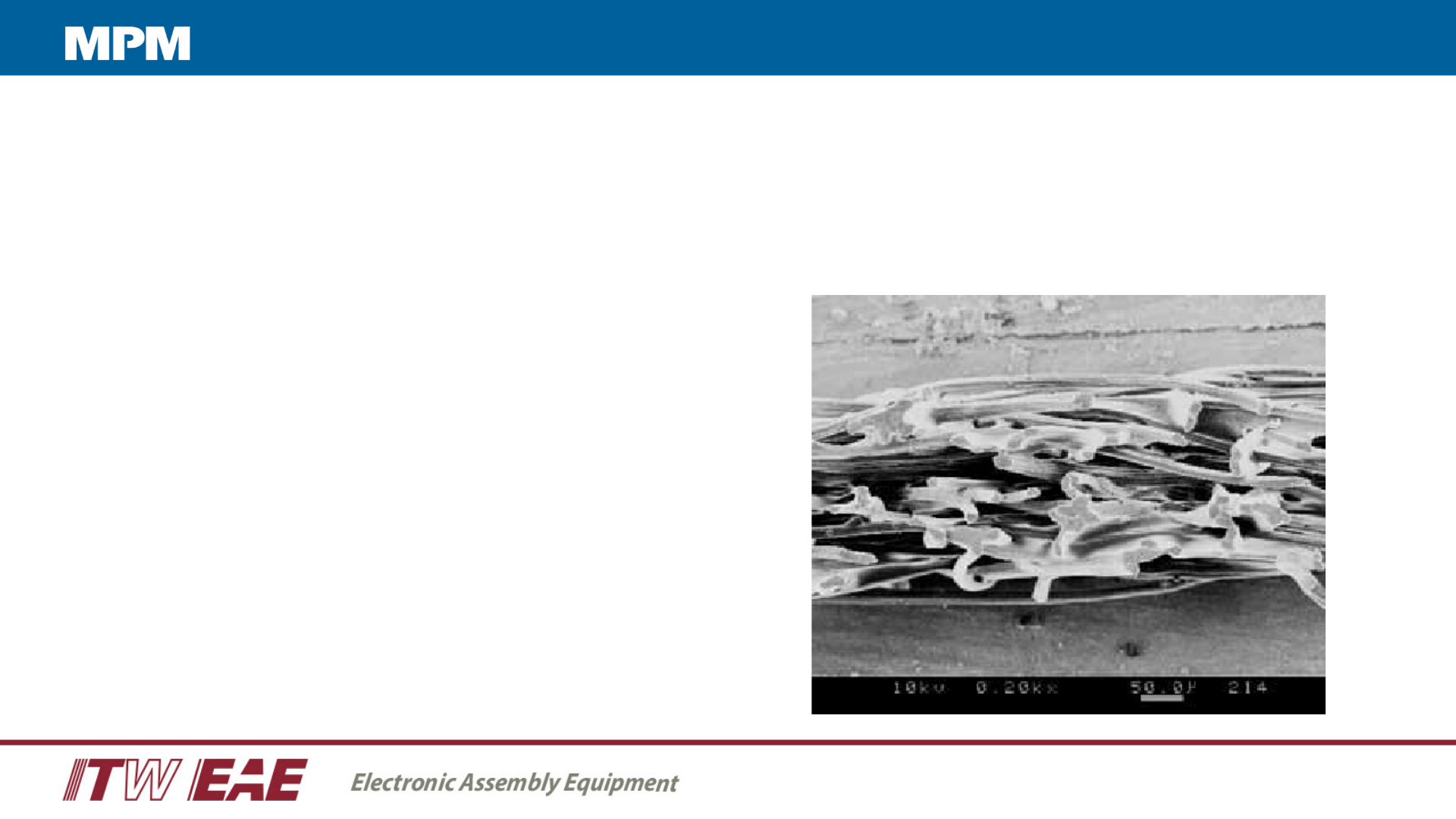
• Cross-section microphotograph of polyester paper made
with binders, enlarged 200 times.
• The fibers are coated with glue, making surfaces hard and unable to
absorb contamination.
• Most empty space in the wipe has been filled with binders, reducing the
ability to pick up solder paste.
Understanding the Cleaning Process for Automatic Stencil Printers