Understanding_ the_Cleaning_Process_for_Automatic_Stencil_Printers - 第23页
Isopropyl Alcohol Alcoho l T ypes • Ethanol – Fermented / yeas t – consumab le • “ the r oot cau se and soluti on to all of life' s p r obl ems ” – Homer Simps on • Methanol – Fe rment ed / wood – toxic • Ethanol + …
Solvents
• Usage on solvents split down the middle with yes or no
• A NO to solvent is often based on a negative experience that can be traced to:
• Negative effect on the print process following solvent application
• Poor solvent performance
• Application method used
• Mismatch of solvent to printing material
• Misunderstanding of what solvents do
• Most common solvent used is Isopropyl Alcohol – which now has its issues
• Chemistry companies, prior to 7 years ago, did not understand the printing process and its requirements
• Often what was being recommended to be applied to the printer is also used to clean boards or stencils in a
tank
• Requirements of the print process and new chemistries have improved performance in the printer and have a
targeted this application
22
Understanding the Cleaning Process for Automatic Stencil Printers
Isopropyl Alcohol
Alcohol Types
• Ethanol – Fermented / yeast – consumable
• “
the root cause and solution to all of life's problems
” – Homer Simpson
• Methanol – Fermented / wood – toxic
• Ethanol + Methanol = denatured alcohol
• Propanol – Fermented / bacterium (Clostridium Acetobutylicum) - feeds on cellulose – common name – Rubbing Alcohol
• Isopropyl - mixture of Propanol and ethyl methyl ether - secondary alcohol that uses a binder
Issues with Isopropyl
• Flash Point = 53 F (open cup) 55 F l (closed cup)
• Defined as a Class 1B flammable liquid ( same as Gasoline)
• Definition of a flammable liquid – flash point below 100 F
• National Fire association
• US Environmental Protection Agency (EPA)
• US Occupational Safety and Health Administration (OSHA)
• Previously Isopropyl was a match as it was the solvent of choice used in paste
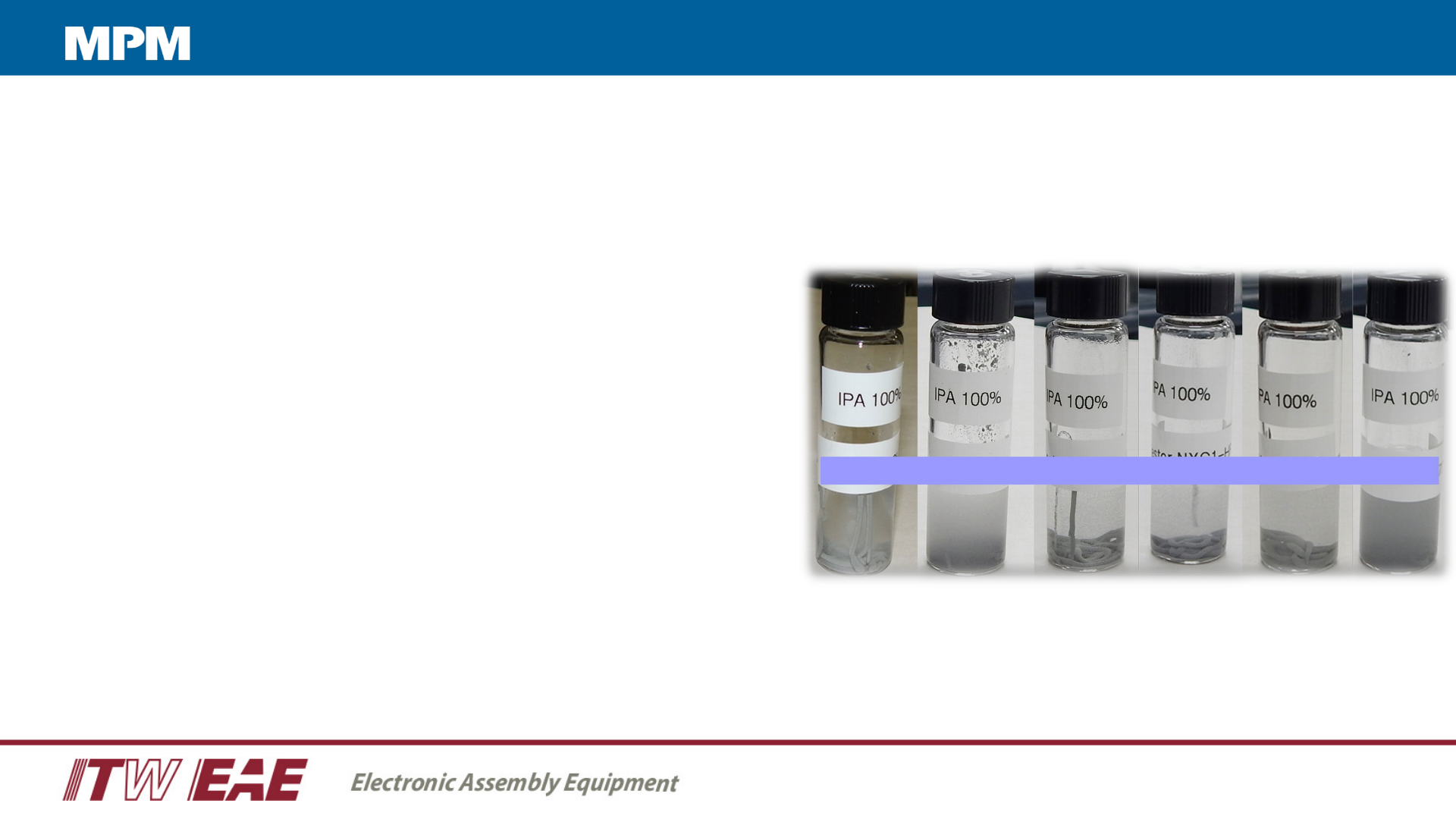
• Newer paste designs use a solvent to increase stencil life – can react badly to Isopropyl
• Results in “clumping” of paste when combined with flux
• Less than 90% purity will leave residue on stencil that will result in poor transfer efficiency
Understanding the Cleaning Process for Automatic Stencil Printers
Solvent Checklist
• Chemical compatibility with the solder paste
• Dissolve the flux & free up the powder spheres
• No bad reaction with paste that affects paste viscosity
• Process compatibility
• Dry evenly and at a controlled rate
• No adverse paste reactions
• Leave no residue
• Equipment compatibility
• Does not attack valves, seals, pumps, reservoirs
• Safety & health
• Non-toxic, non-flammable, low- (or no-) odor
24
Understanding the Cleaning Process for Automatic Stencil Printers