ThermoFlex-Manual.pdf - 第125页
ThermoFlex D-1 Thermo Scientific Appendix D NC Serial Communications Protocol Note Appendix D assumes you ha ve a basic understanding of communications protocols . Never apply line v olta ge to any of the connections. …
Thermo Scientific
C-8 ThermoFlex
Appendix C
Thermo Scientific
xx.x
xx.x
xx.x
xx.x
Rdt H
rtd H
rtd L
rdt L
xx.x C
mode
rtd1
Flo
CAL
enter
enter
enter
enter
enter
enter
mode
r rtd
A in
Aout1
StorE
PrES1
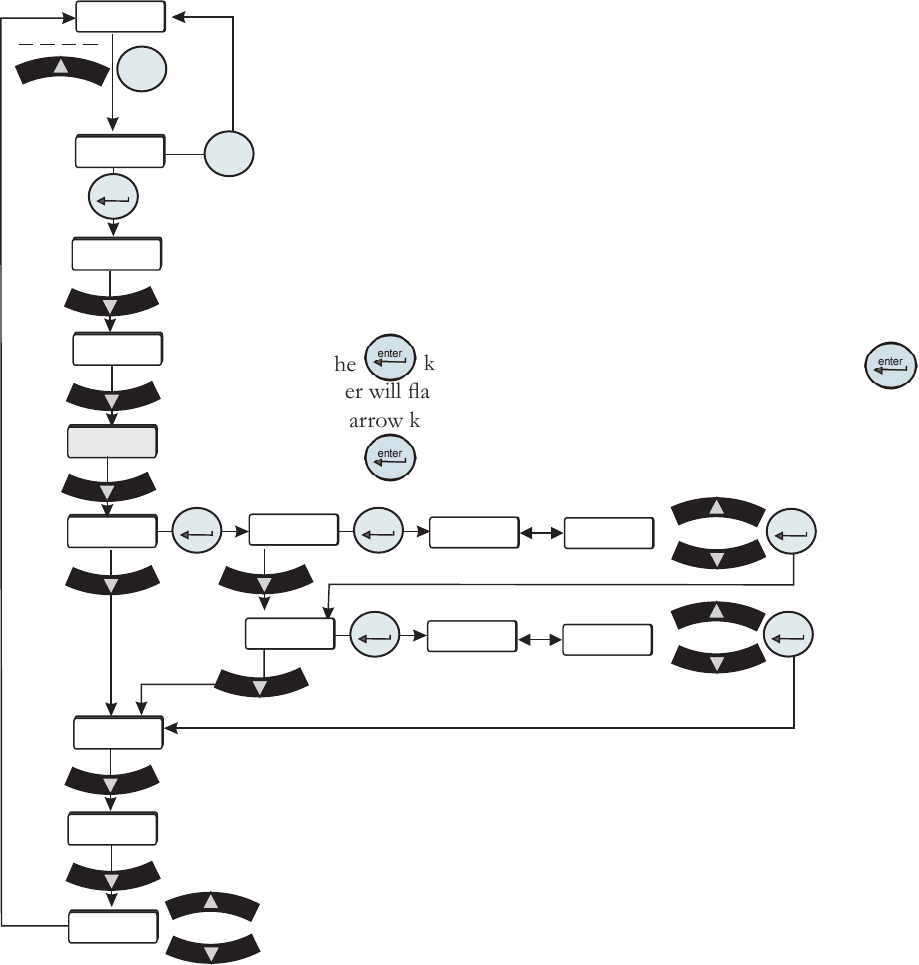
Remote Sensor Calibration
Figure C-6 Remote Sensor
Calibration Loop
This procedure requires a running chiller and a calibrated reference thermometer.
Note If it is more convenient, perform the low-end calibration before doing the
high-end.
Do not pick calibration points that are outside the safe operating limits of the uid
in your application. For example with water, 40°C and 5°C are typical high and low
calibration points.
Place the remote sensor and a calibrated reference thermometer in the high
temperature remote reservoir. Ensure the uid temperature is stabilized.
Press the
key and the controller will display rtd H. Press again and the
controller will ash between rtd H and the temperature.
Use the arrow keys to adjust the temperature to match the reference thermometer.
Press the
key again to accept the value.
Save calibration
Do not save calibration
Place the remote sensor and calibrated reference thermometer
in a low temperature reservoir. At the rtd L (low-end
calibration) display repeat the procedure.
After the low-end calibration is accepted StorE is displayed.
Press the up arrow to accept the calibration, press the down
arrow key to not accept it.
Note After pressing the up arrow button at the StorE
prompt wait several seconds before proceeding to ensure that
a bad calibration message (Er 16) does not appear. Premature
use of the keypad after pressing the up arrow may cancel the
bad calibration error message.
ThermoFlex D-1
Thermo Scientific
Appendix D NC Serial Communications Protocol
Note Appendix D assumes you have a basic understanding of communications protocols.
Never apply line voltage to any of the connections.
Connect your PC to the applicable connector on the rear of the chiller. Use the Setup Loop,
see Section 4, to enable serial communications.
Note Keypad operation is still available with serial communications enabled.
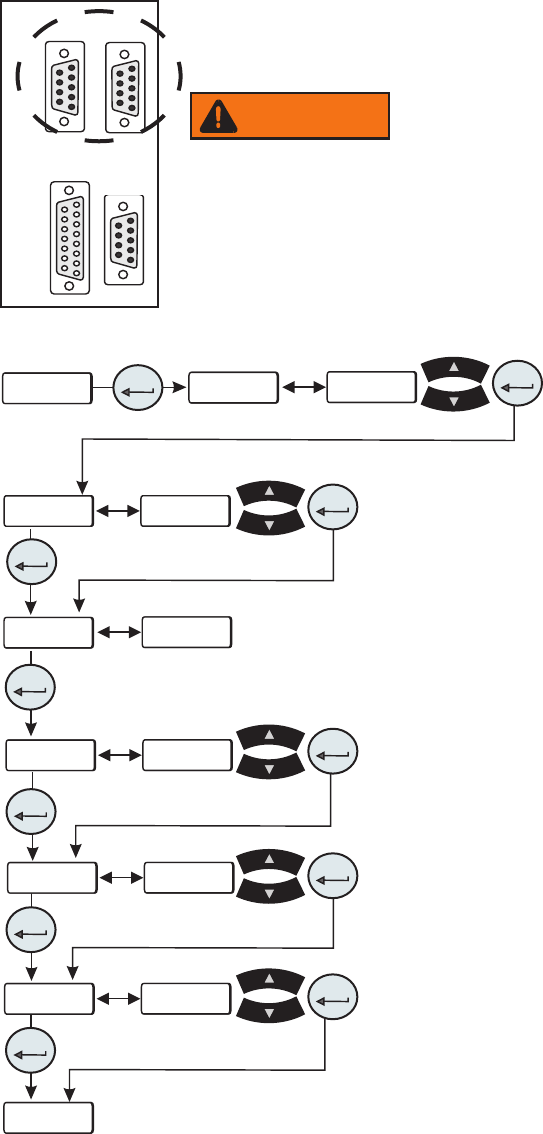
• SEr is used to enable/disable and to congure
serial communications.
Range:
oFF, rS232, rS485 Default: oFF
This display depends on your chiller
configuration, see Section 4.
Figure D-1 Connectors
Figure D-2 Serial Communications Loop
BAud
StoP
dAtA
PAr
uid
----
SEr
SEr
enter
enter
enter
enter
enter
enter
xx
xx
xx
xx
xx
xx
xxxx
8
xxxx
x
xx
xx
enter
enter
enter
enter
enter
1 2 3 4 5
6 7 8 9
1 2 3 4 5
6 7 8 9
1 2 3 4 5
6 7 8 9
8 7 6 5 4 3 2 1
15 14 13 12 11 10 9
RS232 RS485
A I/O REMOTE
SENSOR
• BAud is used to select the baud rate (speed) for serial
communications.
Range: 9600, 4800, 2400, 1200, 600, or 300 bits per second
Default: 9600
• dAtA is used to display the number of data bits.
Range: Fixed at 8
• StoP is used to indicate the number of stop bits.
Range:
2 or 1 Default: 1
• PAr is used as a means to check for communication errors.
Range:
even, odd, or none Default: none
• u id (chiller id) is used in RS485 only. Identies devices
connected to the RS 485 port.
Range:
1 to 99 Default: 1
Note: To prevent data errors limit the number of chillers to 32.
WARNING

Thermo Scientific
D-2 ThermoFlex
Appendix D
Thermo Scientific
Thermo Scientific
RS-232 COMM RS-485 COMM
Pin # Function Pin # Function
1 No connection 1-7 No connection
2 TX 8 T+
3 RX 9 T-
4 No connection
5 GND = Signal ground
6 - 9 No connection
TX = Transmitted data from controller
RX = Received data to controller.
Hardware Mating Connector
AMP Part# 745492-2 or equivalent
All data is sent and received in binary form, do not use ASCII. In the following pages the
binary data is represented in hexadecimal (hex) format.
The NC Serial Communications Protocol is based on a master-slave model. The master
is a host computer, while the slave is the chiller's controller. Only the master can initiate a
communications transaction (half-duplex). The slave ends the transaction by responding
to the master’s query. The protocol uses RS-232/RS-485 serial interface with the default
parameters: 9600 baud, 8 data bits, 1 stop bit, and no parity. RS-485 offers a slave address
selection, default parameter: 1.
The chiller can be controlled through your computer’s serial port by using the chiller's
standard female 9-pin connection.
Communication cables are available from Thermo Fisher. Contact us for additional
information.
5 4 3 2 1
9 8 7 6
All commands must be entered in the exact format shown in the tables on the following
pages. The tables show all commands available, their format and responses. Controller
responses are either the requested data or an error message. The controller response must
be received before the host sends the next command.
The host sends a command embedded in a single communications packet, then waits for
the controller’s response. If the command is not understood or the checksums do not
agree, the controller responds with an error command. Otherwise, the controller responds
with the requested data. If the controller fails to respond within 1 second, the host should
resend the command.