ThermoFlex-Manual.pdf - 第53页
Section 3 ThermoFlex 3-15 Thermo Scientific Facility W ater Quality and Standards (water -cooled chillers) Facility Water Permissible (PPM) Desirable (PPM) Microbiologicals (algae, bacteria, fungi) 0 0 Inorganic Chemicals…

Section 3
3-14 ThermoFlex
Thermo Scientific
Process Fluid Permissible (PPM) Desirable (PPM)
Microbiologicals
(algae, bacteria, fungi) 0 0
Inorganic Chemicals
Calcium <25 <0.6
Chloride <25 <10
Copper <1.3 <1.0
0.020 ppm if fluid in contact with aluminum
Iron <0.3 <0.1
Lead <0.015 0
Magnesium <12 <0.1
Manganese <0.05 <0.03
Nitrates\Nitrites <10 as N 0
Potassium <20 <0.3
Silicate <25 <1.0
Sodium <20 <0.3
Sulfate <25 <1
Hardness <17 <0.05
Total Dissolved Solids <50 <10
Other Parameters
pH 6.5-8.5 7-8
Resistivity 0.01* 0.05-0.1*
* MΩ-cm (compensated to 25°C)
Unfavorably high total ionized solids (TIS) can accelerate the rate of galvanic
corrosion. These contaminants can function as electrolytes which increase
the potential for galvanic cell corrosion and lead to localized corrosion such
as pitting. Eventually, the pitting will become so extensive that refrigerant will
leak into the water reservoir.
As an example, raw water in the United States averages 171 ppm (of NaCl).
The recommended level for use in a water system is between 0.5 to 5.0 ppm
(of NaCl).
Recommendation: Initially ll the tank with distilled or deionized water
within a range of 1-3 M
Ω-cm. (It is acceptable to have the uid drop to the
Process Water
Quality and
Standards
When using the ThermoFlex chiller to circulate through aluminum, a
compatible corrosion inhibitor should be utilized to prevent galvanic
corrosion.
Fluid viscosity should be 50 cSt or less at the lowest temperature used.
Visible pump weepage may occur when compatible glycols, oils or other
additives are used. Pump weepage is considered as a normal operating
condition of mechanical seal pumps.
Additional Fluid
Information

Section 3
ThermoFlex 3-15
Thermo Scientific
Facility Water
Quality and
Standards
(water-cooled
chillers)
Facility Water Permissible (PPM) Desirable (PPM)
Microbiologicals
(algae, bacteria, fungi) 0 0
Inorganic Chemicals
Calcium <40 <0.6
Chloride <250 <25
Copper <1.3 <1.0
0.020 ppm if fluid in contact with aluminum
Iron <0.3 <0.1
Lead <0.015 0
Magnesium <12 <0.1
Manganese <0.05 <0.03
Nitrates\Nitrites <10 as N 0
Potassium <20 <0.3
Silicate <25 <1.0
Sodium <20 <0.3
Sulfate <250 <50
Hardness <17 <0.05
Total Dissolved Solids <50 <10
Note A corrosion inhibitor is recommended if mixed metals are in the
facility water loop.
other levels over-time.) Do not use untreated tap water as the total ionized
solids level may be too high. This will reduce the electrolytic potential of
the water and prevent or reduce the galvanic corrosion observed.
Section 3
3-16 ThermoFlex
Thermo Scientific
Facility Water Maximum Inlet Pressure must not exceed 150 PSIG.
Facility Water Maximum Pressure Differential must not exceed
50 PSID.
(Pressure Differential = Inlet Pressure - Outlet Pressure)
Note Before using facility water that is above 35°C contact Thermo Fisher
Scientic.
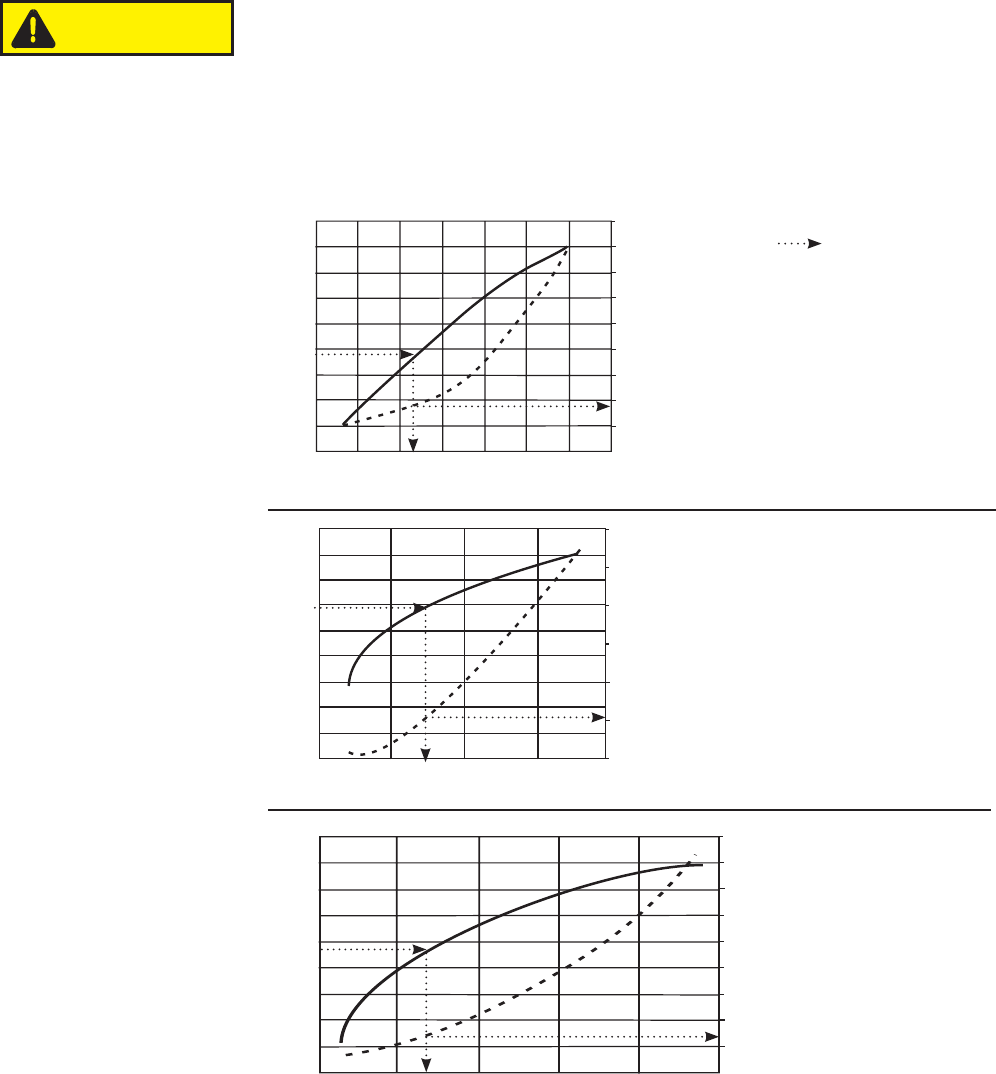
The facility water must meet the following conditions for the chiller to
maintain its full rated capacity.
Facility Water
Requirements
(water-cooled
chillers)
Facility Pressure Drop PSID
0 0.5 1.0 1.5 2.0 2.5 3.0 3.5
Facility Flow - GPM
Facility Temperature °C
45
40
35
30
25
20
15
10
5
4.5
4.0
3.5
3.0
2.5
2.0
1.5
1.0
0.5
°C
PSID
ThermoFlex1400
Example:
Follow the lines.
Start with a known, e.g., facility water
temperature.
A - go across to temperature curve
B - drop down to determine the minimum
required facility ow.
C - Where B crosses the PSID curve, go
across to determine the minimum required
PSID.
A
B
C
Facility Temperature °C
45
40
35
30
25
20
15
10
5
2 4 6 8 10
Facility Flow - GPM
Facility Pressure Drop PSID
45
40
35
30
25
20
15
10
5
°C
PSID
ThermoFlex3500/5000
A
B
C
Example: See above.
Facility Pressure Drop PSID
2 4 6 8
Facility Flow - GPM
Facility Temperature °C
45
40
35
30
25
20
15
10
5
30
25
20
15
10
5
°C
PSID
ThermoFlex2500
A
B
C
Example: See above.
CAUTION