PSV7000_ Owners Manual_096-0460-001B - 第154页
Maintenance ■ Troubleshoot ing 4—48 Data I/O • 096-0640-001B back Progr amming Problems Lamp Color Programmer T rouble Possible R esolutions One programmer has many continuity failures (in Statistics window). Move …
■ Troubleshooting ◘ Collect all PSV7000 System Logs
PSV7000 Owner’s Manual 4—47
back
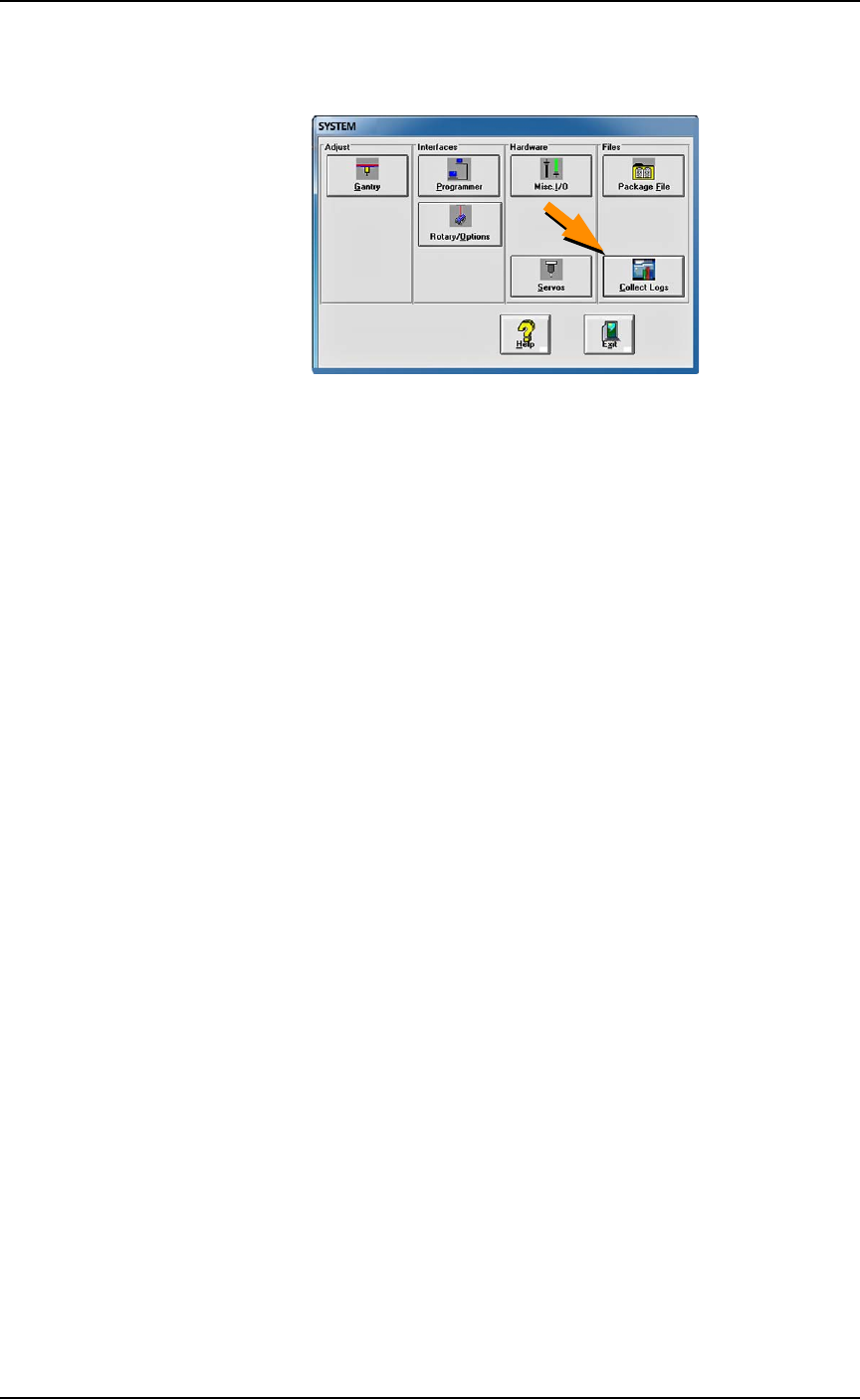
• SECOND AUTO METHOD: The AH700 Software also displays
a button in the System window.
When starting Collect PS Logs in AUTO Mode), only a progress
screen is shown on the lower left corner of the screen. All defaults are
used and no user action is required. A log zip file named with the
current date and time is saved in the Documents folder (
C:\Docu-
ments
, or C:\Libraries\Documents.)
Start App Method in Windows OS
The Start App (non-auto) method is the Windows method using the
Windows Start menu; it offers some options. Click Window Start >
All Programs > Data IO > Collect PS Logs.
After starting Collect PS Logs from the Start menu, the main window
appears where you can select which items you need to collected.
1. Select or clear check boxes for files as desired.
2. (Optional) Check additional SPC files if the error rarely appears
or appeared a long time ago.
3. (Optional) In Collect PSV7000 Logs, to enter a text description to
the Zip file:
3a. Click Add description.
3b. Type a description into the field available. In addition to
what you type, the description will include the Date and
Time the log was captured and the serial number informa-
tion from the winAH400.ini file.
4. Click Collect and ZIP.
A ZIP file is created and copied to the Windows Clipboard. A mes-
sage advises pasting it into a folder you choose.
5. Click OK to the message about pasting the ZIP file to a desired
folder.
For more information see the AH700 on-screen Help.

Maintenance ■ Troubleshooting
4—48 Data I/O • 096-0640-001B
back
Programming Problems
Lamp
Color
Programmer Trouble Possible Resolutions
One programmer has
many continuity failures (in
Statistics window).
Move the Socket Adapter to another program-
mer to see if the problem is the programmer or
the adapter, as follows:
1. If a job is running click Pause and wait until all
programmer activity is done.
2. Check that there are no devices in the target
adapter. If there are, click Finish.
3. Replace the target Socket Adapter with
another empty adapter.
If the failure moves with the Socket Adapter,
check for bent, damaged or worn pins on the
sockets.
If continuity failures persists in the same pro-
grammer, see Pick and Place Problems on page
4-49.
Note: If a programmer is not performing and
you cannot correct the error, you can continue
to use other programmer sites after disabling
the non-functional programmer. See Disabling
Programmers in the PSV7000 Operators
Manual or the AH700 on-screen Help.
Many Programmers
have continuity failures.
The Device Position Sensor may need clean-
ing. Refer to Cleaning the Device Position Sensor
on page 4-12.
Red
All programmers fail to
program devices.
Check that the Programmer Simulation switch
on the Setup window is OFF. If not, switch it to
OFF.
Check that the Programmers circuit switch on
the Power Panel is On.
Check the Log file for helpful information as
follows:
1. Pause the job.
2. Exit the Run window.
3. At the Setup window click System > Log File.

■ Troubleshooting ◘ Pick and Place Problems
PSV7000 Owner’s Manual 4—49
back
Pick and Place Problems
Lamp
Color
Pick and Place Trouble Possible Resolutions
Red/
Yellow
Devices are not being
placed into sockets or output
media accurately.
The PNP head does not
center on the devices.
Check that the probe is not bent.
Check all fasteners and connections on the
head and gantry. Also see Inspecting Gantry
Parts on page 4-22.
Clean the Device-position Sensor. See Cleaning
the Device Position Sensor on page 4-12.
Adjust the X-, Y-, and Z-axis positions using
the adjustment arrows on the Gantry window.
For more information, see Teaching the Work-
space Locations on page 3-9.
Yellow/
Red
One of the probes expe-
riences pick and/or place
errors regularly while the
other does not.
Contact Data I/O Customer Support or a local
Data I/O approved service representative.
The Probe is dropping
devices.
Clean or replace the Probe Tips. See Pick and
Place Probes on page 4-14.
Clean the vacuum filters. See Vacuum Generator
Filters on page 4-19.
Check the main input air pressure; refer to
Connecting Air on page 2-3.
A probe attempts to
pick a device twice even
though it picked up the
device the first time.
The Vacuum sensor may need calibrating. See
To Adjust Probe Vacuum Generator Sensors: on
page 4-17.
If programming TQFP 144, you can increase
the value for ‘suckup time’ in the Package File
to maximum value of 500 ms. See the Setup
window > System > Package File. Refer to the
on-screen Help.
Devices are bouncing.
The socket air pressure may be too high.
Reduce the socket actuation air pressure. See
Adjusting the Socket Actuator Air Pressure on the
Programmers on page 4-9
Red/
Yellow
Pick or place errors at
all programmers.
The socket is not opening completely—the air pres-
sure might be set too low.
Adjusting the Vacuum Generator Sensors on page
4-17.
Increase the socket actuation air pressure. See
Adjusting the Socket Actuator Air Pressure on the
Programmers on page 4-9