PSV7000_ Owners Manual_096-0460-001B - 第21页
■ System Description ◘ Machine Axes PSV7000 Owner’s Manual 1—7 back Machine Axes The PSV7000 System gantry operates on three primary axes: X , Y, Z . An additional axis, called the R-axis ( theta ), is used by the PNP he…
Introduction ■ System Description
1—6 Data I/O • 096-0460-001B
back
Electrostatic Discharge (ESD) Precautions
Devices (integrated circuits) are very sensitive to static, and could be
damaged by unintended electrostatic discharge while being handled.
The most effective way to prevent damage from ESD is to make sure
a common electric potential (ground) exists between a static-sensitive
device or component, its environment, and the operator.
Operators should wear an antistatic wrist strap (Data I/O part
number 440-0021-001+) connected to one of the grounding connec-
tions on the machine. The wrist strap should contain a 1–10 M-ohm
current limiting resistor.
Handling Devices Safely
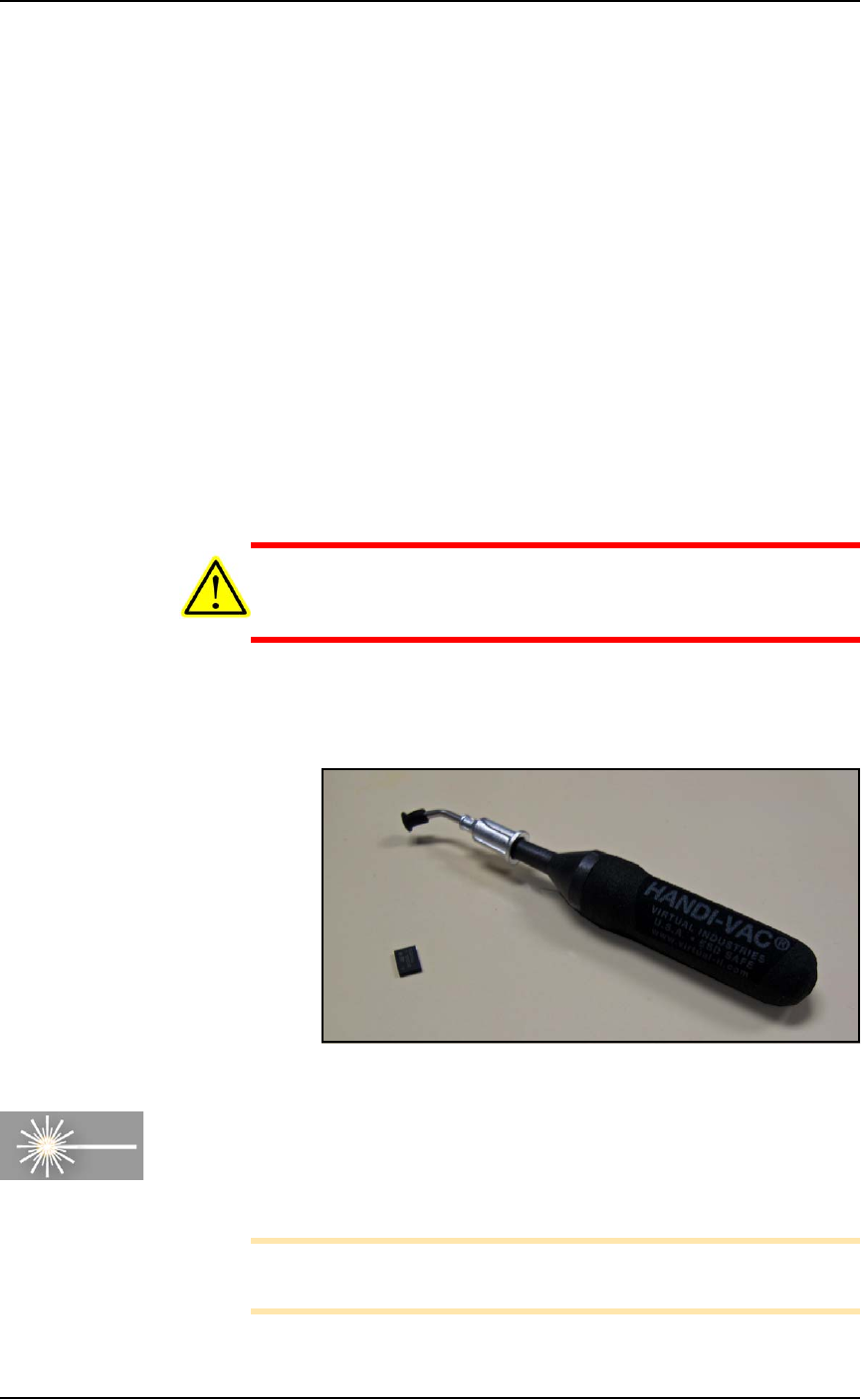
To prevent damage to device pins, use a vacuum tool, also called a
vacuum tweezer, to pick up devices. The vacuum tool is designed to
handle devices without damaging them.
CAUTION: Possible device pin damage! Do not touch devices
with your hands or any implement other than the vacuum tool.
Doing so could damage devices with fine-pitched leads.
To pick up a device using the vacuum tools use an squeezable air
bladder for suction. There are a variety of models, sizes and tips.
Some tips are replaceable.
Figure 1-1: A Vacuum Tweezer: Data I/O PN 565-8000-001.
[Laser Marking only] Fume Extractor
Used with the Laser Marking option, the laser fume extractor
removes harmful smoke and hazardous materials from the marking
area and safely stores them for proper disposal.
Note: Refer to Laser Safety on page 1-20 for more information.
For maintenance, see Laser Marking Fume Extractor on page 4-35.
■ System Description ◘ Machine Axes
PSV7000 Owner’s Manual 1—7
back
Machine Axes
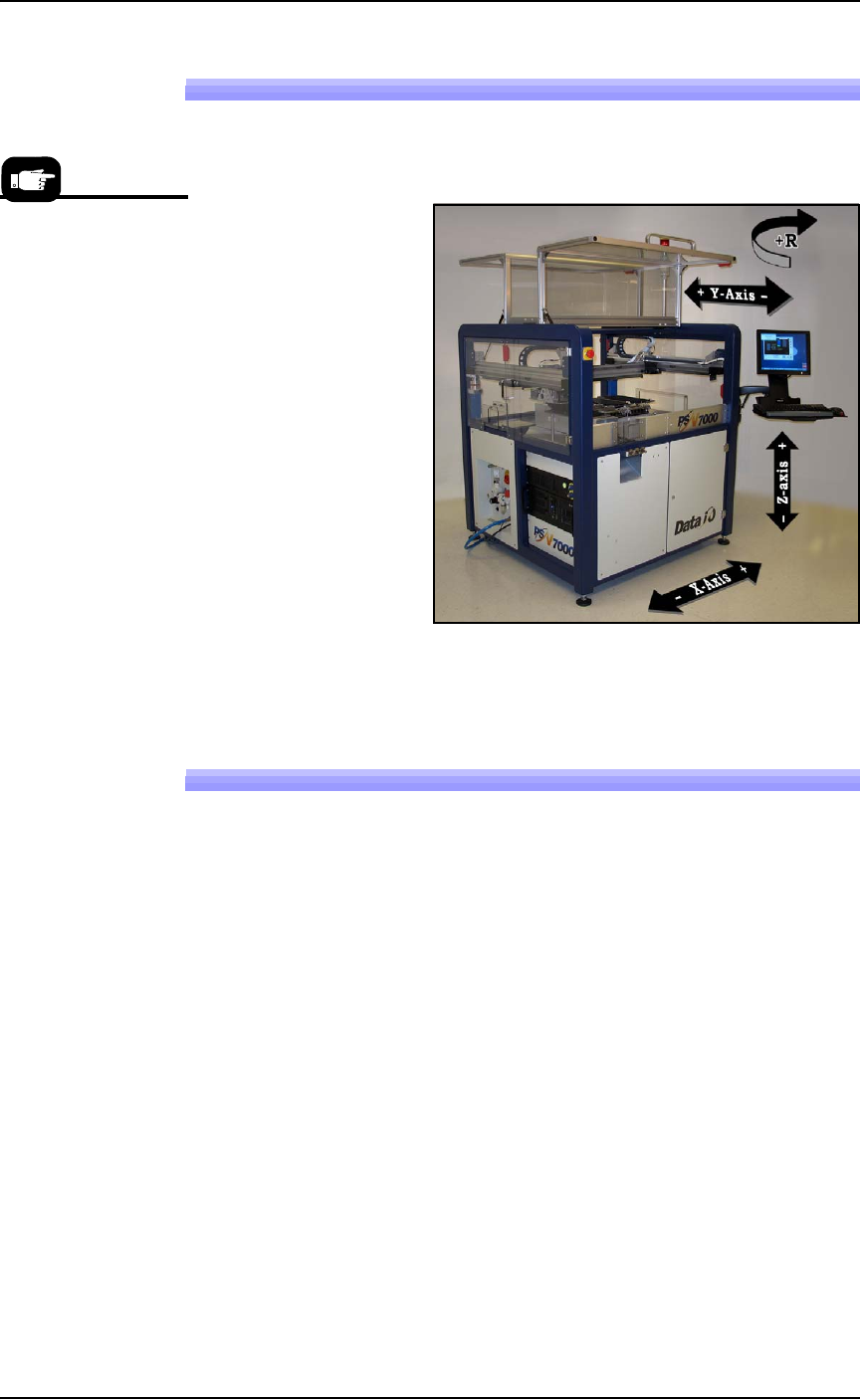
The PSV7000 System gantry operates on three primary axes: X, Y, Z.
An additional axis, called the R-axis (theta), is used by the PNP head
to change device orientation (rotation).
Figure 1-2: These axes describe motion direction on the PSV7000. The
X-Y coordinate 0,0 is at the left front corner.
Basic Machine Functions
The PSV7000 System performs these basic operations when pro-
cessing devices:
1. Pick devices from the input media—
The pick and place head (PNP head) unloads devices from the input
tube, tray, or tape module. These devices are placed into program-
ming sockets in all cases except when Ignore Programmers is selected,
in which case the head takes devices directly to a different media
(repackaging only) or to the shuttle for marking only.
2. Process devices—
Devices in the programming sockets undergo any or all of the fol-
lowing processes as determined by the job. These processes are set in
TaskLink.
• Continuity check
•ID check
•Erase
•Blank check
•Program
• Verify programming
•Read
There’s a glossary (just
before the index) of
terms related to pro-
gramming with the
PSV7000 System.
Introduction ■ System Description
1—8 Data I/O • 096-0460-001B
back
• Illegal-bit check
• Functional verification operations
• Secure device
• Verify options such as voltage
(Optional) Inspect device leads—
The optional 3D Coplanar Inspection System detects bent leads on
devices prior to further processing.
(Optional) Mark devices—
When available, devices that pass the programming and verification
operations are marked at the Laser Module or moved to a Label
Marker where they are marked for identification.
3. Load devices into the output media—
Devices are moved by the PNP head to output media: trays, tubes, or
tape. Devices that fail one of the programming processes are placed
into the reject bin or reject tray.
Input and Output Options
PSV7000 System input and output options are: static tray (manual),
tray feeder (automatic), tube, and tape.
Most combinations of input and output options may be used. For
example, the PSV7000 System can be configured with input as static
tray and output as taped. However, the use of a tray feeder precludes
the use of static trays and vice versa.
Manuals for Optional Equipment
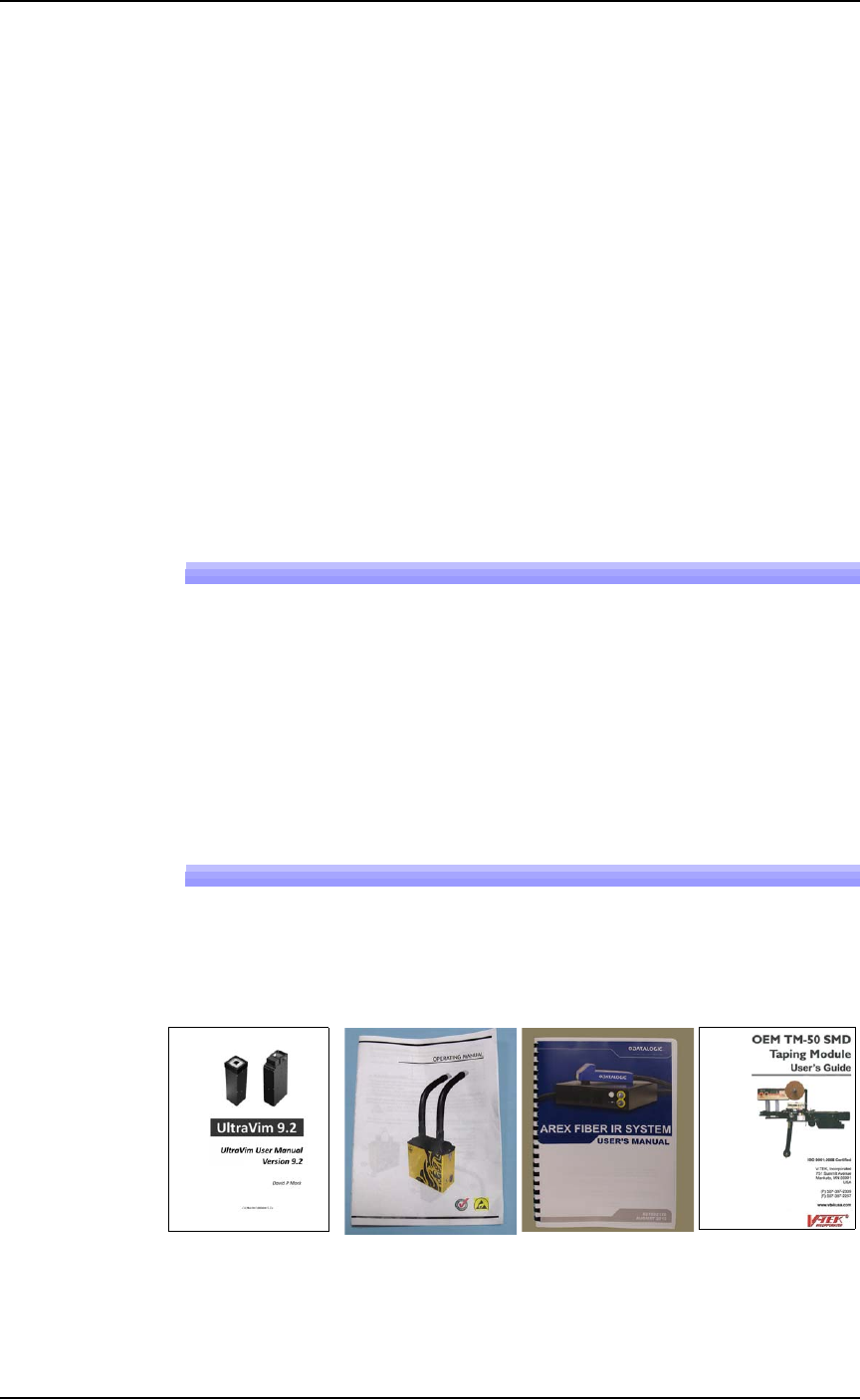
The manuals that came with any optional equipment on your system
contain additional, more in-depth information. Some of the manuals
came in hard copy format with your PSV7000 System. Others are
PDFs installed on the Handler computer.
Figure 1-3: A few of the Optional equipment manuals, from left to
right: 3D Inspection System, Tiger Fume Extractor, Laser Marker, Tape
Output Module.