00193411-02.pdf - 第158页
7 Station extensions User Manual SIPLACE HS-60 7.3 Dual conve yor Software version SR. 503.xx 07/2003 US Edition 158 7.3 Dual convey or 7.3.1 Struc ture of the dual conveyor The co nveyor be lts are d riven by DC m otors…

User Manual SIPLACE HS-60 7 Station extensions
Software version SR.503.xx 07/2003 US Edition 7.2 Component barcode reader
157
Track allocation 7
Four-digit barcode strips are attached to the lateral safety screens for the purposes of track allo-
cation. The first digit is used to identify the component table (1, 2, 3, or 4), while the remaining
three digits specify the track number. There are also return barcodes at both ends of the barcode
strip. The barcode strips are numbered consecutively in intervals of two (1, 3, 5, 7...) and each
represents 2 tracks (barcode 1 = track 1 and 2).
Components 7
Data can be read from the component reels to compare the stock of components against the quan-
tity specified in the set-up file (refill check), for example.
An audible signal is given when each dataset has been read successfully.
PLEASE NOTE 7
The component barcode reader option must be configured on the line computer or the SIPLACE
Pro.
Barcodes that start with the number 1, 2, 3, or 4 and are five digits long are interpreted as track
barcodes. All other barcodes that do not start with number 1, 2, 3, or 4 are regarded as compo-
nent barcodes.
7.2.2 Technical data
7
Connection Station computer
Data entry Barcode reader or keyboard
Number of characters Max. 40 / single conveyor
Max. 2 x 20 / dual conveyor
Not permissible Barcodes starting with a 1, 2, 3, or 4 and less than
5 characters long
Number of barcodes Up to 6 per component
Filter for suppressing data Up to 1 per barcode
Preset barcode types Code 39 (standard or ASCII)
Code 2 of 5, interleaved and normal,
Code 128, UPC/EAN/JAN codes
(others available upon request)
Max. resolution 0.13 mm
Scanning speed 36 scans/sec.
Laser class IEC class 1 - VDE0837
Degree of protection IP 64
7 Station extensions User Manual SIPLACE HS-60
7.3 Dual conveyor Software version SR.503.xx 07/2003 US Edition
158
7.3 Dual conveyor
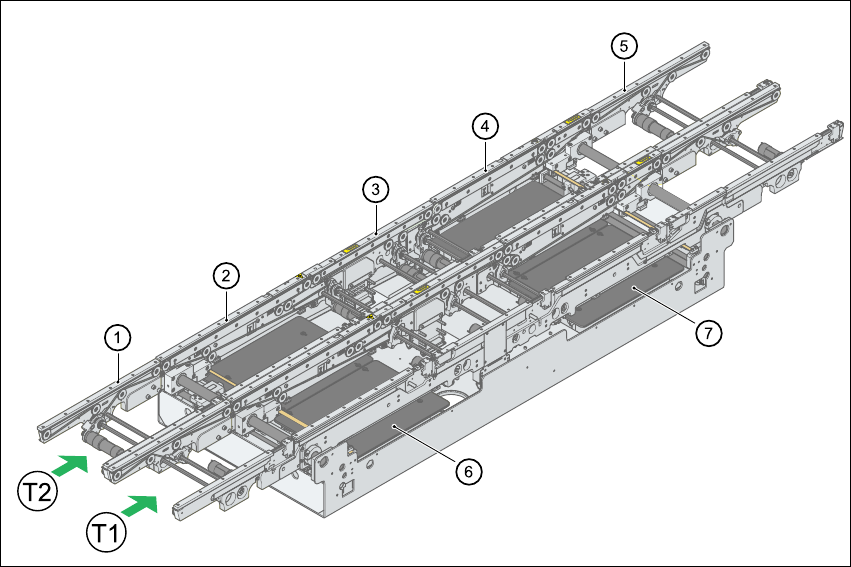
7.3.1 Structure of the dual conveyor
The conveyor belts are driven by DC motors. There is a lifting table for clamping the PCBs in each
processing area. The width of the PCB conveyor can be adjusted either via the menu or using the
line computer.
7
Fig. 7.3 - 1 Structure of the dual conveyor
7
(1) Input area
(2) Processing area 1
(3) Intermediate area
(4) Processing area 2
(5) Output area
(6) Lifting table, processing area 1
(7) Lifting table, processing area 2
T1 Conveyor track 1
T2 Conveyor track 2

User Manual SIPLACE HS-60 7 Station extensions
Software version SR.503.xx 07/2003 US Edition 7.3 Dual conveyor
159
7.3.2 General
As the name suggests, the dual conveyor has two transport tracks, which are electrically and me-
chanically independent of one another. In the standard version, the right-hand side is the fixed
side. There is another version, however, in which the left-hand side is the fixed side.
7.3.3 Defining the conveyor tracks
The right transport track (viewed in the transport direction) is designated "Transport 1" and the left
as "Transport 2" (see Fig. 7.3 - 1
).
7.3.4 Changing transport mode
7
7.3.5 Asynchronous transport mode
7.3.5.1 Description
In asynchronous mode, only one PCB in a transport track is processed. At the same time, another
PCB in the second transport track is moved into the placement position. This saves the full con-
veying time of one PCB, thus considerably increasing performance, particularly for PCBs with a
short cycle time.
7.3.5.2 Function
Once the machine has received the job data (panel, set-up), the PCBs on the feeding belts are
continuously transported to the available processing belt (provided that the processing belt is free)
throughout the placement operation. The placement sequence starts as soon as a PCB has
moved onto the processing belt. The PCBs are processed one after another.
If the placement sequence is interrupted, the conveyor interface will be disabled and the PCBs
currently on the processing belts will be completed.
The conveyor interface is disabled or enabled simultaneously for both transport tracks.
Conveyor mode Entry in the SITEST program
Single conveyor 0
Dual conveyor, synchronous 1
Dual conveyor, asynchronous 2