M20_Ope_E.pdf - 第103页
Chapter 2 Creating and Editing a Program 2-59 2-7-3-2 Manual Feeder Support Function Menu: Program > Pickup Data Action: ① In the pickup data window, select the [Feed er Support Function] from the tool bar. ② The conf…
Chapter 2 Creating and Editing a Program
2-58
③
z Instead of creating a new image data, you can copy a pocket type component data from the
master library. (Library > Copy Library > Image)
Select [Pocket 0402], [Pocket 0603], or [Pocket 1005] for the feeder support function.
z The way of creating the image data is same as creating an image data of fiducial mark.
z Enter a mark image code.
z The image process method is the pattern matching. Templates of the pocket models are
prepared. (An appropriate template model is selected automatically for each paper tape.)
z Enter pocket dimensions of the paper tape in the [Mark X] and the [Mark Y].
z Adjust brightness of the pocket displayed in the monitor so that the pocket image becomes
dark and the paper becomes white with the Gain/Offset. Also adjust the Teach camera light.
z You can operate this function whether a component exists in the pocket or not.
z At the end of procedures, be sure to execute image test and the result becomes OK.
④ Save the image data. Close the window.
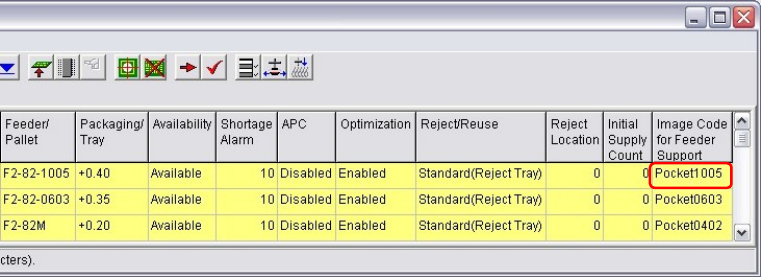
⑤ Enter the created image data code in the [Image Code for Feeder Support] cell.
If the cell is empty, the feeder support function does not work.
Chapter 2 Creating and Editing a Program
2-59
2-7-3-2 Manual Feeder Support Function
Menu: Program > Pickup Data
Action:
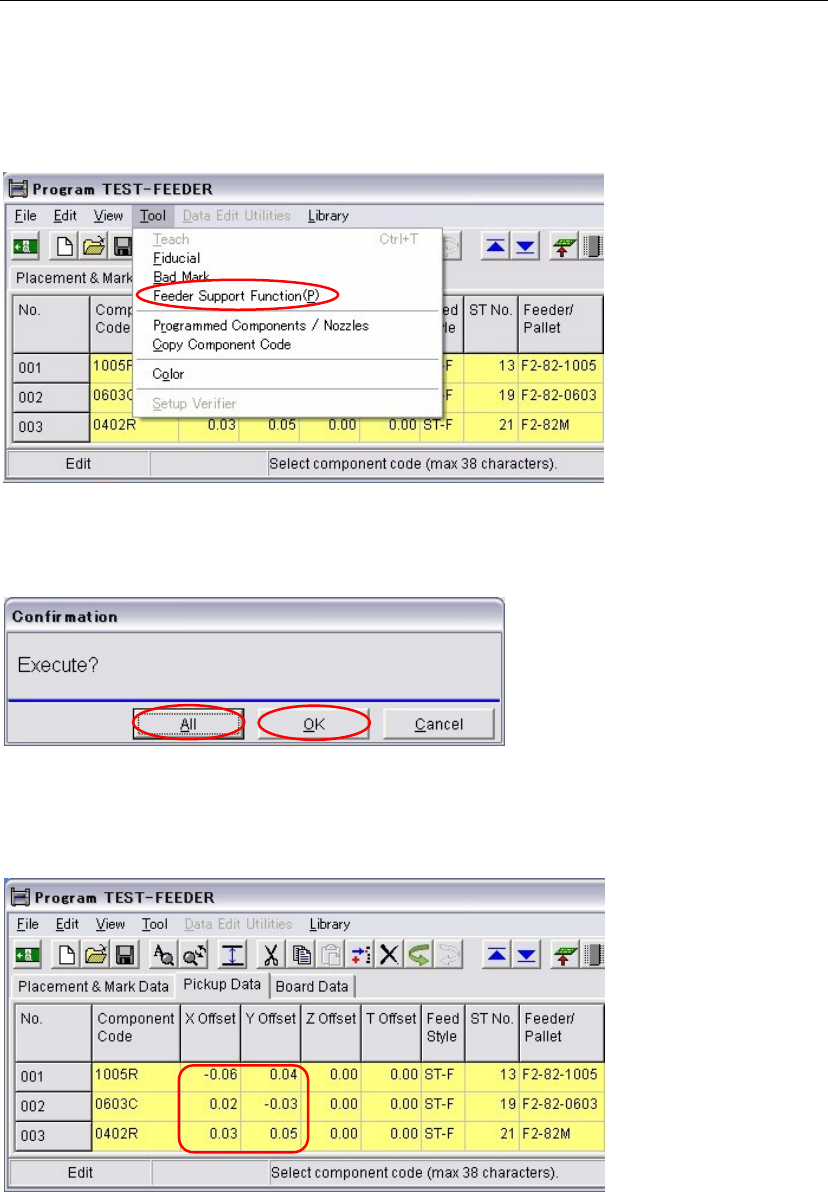
① In the pickup data window, select the [Feeder Support Function] from the tool bar.
② The confirmation message appears.
Clicking the <OK> button moves the main teach camera to the specified pickup point. The
main teach camera captures an image of the pickup point and the correction values are
entered in the [X Offset] and the [Y Offset] cells.
③ Clicking the <All> button will perform the automatic pickup point correction continuously
for all the pickup points which have mark codes in their [Image Code for Feeder Support]
cells.
The acquired correction values are entered in the [X Offset] and the [Y Offset] cells.
④ The acquired X Offset and the Y Offset are saved in the program.
Note: To use these manually acquired X offset and Y offset values in production, disable the [Feeder
Support Function] in the system parameter. Because offset values acquired during a job run have a
priority to offset values acquired manually.
Chapter 2 Creating and Editing a Program
2-60
2-7-3-3 Feeder Support Function during a Job Run
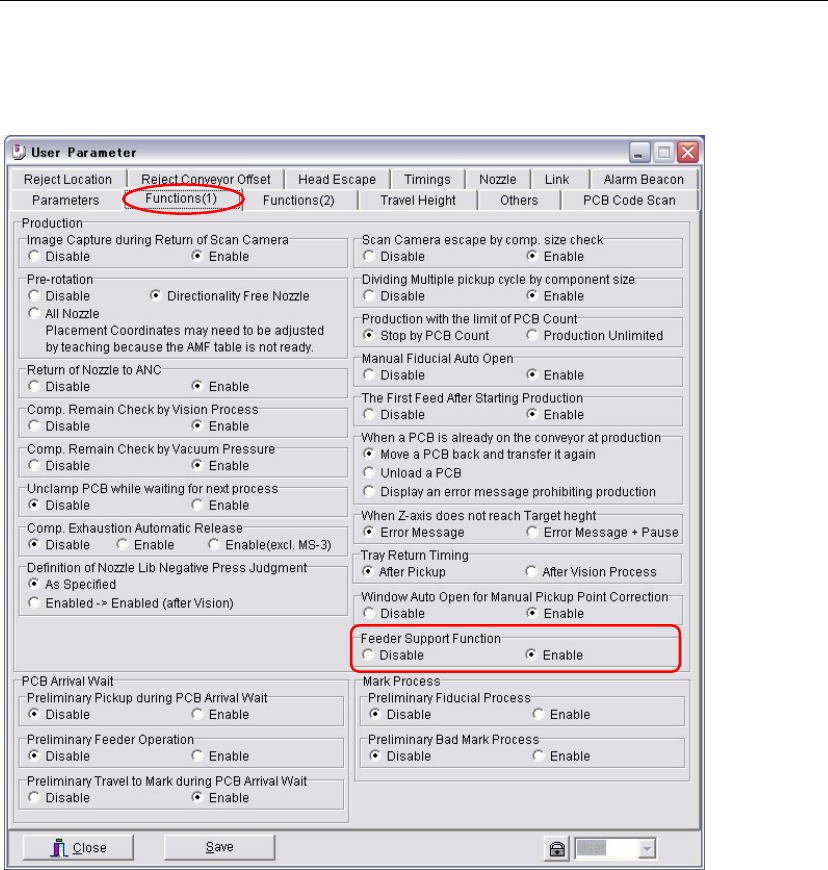
Menu: Parameter > User Parameter > Functions(1)
Action:
① Enable the [Feeder Support Function].
② When this function is enabled, the feeder support function is performed every time at the
start of production for all the pickup points which have image codes in their [Image Code for
Feeder Support] cells and the results are referred to the placements.
The acquired correction values are available until the current job is complete or the stop and
the cancel buttons are pressed.
Note: Not only at the start of production, pickup points are image captured at fixed the interval, after
specific times of pickups are performed, and also when an image capture error or a pickup error
occurs.
Note: Result values acquired by image captures of pickup points are not entered in the [X Offset] and the
[Y Offset], either not saved in the program. Usually the results of this function during production
do not need to be saved. But if you want to save them, click the [Apply] button in Run mode.
Important:
z Paper tapes for component dimensions, 0402, 0603, and 1005 are available.
Plastic embossed tapes are not available.
z The feeder support function works for steps of the feeder styles, ST-F and ST-R. The feeder
styles such as a the CTF tray feeder is not available.
z Make sure the image codes are input in the [Image Code for Feeder Support] cells.
z Make sure paper tapes are used for the specified feeders.
z Make sure the specified pickup points are within movable range of the main teach camera.
The aux. teach camera does not perform this function.