M20_Ope_E.pdf - 第228页
Chapter 5 Libraries 5-78 5-1-5-13 Fiducial Marks Register the fiducial model for the fiducial image data using a sample board from the production lot. This model will be the reference to be compared with the actual fiduc…
Chapter 5 Libraries
5-77
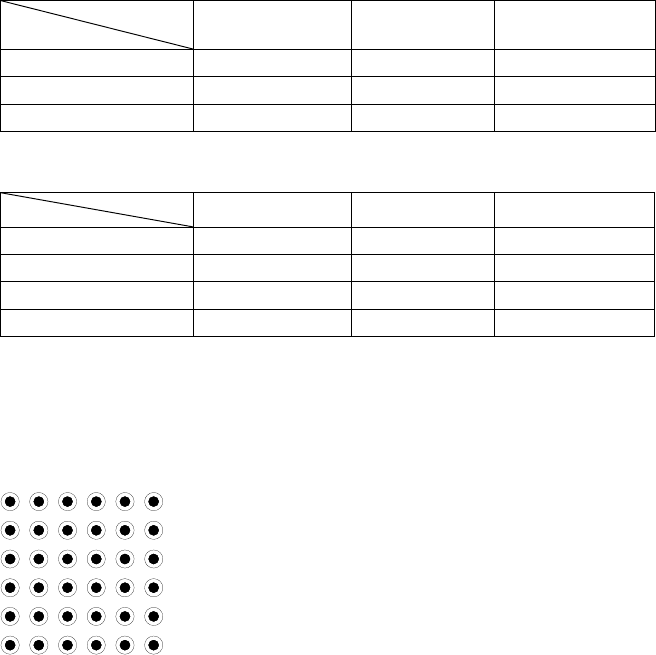
Comparison between BGA mode and BGA/CSP mode
BGA mode
Upper-right Ball
Coordinate
Lower-left Ball
Coordinate
Ball-less Square
(Missing Data)
Full grid -- -- Not required
Perimeter grid Required Required Not required
Partial grid -- -- Required
BGA / CSP mode
Perimeter grid Partial grid Random ball
Full grid Not required Not required Not required
Perimeter grid Required Not required Not required
Partial grid Required Required Not required
Random ball Not required Not required Required
Illuminator Settings
Increased quantity of the side light results in brighter side portion and then center portion.
Adjust the quantity so that the center of a ball is slightly dark.
Note: Do not use the outside light.
Note: The best way: Prepare a ball-missing BGA component. Adjust illuminator settings so that the
image of normal balls can be clearly captured, while ball-missing portion is unseen.
Ball Pattern
Setting
Ball Pattern
Setting
Chapter 5 Libraries
5-78
5-1-5-13 Fiducial Marks
Register the fiducial model for the fiducial image data using a sample board from the
production lot. This model will be the reference to be compared with the actual fiducial on each
board. The fiducial process allows the system to measure and compensate X/Y/T offsets and
stretch/shrink of the board pattern to achieve precise placement for the overall program.
Fiducial Process
There are two ways to perform the fiducial process:
1. Pattern matching
This process allows for comparison between the registered fiducial model and an actual
fiducial on a board to see the offset between them. Its capability is hardly susceptible to the
inconsistent lightness of the overall or part of the fiducial image, or to the unclear fiducial
image due to its unsmooth surface. It is recommended that this process should be selected.
2. Center search based on fiducial shape
This process does not require time-consuming model registration unlike the pattern matching.
It merely requires you to select a fiducial shape to perform fiducial center search.
z Fiducial Mark Centering
The coordinates of the center of the fiducial model must correspond to the programmed
fiducial coordinates. If the fiducial model is registered off-centered, the offset value is added to
the compensation value to result in mis-compensation for all the production lot. To prevent this,
in teaching the fiducial model, the Model centering allows a fiducial to be centered
automatically by the vision process system, not manually, for proper registration. Before this
feature can be used, the fiducial shape and size must be specified.
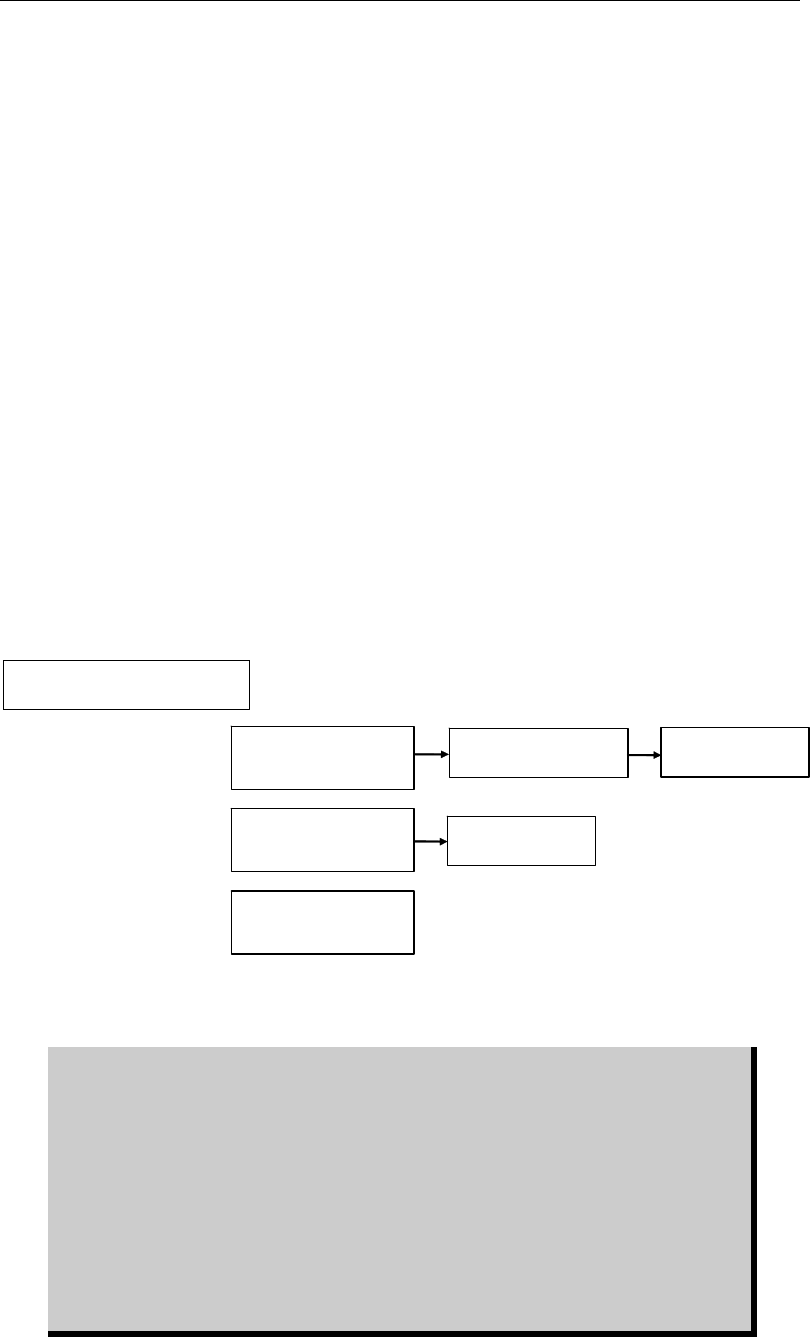
Summary of processing
Center search by
specifying shape
Pattern matching
(Actual model)
Model centering
Acquire model
Pattern matching
(Template model)
Register shape and
dimensions.
Register shape and
dimensions.
Register shape and
dimensions.
Acquire model
The “Actual model” for fiducial ‘Pattern matching process’ is registered actually
captured by the teach camera.
On the contrary, “Template model” for fiducial ‘Pattern matching process’ is
created from the specified mark shape and input sizes. “Template model” is
recommended to use for the fiducial pattern matching process because;
① The “Template model” does not require model centering and an accurate
mark model can be created.
② Besides, illumination setting of “Template model” can be adjusted by Image
Test even after model registration to get a better result of “Actual score”.
③ Only common mark shapes; circle, square, diamond, and triangle, are
available for “Template model”.
④ Use “Actual model” for the rest of mark shapes.
Chapter 5 Libraries
5-79
Fiducial Surface Material and Illuminator Settings
The ideal fiducial surface is of bare copper or of gold/nickel plating.
Fiducial surface for epoxy fiberglass board may be of leveled solder, copper, and gold plating.
For ceramic board may be of silver/palladium. These materials, especially leveled solder, may
have irregular reflectance because of their unsmooth surface. Accordingly, the captured
fiducial image may not be just like the real target. To improve this, prior to registering the
fiducial model, adjust the Inside/Outside Light settings of the main teach camera.
Note: When it is impossible to obtain a satisfactory model image even after adjusting illuminator
settings, see the Distance X/Y setting in the following section.
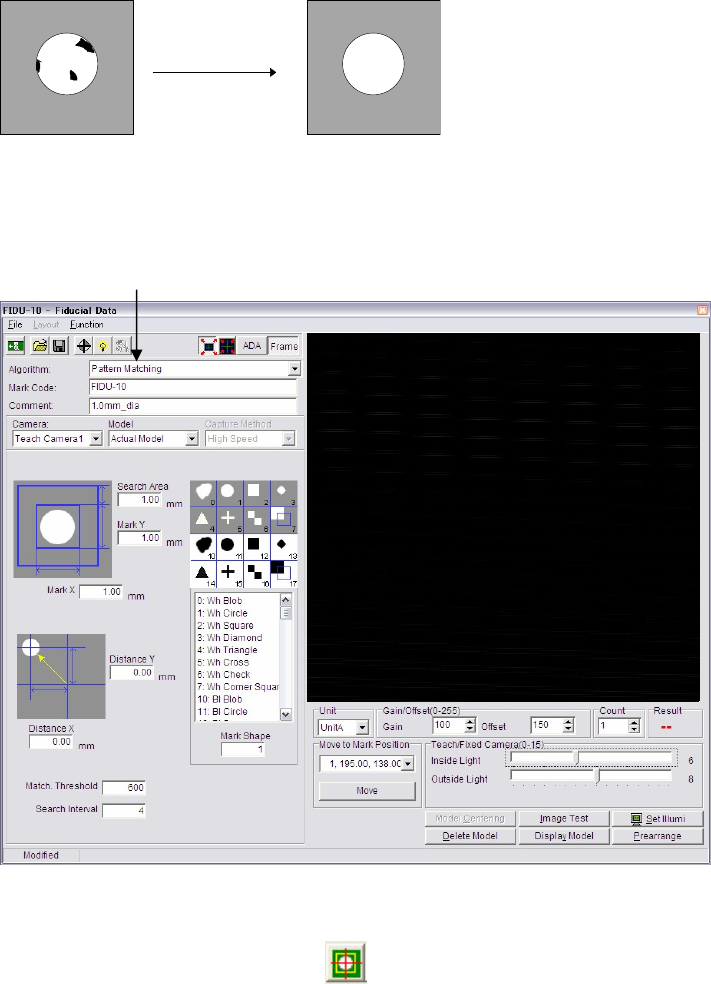
Creating Fiducial Data
Note: Mark image data cannot be opened/edited in Image Library, but in Program editor. Mark
image editor window above should be opened from:
Program>Tool>Fiducial/Badmark or button on the Program Edit screen.
Window:
File>Open: Opens the list of existing fiducial data. Select data and click <Open>
button. To delete data, select data and click <Delete> button.
File>Save As…: Saves the current file with a name and comment. Comment is not
necessarily required.
File>Save: Overwrites the current file.
File>Exit: Closes the Fiducial Data dialog box.
Algorithm: Click the mode select combo box to select “Pattern Matching” or
“Center Search”. If “Pattern Matching” is selected, comparison will
Mode selecting combo box