M20_Ope_E.pdf - 第85页
Chapter 2 Creating and Editing a Program 2-41 [Placement & Mark Data] Code Reference Comment X Y Head B Group No. Task Designator White dot Bad A Master B 290.00 170.00 Main teach Camera 255 B Mark Positive Logic Whi…

Chapter 2 Creating and Editing a Program
2-40
z Examples
[Placement Program]
B Group No.
① Bad mark 1
255 (Master bad mark)
② Bad mark 2
1 (Group bad mark)
③ Start of block placement
④ Bad mark 3
0 (Standard bad mark)
⑤ Placement of R1 (Multiple Pickup) 0
⑥ Placement of R2 (Multiple Pickup) 0
⑦ Placement of C1 (Multiple Pickup) 0
⑧ Placement of C2 (Multiple Pickup) 1 (bad mark group is specified)
⑨ Placement of IC1 (Single Pickup) 0
⑩ End of block placement
⑪ Repeat offset 1 (Block 2)
⑫ Repeat offset 2 (Block 3)
⑬ Bad mark 4
255 (Master bad mark)
⑭ Bad mark 5
0 (Standard bad mark)
⑮ Start of block placement
⑯ Bad mark 6
0 (Standard bad mark)
⑰ Placement of R1 (Multiple Pickup) 0
⑱ Placement of R2 (Multiple Pickup) 0
⑲ End of block placement
⑳ Repeat offset 1 (Block 2)
A. The effective range for the master bad mark ① is until immediately before master bad mark ⑬.
The master bad mark ① determines whether the bad mark process ②/④ will be performed or
not.
B. When the placement ⑧ is to be determined by the group bad mark ② regardless of the result of
the master bad mark ① process, “254” shall be entered in the [B Group No.] cell.
C. The group bad mark ② determines whether the placement ⑧ will be performed or not.
D. The standard bad mark ④ determines whether the placement of the following each block will
be performed or not.
E. The effective range for the master bad mark ⑬ is until the end of the placement program.
The master bad mark ⑬ determines whether the bad mark process ⑭/⑯ will be performed or
not.
F. The standard bad mark ⑭ determines whether the placement of all the blocks after the step ⑮
will be performed or not.
G. The standard bad mark ⑯ determines whether the placement of the following block will be
performed or not.
Example Program for Multi-block PCB
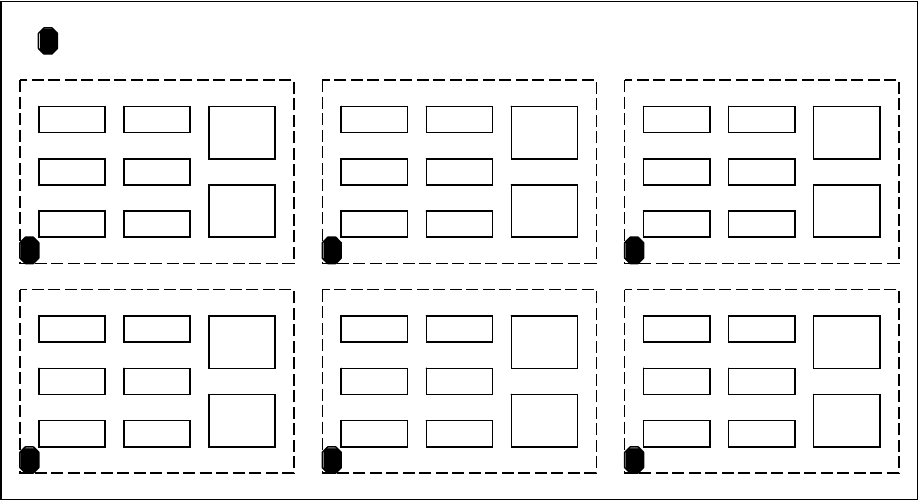
An example of a multi-block PCB aiming to reduce cycle rate is shown below.
[Conditions]
1. The master bad mark A is used to determine whether the following bad mark processes will be
performed or not.
2. IC1 and IC2 shall be picked up continuously (multiple pickup process) to reduce cycle rate.
Chapter 2 Creating and Editing a Program
2-41
[Placement & Mark Data]
Code Reference Comment X Y Head B Group No. Task
Designator
White dot Bad A Master B 290.00 170.00 Main teach Camera 255 B Mark Positive Logic
White dot Bad 1-1 Group B 300.00 100.00 Main teach Camera 1 B Mark Positive Logic
White dot Bad 1-2 Group B 200.00 100.00 Main teach Camera 2 B Mark Positive Logic
White dot Bad 1-3 Group B 100.00 100.00 Main teach Camera 3 B Mark Positive Logic
White dot Bad 2-1 Group B 300.00 20.00 Main teach Camera 4 B Mark Positive Logic
White dot Bad 2-2 Group B 200.00 20.00 Main teach Camera 5 B Mark Positive Logic
White dot Bad 2-3 Group B 100.00 20.00 Main teach Camera 6 B Mark Positive Logic
0.00 0.00 Start Block Placement
White dot Bad y-x Standard B 300.00 100.00 Main teach Camera 0 B Mark Positive Logic
1005R R1 R1 280.00 150.00 Head 1 0 Multiple Pickup
1005R R2 R2 280.00 130.00 Head 2 0 Multiple Pickup
1005R R3 R3 280.00 110.00 Head 3 0 Multiple Pickup
1005C C1 C1 260.00 150.00 Head 4 0 Multiple Pickup
1005C C2 C2 260.00 130.00 Head 5 0 Multiple Pickup
1005C C3 C3 260.00 110.00 Head 6 0 End Multiple Pickup
0.00 0.00 End Block Placement
-100.00 0.00 0 Repeat Offset
-200.00 0.00 0 Repeat Offset
0.00 -80.00 0 Repeat Offset
-100.00 -80.00 0 Repeat Offset
-200.00 -80.00 0 Repeat Offset
SOP8 IC1 IC1 230.00 140.00 Head 1 1 Multiple Pickup
SOP8 IC1 IC1 130.00 140.00 Head 2 2 Multiple Pickup
SOP8 IC1 IC1 30.00 140.00 Head 3 3 Multiple Pickup
SOP8 IC1 IC1 230.00 60.00 Head 4 4 Multiple Pickup
SOP8 IC1 IC1 130.00 60.00 Head 5 5 Multiple Pickup
SOP8 IC1 IC1 30.00 60.00 Head 6 6 End Multiple Pickup
PLCC28P IC2 IC2 230.00 120.00 Head 1 1 Multiple Pickup
PLCC28P IC2 IC2 130.00 120.00 Head 2 2 Multiple Pickup
PLCC28P IC2 IC2 30.00 120.00 Head 3 3 Multiple Pickup
PLCC28P IC2 IC2 230.00 40.00 Head 4 4 Multiple Pickup
PLCC28P IC2 IC2 130.00 40.00 Head 5 5 Multiple Pickup
PLCC28P IC2 IC2 30.00 40.00 Head 6 6 End Multiple Pickup
Bad Mark A
R1 C1
R2 C2
IC1
Block 1-2
Bad Mark 1-2
R3 C3
IC2
R1 C1
R2 C2
IC1
Block 1-1
Bad Mark 1-1
R3 C3
IC2
R1 C1
R2 C2
IC1
Block 1-3
Bad Mark 1-3
R3 C3
IC2
R1 C1
R2 C2
IC1
Block 2-2
Bad Mark 2-2
R3 C3
IC2
R1 C1
R2 C2
IC1
Block 2-1
Bad Mark 2-1
R3 C3
IC2
R1 C1
R2 C2
IC1
Block 2-3
Bad Mark 2-3
R3 C3
IC2
Chapter 2 Creating and Editing a Program
2-42
2-7-1-4 Repeat Programs and Bad Marks
Menu: Program>Placement&MarkData>Task>StartBlockPlacement
Program>Placement&MarkData>Task>EndBlockPlacement
Program>Placement&MarkData>Task>RepeatOffset
In producing multi-up panels, the same program is repeated for the number of boards. This
section describes programming of repeat programs and bad marks.
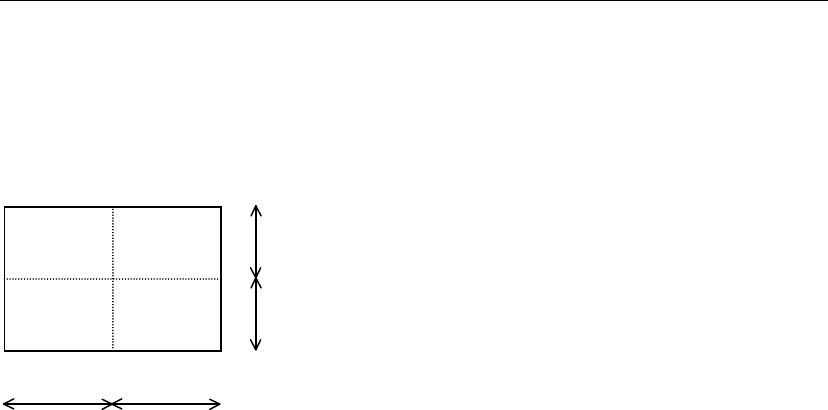
Example1:Four-board panel:
40mm
40mm
60mm
60mm
DC
B
A
Suppose the program for board A is as follows:
X Y
10.00 10.00
30.00 20.00
To repeat the above program for the remaining boards (B ⎝ C ⎝ D), the program will be as follows:
X Y Task Board
0.00 0.00 Start Block Placement
10.00 10.00 Multiple Pickup A
30.00 20.00 End Multiple Pickup A
0.00 0.00 End Block Placement
60.00 0.00 Repeat Offset B
60.00 40.00 Repeat Offset C
0.00 40.00 Repeat Offset D
Note: Offset values in a repeat offset step are always based on the original board position for which the
repeat program is created. (board A in the above example)
Note: Only the Task setting is required for the Start Block Placement/End Block Placement steps.
Effective Range for a Bad Mark Inspection
z Assign a bad mark step immediately before a repeat block
The result of the bad mark inspection is effective up to the end of the repeat block. When the bad
mark is present, the entire repeat block will be skipped.
Note: To assign a bad mark step, specify a bad mark code to [Code] of the step.
z Within a repeat block, assign only one bad mark step immediately after [Start Block Placement]
step
The result of the bad mark inspection is effective up to [End Block Placement] step. This
assignment is typically used for skipping a particular board of a multi-up panel.