M20_Ope_E.pdf - 第94页
Chapter 2 Creating and Editing a Program 2-50 Fiducial Mark Learning Feature In running a repeat program that contains fiducial steps, the system learns the result of the first fiducial process and applies it to the se…
Chapter 2 Creating and Editing a Program
2-49
z Example for Programming 2 (local fiducial number is selectable from 0-249)
F Group No. Task Description
0 Fiducial Global fiducial process (coordinates assignment)
0 Fiducial Global fiducial process (coordinates assignment)
0 Multiple Pickup Place chip (1) with global fiducial compensation
0 End Multiple Pickup Place chip (2) with global fiducial compensation
1 Fiducial Local fiducial process (coordinates assignment) for IC (1)
1 Fiducial Local fiducial process (coordinates assignment) for IC (1)
1 Single Pickup Place IC (1) with local fiducial compensation
3 Fiducial Local fiducial process (coordinates assignment) for IC (2)
3 Fiducial Local fiducial process (coordinates assignment) for IC (2)
3 Single Pickup Place IC (2) with local fiducial compensation
0 Multiple Pickup Place chip (3) with global fiducial compensation
Note: The programming 2 is recommended rather than the programming 1. Use the programming 1
when there are 250 or more local fiducials in a program.
Note: In producing multi-up panels, fiducial process is available for each board.
Fiducial Correction
z Local Fiducial Correction
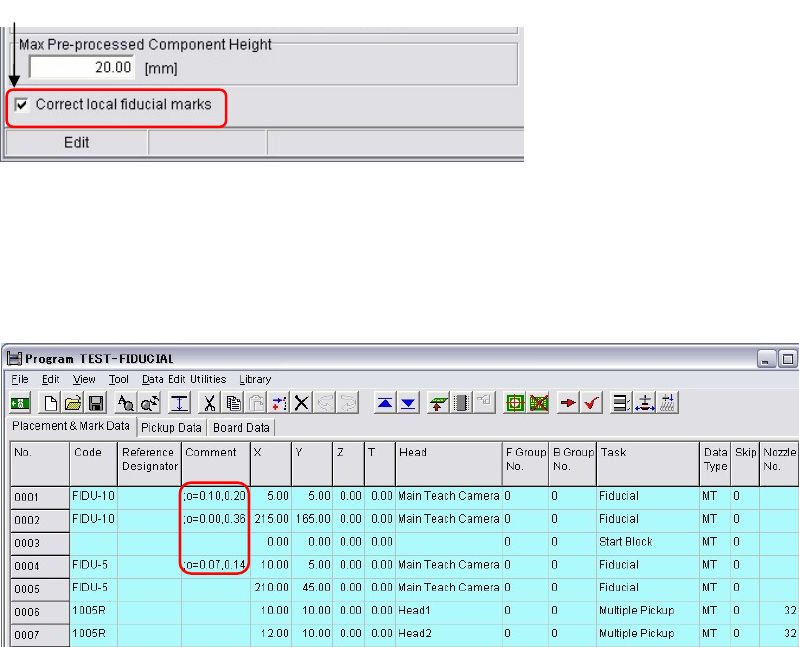
A result of global fiducial process can correct coordinates of local fiducial marks. To enable this
function, check the “Correct local fiducial marks” box.
Menu: Program>Board Data
z Fiducial Correction by entering XY Correction Coordinates in the Comment Column
Entering XY correction coordinates in the Comment in fiducial steps correct fiducial points.
Use this function when an out of search area error occurs.
Menu: Program>Placement & Mark Data
The characters code “;o=” (semicolon, small letter o, and equal) in the comment column becomes
the command of fiducial correction. After entering the command sign (;o=”), enter in order of an X
correction coordinate, comma (,), and a Y correction coordinate without spaces.
A comment can also be entered in the Comment column. Insert a space after a Y correction
coordinate and enter a comment.
To enable the correction of local fiducial marks
,
check the box.

Chapter 2 Creating and Editing a Program
2-50
Fiducial Mark Learning Feature
In running a repeat program that contains fiducial steps, the system learns the result of the first
fiducial process and applies it to the second or later fiducial process with the same coordinates
setting, enabling to skip actual mark capture process. This feature allows for reducing the process
time.
For example, this feature can take effect in the following program:
X Y Task
0.00 0.00 Start Block Placement
5.00 5.00 Fiducial
. .
. . (Placement routine A)
. .
0.00 0.00 End Block Placement
60.00 0.00 Repeat Offset
60.00 40.00 Repeat Offset
0.00 40.00 Repeat Offset
0.00 0.00 Start Block Placement
5.00 5.00 Fiducial
. .
. . (Placement routine B)
. .
0.00 0.00 End Block Placement
60.00 0.00 Repeat Offset
60.00 40.00 Repeat Offset
0.00 40.00 Repeat Offset
Note: This feature can be applied to the maximum of 300 fiducial steps per program.
The fiducial mark learning
function skips the second and
later fiducial processes which
have the same coordinates.
Chapter 2 Creating and Editing a Program
2-51
2-7-1-7 7Multiple/Simultaneous Pickup
Menu: Program>Placement&MarkData>Task>MultiplePickup
Program>Placement&MarkData>Task>SinglePickup
There are three ways the head assembly picks up a component or components:
Single Pickup
A head moves to a pickup point for a component and transports it to a placement point. Although
this is the slowest method, it must be employed depending on the size and the number of
programmed components.
Multiple Pickup
Two or more heads move to one or more pickup points. Each head picks up a component at
different timings.
Simultaneous Pickup
Two or more heads move to pickup points at the same timing—the fastest of the three methods.
You can approach the maximum tact time by simultaneous pickup with 4 or 6 heads.
To allow simultaneous pickup to occur...
● “Multiple Pickup” is specified to [Task] of the placement data.
● Component size is 1005 or larger.
● Feeders are placed at the same spacing as the heads. (Each feeder can have
tolerance, which is specified for Component Library. See below.)
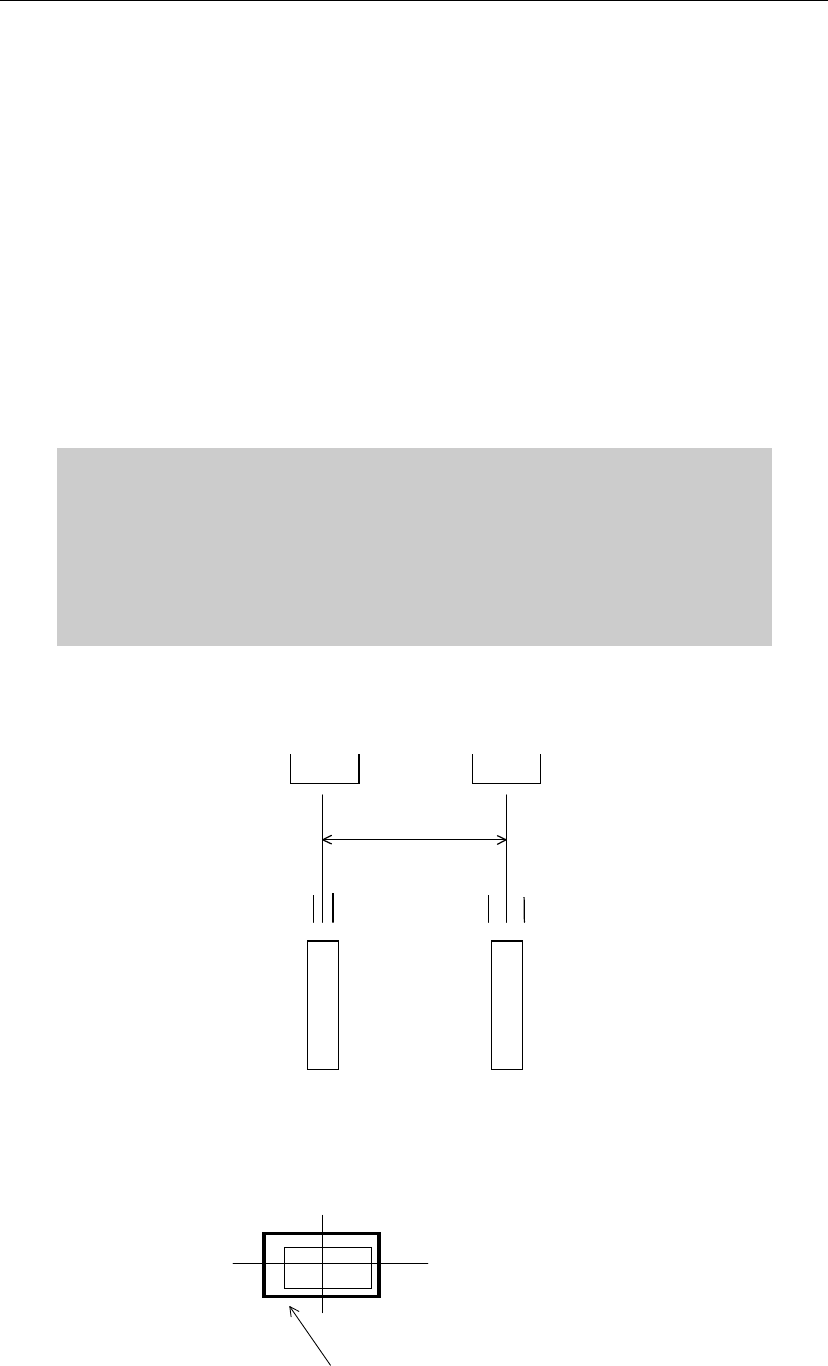
Example: Perform simultaneous pickup using Head 1 and 2 at feeders located at 30mm spacing.
Simultaneous pickup permissions for the components are 0.2mm and 0.1mm.
Tape feeder
Tape feeder
Head 2 Head 1
0.1 0.1 0.2 0.2
Feeder pitch X
In the above example, simultaneous pickup is possible when the feeder pitch is within the range
from (Feeder pitch X + 0.3) to (Feeder pitch X - 0.3).
Define the simultaneous pickup permission keeping in mind a component is stored in a tape
cavity with clearance.
Clearance between the component and the
tape cavity disables component pickup at
the component center.