IPC-4556 印制板化学镍钯浸金(ENEPIG)规范ENG.pdf - 第44页
IPC-4556-a5-6 Figure A5-6 Example of the W etting Performance for a Nominal 4 µin Electroless Palladium T ested with SnPb Solder Sample 16 1.33Au/3.80Pd/181.65Ni Fr(mN/mm) Standard : NF-A-89 400P t(s) 0.25 0.20 0.15 0.10…
Some of these suppliers submitted ENEPIG samples that used
a phosphorus-containing reducing agent in the electroless pal-
ladium bath, whose deposits contain approximately 2 to 4
wt% phosphorus, while others submitted samples using other
non-phosphorus containing reducing agents, whose deposits
are sometimes classified as ‘‘pure palladium.’’ The samples
remained in their original packaging until the final ones had
been received for testing. This took some time in the case of
some suppliers and, when ready to commence the test, some
ENEPIG samples had 8 months of ‘‘natural’’ shelf life. Once
all samples were received, the packages were opened and each
group assigned a Roman numeral corresponding to a specific
nominal electroless palladium thickness and supplier - this
was marked on the edge rail of the array with an electric pen-
cil to avoid surface contamination of the plating. XRF read-
ings, using a PIN diode system with a measurement time of
sixty seconds, were generated for all sample groups. As can be
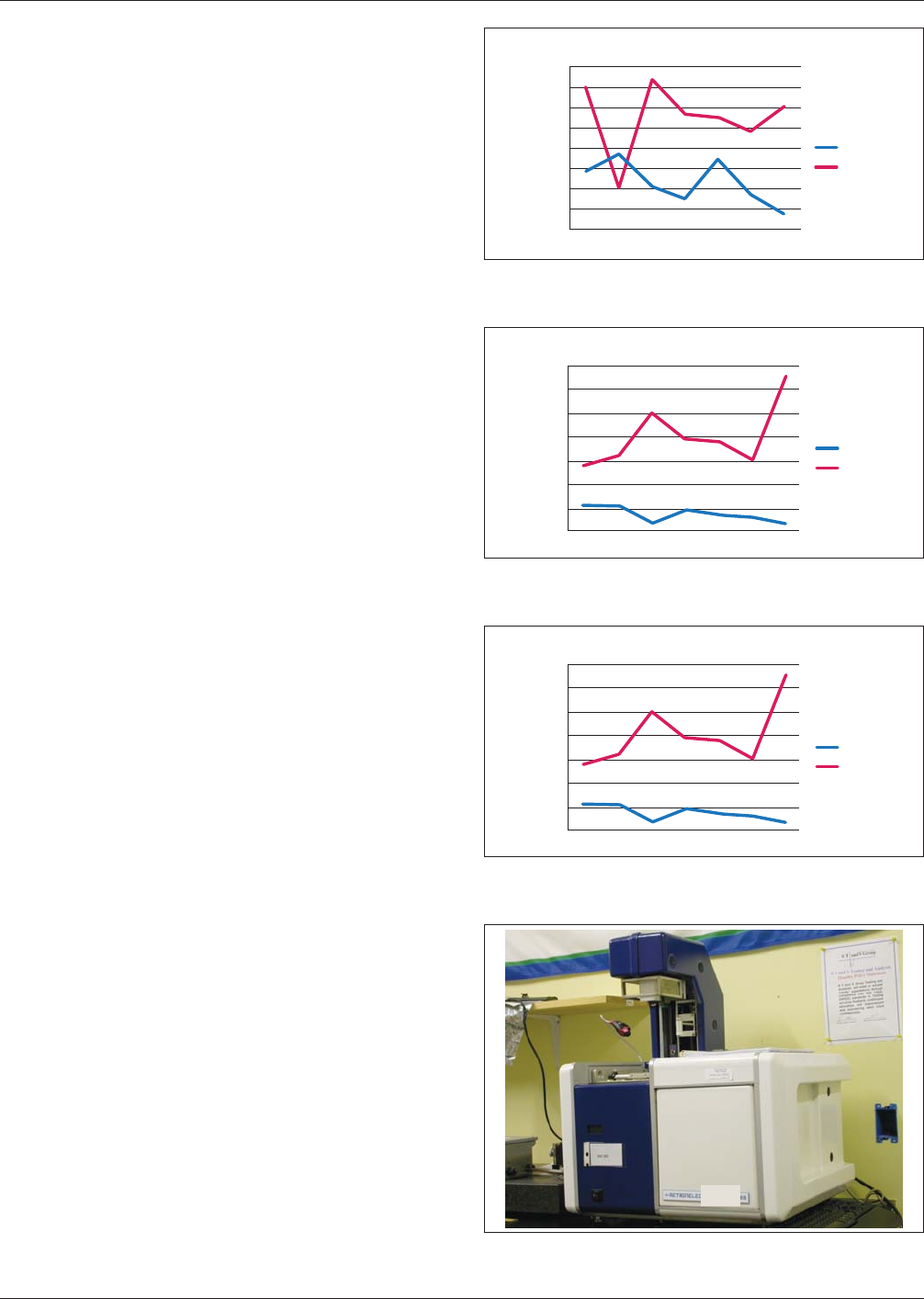
seen from the graphs (Figures A5-2 through A5-4), some of
the suppliers did not correctly measure the deposit at their
location, something that has been a major issue with the intro-
duction of ENEPIG. Additionally, one supplier chose to sub-
mit samples with two different immersion gold thicknesses.
The thinner of these two samples turned out to be of great
value to the committee, as it produced solderability failures
when stressed.
Solderability testing was performed on a Metronelec ST88
wetting balance (see Figure A5-5), using a solder bath for
coupon testing. Testing followed the requirements of the IPC
J-STD-003 B Solderability Standard and samples were tested
with both SAC305 and Eutectic SnPb solders. As per the stan-
dard, test temperatures of 255 °C and 235 °C were used for
the SAC305 alloy and the Eutectic SnPb alloy, respectively.
For the testing, a new charge of solder was used for each
alloy. Similarly per the Standard, Test Fluxes # 1 and # 2 were
used for Eutectic SnPb and SAC305 alloys, respectively.
The test coupons were removed from the array, the edges
carefully ‘‘wiped’’ over 1200 grit silicon carbide paper and
then wiped with a paper towel to remove any dust, to ensure
that no epoxy smear was present on the edge of the SMT pads
on the coupon that might prevent contact with the solder and
produce a false result.
Following coupon preparation, each coupon was immersed
into the appropriate flux for the alloy being used for five sec-
onds, excess flux being allowed to drain. The coupon was then
placed into a suitable tool holder and immersed to a depth of
0.5 mm at 90 degrees incident to the solder surface. A dwell
time of ten seconds was used for each coupon. Following the
test, the sample was inspected to confirm the wetting balance
results and the next coupon from that group run. Ten samples
per group were run for the ‘‘as-received’’ condition. Results
are shown in Figures A5-6 - A5-15.
IPC-4556-a5-2
Figure A5-2 XRF Measurements of Gold and Palladium Thick-
nesses Supplied as Nominal 0.1 micron Electroless Palladium
0.1 microns Palladium
0.160
0.140
0.120
0.100
0.080
0.060
0.040
0.020
Gold
A
Palladium
0.000
microns
BCDEFG
IPC-a5-3
Figure A5-3 XRF Measurements of Gold and Palladium Thick-
nesses Supplied as Nominal 0.2 micron Electroless Palladium
0.2 microns Palladium
0.350
0.300
0.250
0.200
0.150
0.000
0.050
Gold
Palladium
0.000
microns
ABCDEFG
IPC-4556-a5-4
Figure A5-4 XRF Measurements of Gold and Palladium Thick-
nesses Supplied as Nominal 0.3 micron Electroless Palladium
0.2 microns Palladium
0.350
0.300
0.250
0.200
0.150
0.000
0.050
Gold
Palladium
0.000
microns
ABCDEFG
Figure A5-5 Metronelec ST88 Wetting Balance Used for the
Testing
January 2013 IPC-4556
33
maisc0
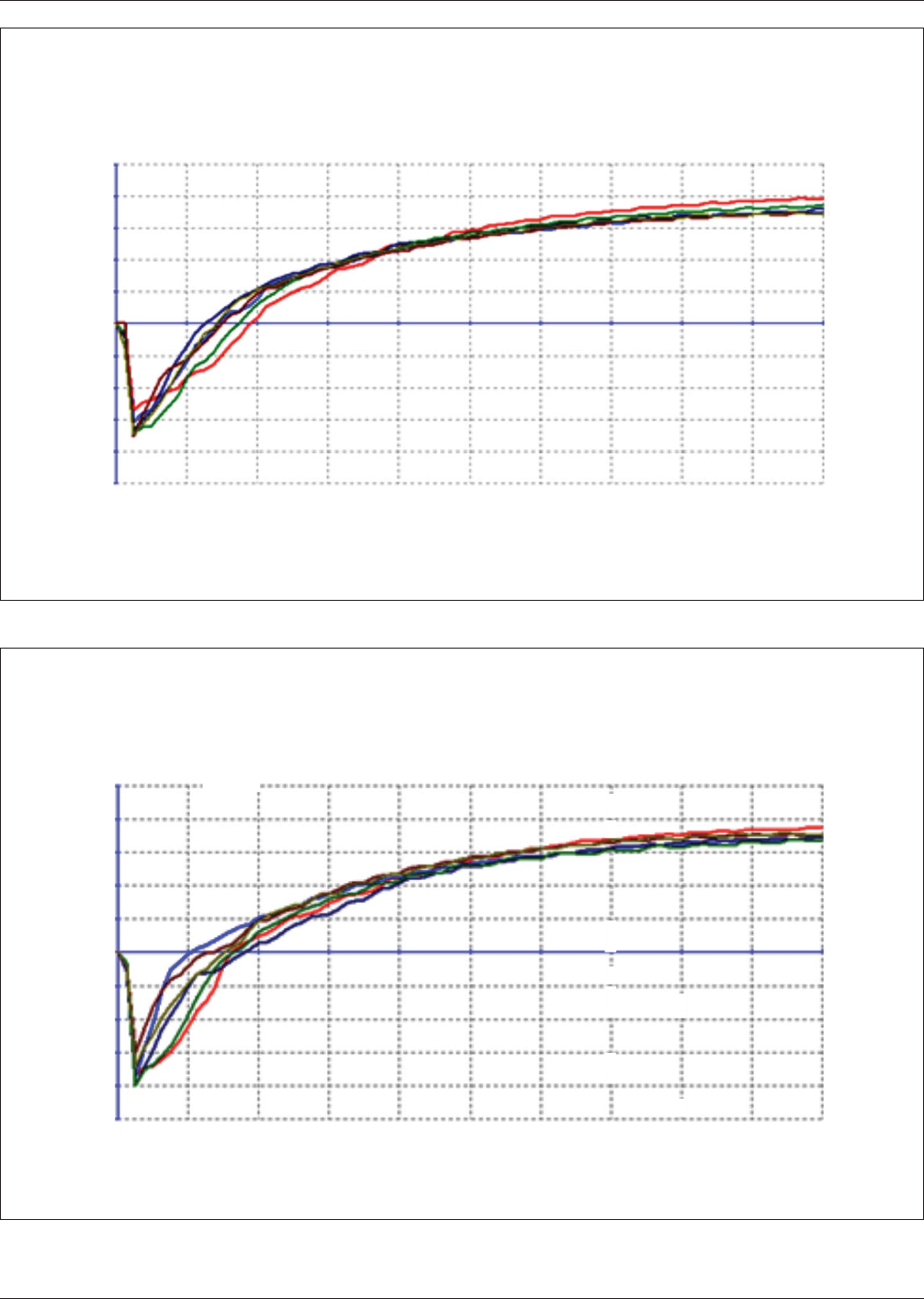
IPC-4556-a5-6
Figure A5-6 Example of the Wetting Performance for a Nominal 4 µin Electroless Palladium Tested with SnPb Solder
Sample 16 1.33Au/3.80Pd/181.65Ni
Fr(mN/mm)
Standard : NF-A-89 400P
t(s)
0.25
0.20
0.15
0.10
0.05
0.00
-0.05
-0.10
-0.15
-0.20
12345678910
-0.25
IPC-4556-a5-7
Figure A5-7 Example of the Wetting Performance for a Nominal 8 µin Electroless Palladium Tested with SnPb Solder
Sample 17 1.24Au/5.93Pd/184.07Ni
Fr(mN/mm)
Standard : NF-A-89 400P
t(s)
0.25
0.20
0.15
0.10
0.05
0.00
-0.05
-0.10
-0.15
-0.20
12345678910
-0.25
IPC-4556 January 2013
34
重用奇
通
通
通
:
通
妻
重
量
:
重
事
重
重
通
重
事
重
:
:
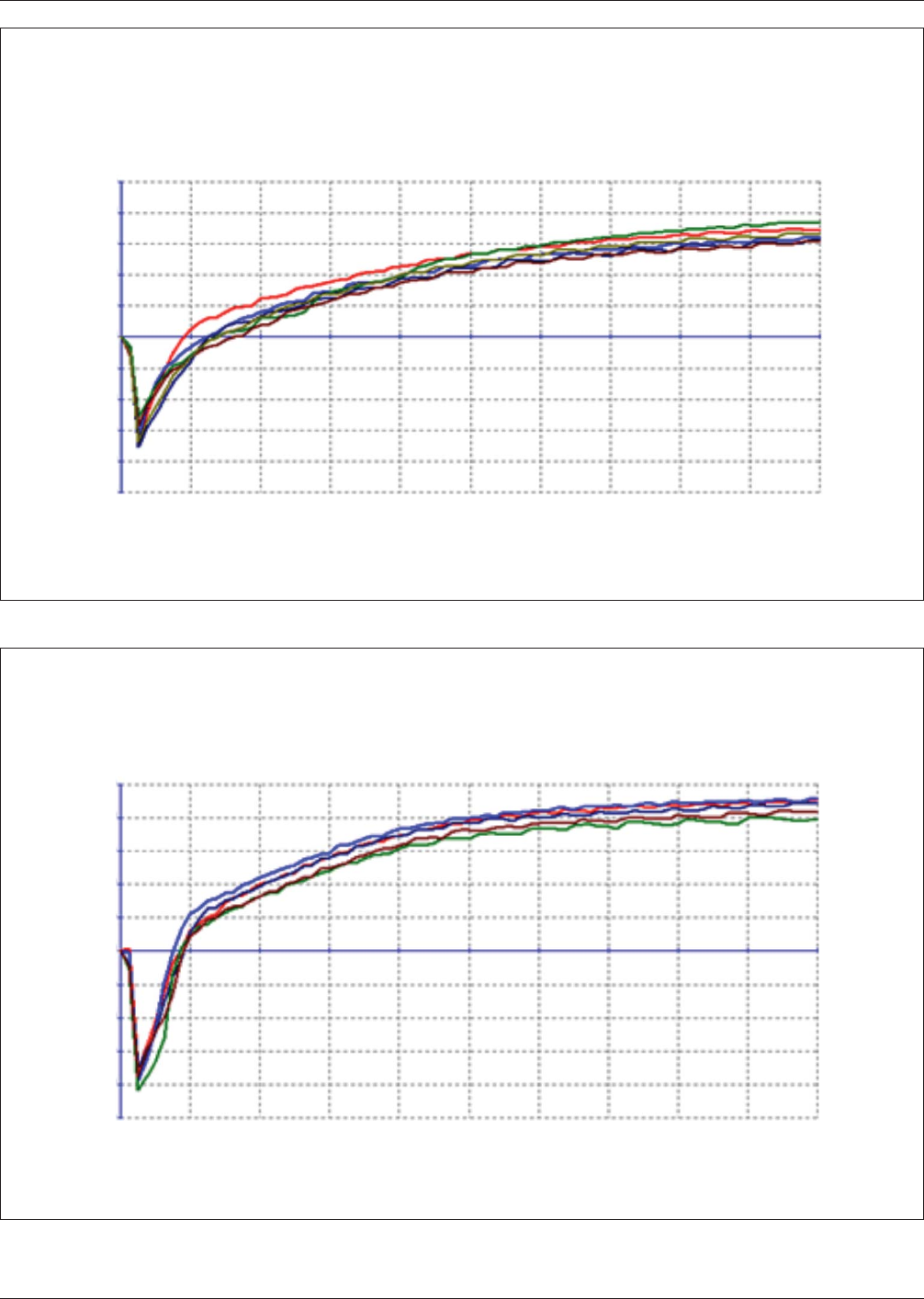
IPC-4556-a5-8
Figure A5-8 Example of the Wetting Performance for a Nominal 20 µin Electroless Palladium Tested with SnPb Solder
Sample 19 1.48Au/17.95Pd/196.17Ni
Fr(mN/mm)
Standard : NF-A-89 400P
t(s)
0.25
0.20
0.15
0.10
0.05
0.00
-0.05
-0.10
-0.15
-0.20
12345678910
-0.25
IPC-4556-a5-9
Figure A5-9 Example of the Wetting Performance for a Nominal 4 µin Electroless Palladium Tested with SAC305 Solder
Sample 13 2.22Au/4.39Pd/280.83Ni
Fr(mN/mm)
Standard : NF-A-89 400P
t(s)
0.25
0.20
0.15
0.10
0.05
0.00
-0.05
-0.10
-0.15
-0.20
12345678910
-0.25
January 2013 IPC-4556
35