IPC-4556 印制板化学镍钯浸金(ENEPIG)规范ENG.pdf - 第76页
APPENDIX 10 Gage Capability. Gage R&R Type 1 Study Michael Haller Chief Operating Of f ıcer Fischer T echnology Goal: T est of gage capability with respect to repeatability and mean of measurement values for a given …

• For samples with thin coatings (<100 nm) and small structures (<0.2 - 0.3 mm) an XRF instrument with a semiconductor
detector and special X Ray optics (poly-capillary) is required to achieve sufficient high intensities.
• Due to the influence of the base material on the measurements (Br in PCB materials, different composition of the PCB
base materials, varying Cu thicknesses) evaluation software with a peak deconvolution, flexible background correction and
the ability to take the P in the Ni, and Pd layer into account, as well utilizing Pd L and Au M emissions is absolutely nec-
essary for the accuracy of the measurements. The influence is especially large for proportional counter instruments, there-
fore, proportional counter XRF systems are not recommended for Cu thicknesses <30 µm (~ 1 oz).
January 2013 IPC-4556
65

APPENDIX 10
Gage Capability. Gage R&R Type 1 Study
Michael Haller
Chief Operating Offıcer
Fischer Technology
Goal: Test of gage capability with respect to repeatability and mean of measurement values for a given tolerance.
• Preferably the gage capability is conducted with a calibrated reference standard, with its reference value approximately in
the middle of the tolerance field.
• At defined measurement points the reference standard is to be measured with n ≥25 times under repeatability conditions.
• For measurement criteria with Upper and Lower Specification Limits (USL and LSL): T=USL-LSL
• For measurement criteria with only a one-sided specification limit (USL or LSL): T is not existent. In this case the allow-
able measurement value lies below USL -4 s or above LSL +4 s.
• The value of the reference standard should be within ± 10 % of the USL or LSL.
• If Gage capability Indexes are to be calculated. use the following formulas.
(The instrument capability is checked thru the Cg and Cgk values. These are defined as:
Gage capability:
C
g
=
0.2 z T
6 z s
C
gk
=
–
0.1 z T –
|
x–x
m
|
3 z s
–
Where: T = tolerance, s = standard deviation), x
m
= mean of standard and x = mean value measurement.
Note: A gage is considered capable if Cg ≥1.33 and Cgk ≥1.33
IPC-4556 January 2013
66
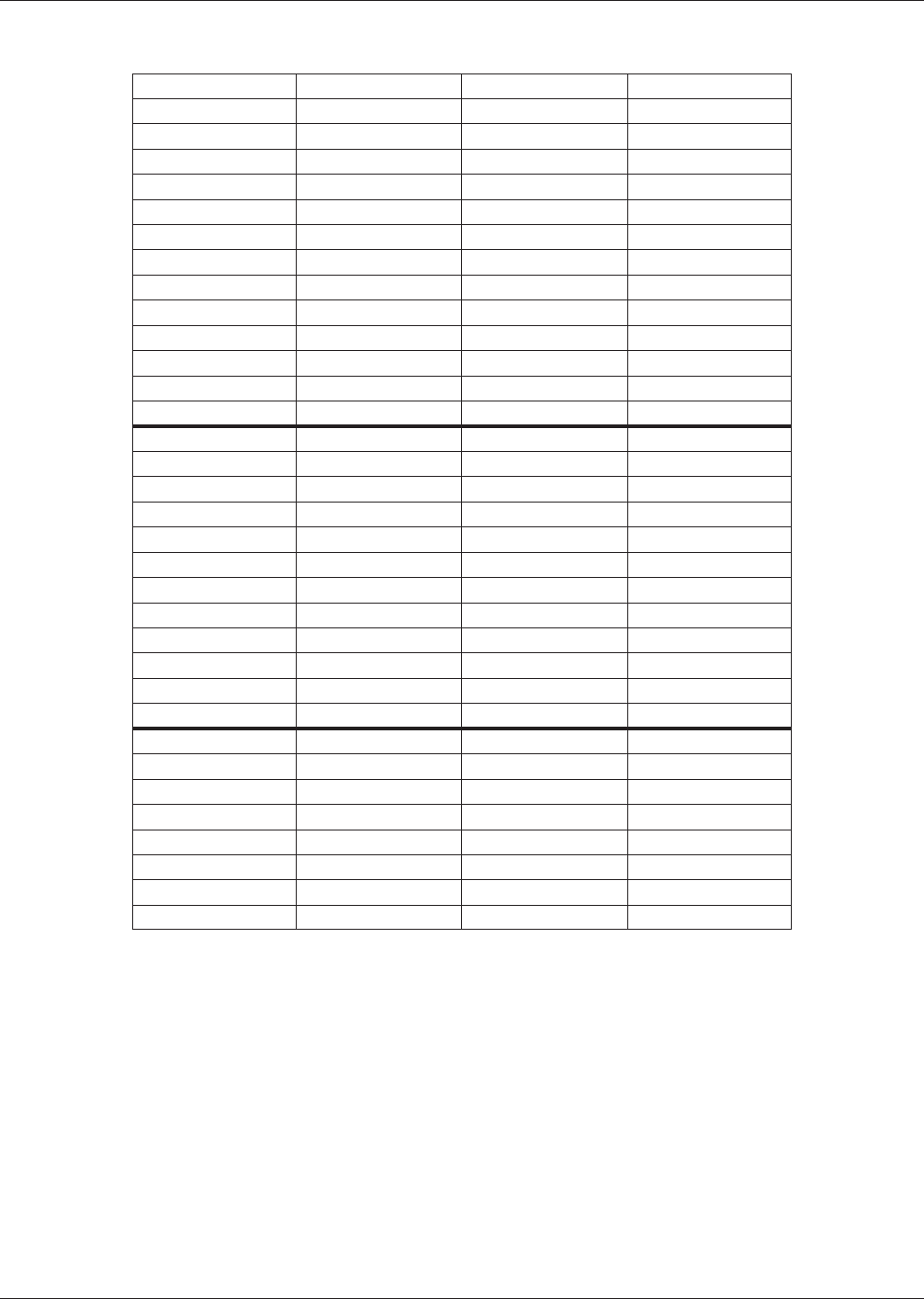
Typical Measurement data achievable with properly calibrated SDD-Detector XRF
Nominal values of standard measured, Au49nm/Pd100nm/Ni4387nm
N Au [nm] Pd [nm] Ni [nm]
1 48.5 97.9 4375
2 48.7 98.6 4381
3 48.6 99.0 4383
4 48.8 100.1 4392
5 49.0 100.1 4388
6 48.8 100.0 4394
7 48.8 99.8 4385
8 48.8 98.9 4384
9 48.9 99.3 4383
10 49.3 100.4 4390
11 48.9 99.7 4385
12 49.2 100.7 4389
13 49.0 101.0 4393
14 49.4 99.7 4390
15 48.8 99.7 4396
16 49.2 100.7 4394
17 48.6 99.6 4387
18 48.9 100.3 4387
19 49.1 100.2 4386
20 49.1 100.4 4395
21 49.3 100.5 4390
22 48.5 100.0 4395
23 48.4 99.0 4383
24 49.2 98.5 4389
25 49.1 98.0 4385
Mean 48.92 nm 99.68 nm 4388.0 nm
Standard Deviation 0.286 nm 0.837 nm 5.112 nm
C.O.V. (%) 0.59 0.84 0.12
Range 1.07 nm 3.14 nm 20.2 nm
# of readings 25 25 25
Min. Read. 48.4 nm 97.9 nm 4375 nm
Max. Read. 49.4 nm 101.0 nm 4396 nm
Measuring Time 120 sec 120 sec. 120 sec.
January 2013 IPC-4556
67