YSi-X_Ope_E.pdf - 第73页
4-12 4 Maintenance 4.2 Checking the board sensor condition T his equipment uses transmission type fiber sensors as the board sensors. P eriodically chec k that these sensors correctly operate even w hen the conveyor r ai…
4-11
4
Maintenance
6
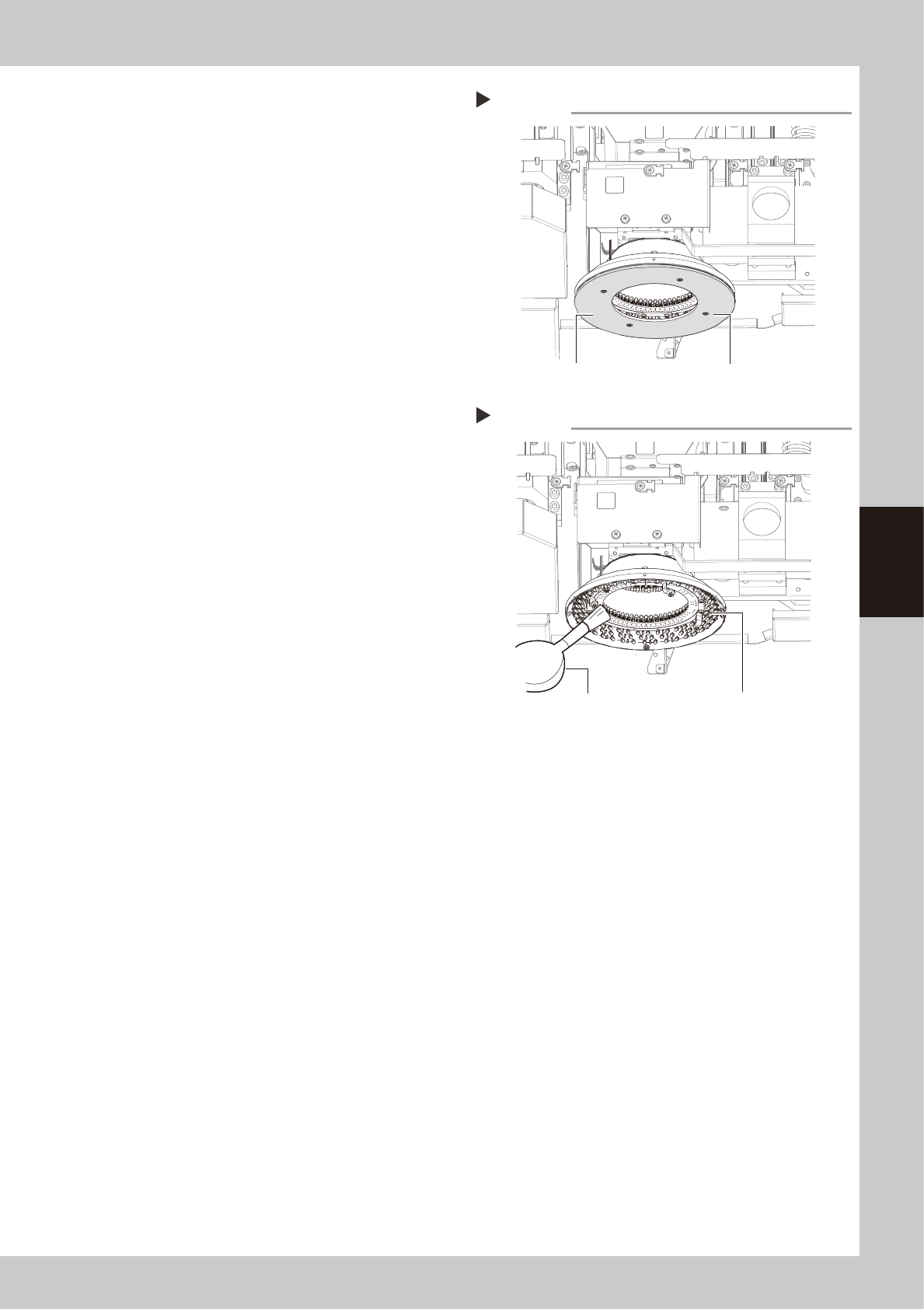
Remove the diffuser plate.
Using the Phillips screwdriver, remove the
four screws holding the diffuser plate and
remove the diffuser plate.
53406-M6-00
7
Clean the diffuser plate.
Remove dirt and dust on the entire diffuser
plate with a paper wipe.
8
Remove dust on the lighting unit of
the inspection camera, using a lens
blower brush.
53407-M6-00
9
Reattach the diffuser plate.
Reattach the diffuser plate in the reverse
order of the removal procedure.
Removing the diffuser plate
Step 6
Diffuser plate mounting screw (four screws)
Diffuser plate
Cleaning the lighting for optical camera
Step 8
Optical lens brush
Camera lighting
4-12
4
Maintenance
4.2 Checking the board sensor condition
This equipment uses transmission type fiber sensors as the board sensors. Periodically check that these sensors
correctly operate even when the conveyor rail width is changed.
1
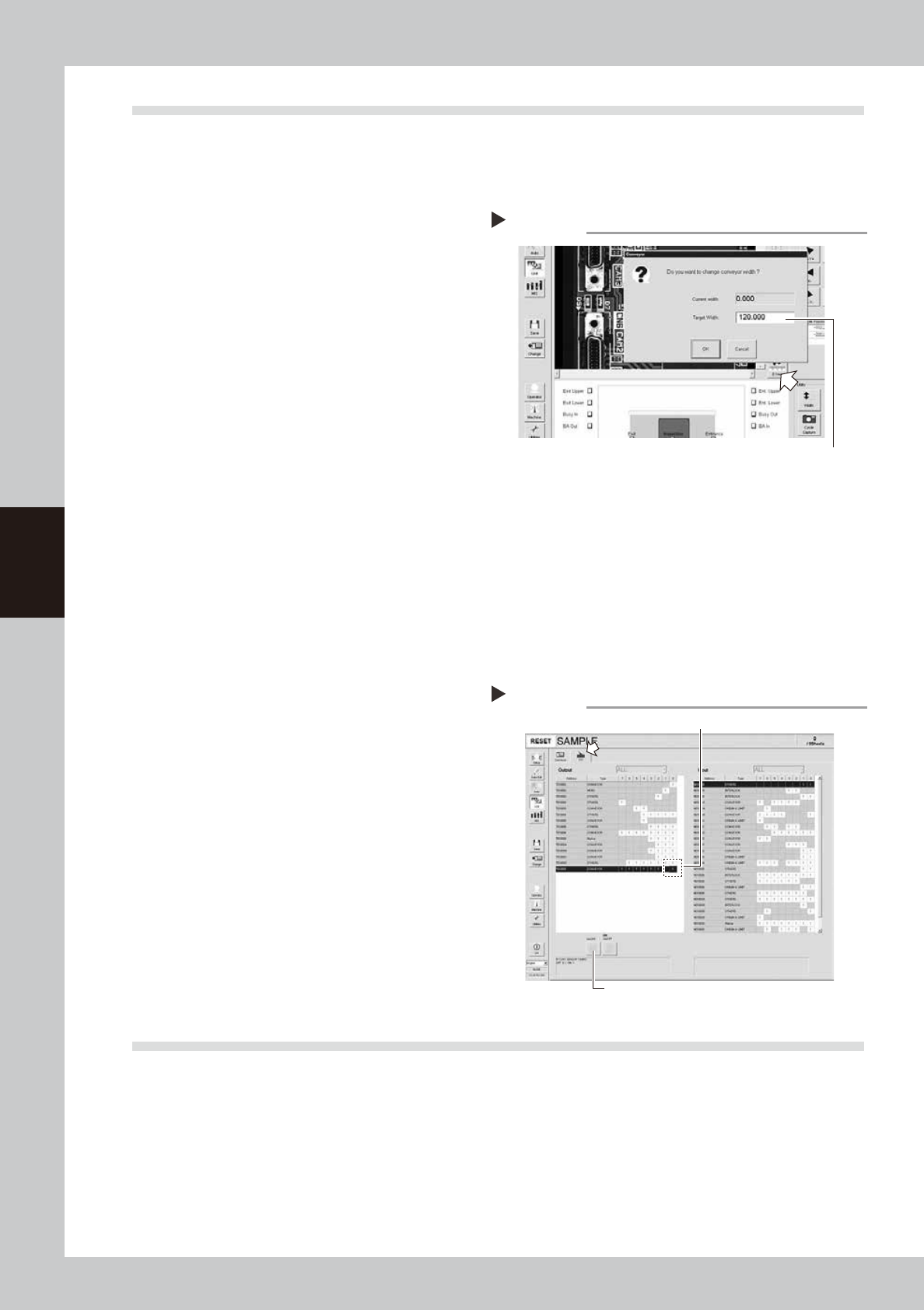
Open the [Unit] – [Conveyor] tab.
2
Press the [Width] button to change
the conveyor width.
1. When the “Conveyor” dialog box
appears, enter the maximum conveyor
width (460mm) in the "Target Width" box
and press the [OK] button. The conveyor
width will automatically change to the
specified size.
2. Then, enter the minimum conveyor width
(50mm) in the “Target Width” box and
press the [OK] button. The conveyor
width will automatically change to the
specified size.
54401-M6-00
3
Check whether an error has
occurred.
The conveyor sensor is operating properly
unless an error message appears when the
conveyor width is changed. No further
check is necessary.
n
If an error message appears, then adjust the sensor with the procedure below.
• Adjusting the conveyor sensor
If an error occurred when the conveyor width was
changed, check
to perform auto-tuning
of the
conveyor sensor.
1. Open the [Unit] – [I/O] tab.
2. In the Output list, select “CONVEYOR”
(T01000E0).
3. Press the [ON/OFF] to switch to 0 (OFF)
→
1 (ON)
→
0 (OFF) to perform auto-tuning.
4. Press the [Conveyor] button again to
change the conveyor width as in step 2.
If no error message appears, the sensors
are correctly working.
54402-M6-00
4.3 Checking the board clamp condition
Check the following points when a board is clamped on the conveyor.
1. Check that the board is securely clamped and there is no play.
2. Check that there is no clearance between the board hold plate and the board.
3. Check that the board surface is flush with the conveyor rail upper surface.
4. Check that the board clamp unit moves smoothly.
5. Check that the board is securely clamped by the side clamp and there is no play in the lateral direction.
6. Check that the side clamp moves smoothly.
Changing the conveyor width
Enter the conveyor width here.
Step 2
Changing the conveyor width
3
2
4-13
4
Maintenance
5. Monthly
5.1 Inspecting each axis
Inspect the ball screws and the guides on each axis.
Check the following points.
n
NOTE
A grease spattering prevention cover is attached along each axis. Remove the cover before inspection and reattach
it in place after inspection.
n
NOTE
Before beginning work, remove the rear center panel by referring to section 3.4 “Removing the rear center panel” in
this chapter so that you can open and close the rear safety door. After finishing the work, reattach the rear center
panel.
Checkpoints
1. Any foreign matter or chips adhering to the ball screws and linear guides?
2. Do the ball screws and linear guides have the correct amount of grease?
Check if grease has flowed off or splattered in the air failing to adhere. Also check if grease has discolored or
hardened.
3. Any abnormal sounds from the ball screws?
Press the emergency stop button. Then check for any abnormal sounds while pushing the unit by hand along the X-axis
or Y-axis back and forth.
Countermeasures
1. Ball screws and linear guides may be damaged when chips or debris bite into them. If chips or debris are adhering,
wipe them off along with the grease or remove with tweezers, etc.
2. Apply grease while referring to "Cleaning and greasing the ball screws and linear guides of each axis" described later.
3. Consult your YAMAHA sales office or representative when abnormal sounds occur even after trying the
countermeasures in the above steps 1 and 2.
c
CAUTION
• When handling grease or lubricant, read and follow the precautions listed in section 3.2.2, "Lubricating tools and
grease", in this chapter.
• If abnormal noise is emitted from the ball screw or guide of each axis, then contact our sales representative for
assistance. Disassembly and cleaning of the ball screw or guide by the user will void the warranty.