N7201A652E.pdf - 第247页
NPM- TT2 EJM1EE-MB -04O-03 4-1-2 -2 Choose whether to exist a carrier PCB or not. ■ Normal PCB positioning ■ Placed component jutting out of PCB edges PCB Reference Placed components Reference Length of a placed componen…
NPM-TT2 EJM1EE-MB-04O-03
Data
editing
4-1-2-1
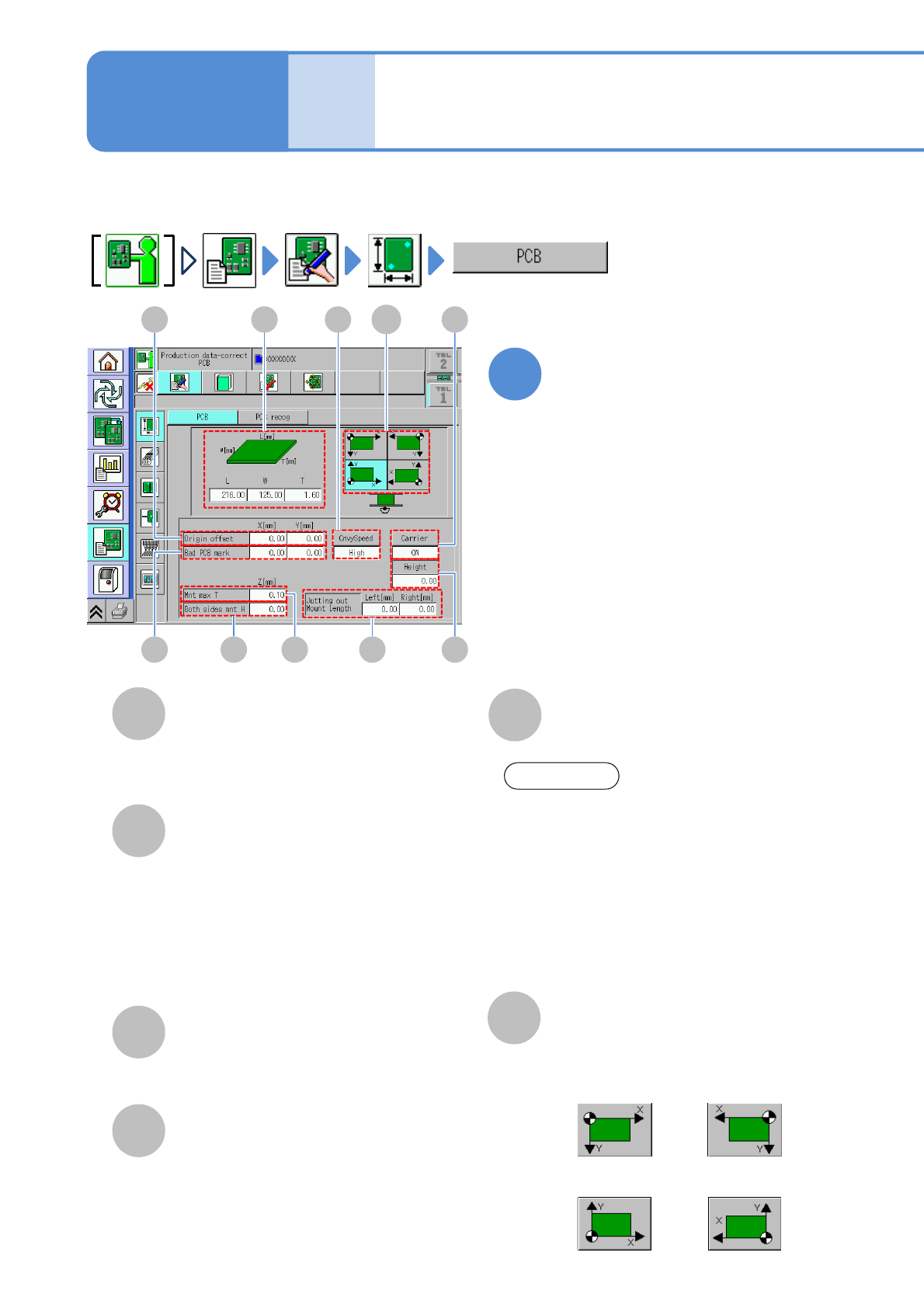
A
Origin offset
D
B
C
The maximum height of the components
that are already placed on the front side.
Both sides mnt H
Bad PCB mark
Edit the data by pointing the
cursor to the desired field
●Touching the screen opens the input
window.
Enter all the offset values of origin for
mount coordinates, PCB recognition
coordinates and bad mark coordinates.
Coordinates of bad PCB mark.
●If the coordinates have this mark, it is
regarded as defective, where mount
will not be carried out.
●To edit it, set [ON] of [Detect Bad
Board Mark] of the soft switch.
(→P.4-1-14)
The maximum height of the components
that are already placed on the rear side.
Mnt max T
1
PCB data edit
Explains how to check and modify the PCB data.
E
PCB dimensions
Enter PCB dimensions.
●Right-front
reference
●Left-front
reference
●Right-rear
reference
●Left-rear
reference
F
Coordinate standard
Choose the PCB coordinate reference.
Operating procedure
4-1-2
D C
A
B
G HE
J
F
I
ATTENTION
Regarding PCB width, you may be able to
input a little bit larger value than the
maximum size of the machine PCB
specifications. It means that the
maximum width can be input on the
machine mechanism because we give
you extra space for variation of your PCB
size. However, regarding a PCB
exceeding the maximum size of PCB
specifications, we do not guarantee.
NPM-TT2 EJM1EE-MB-04O-03
4-1-2-2
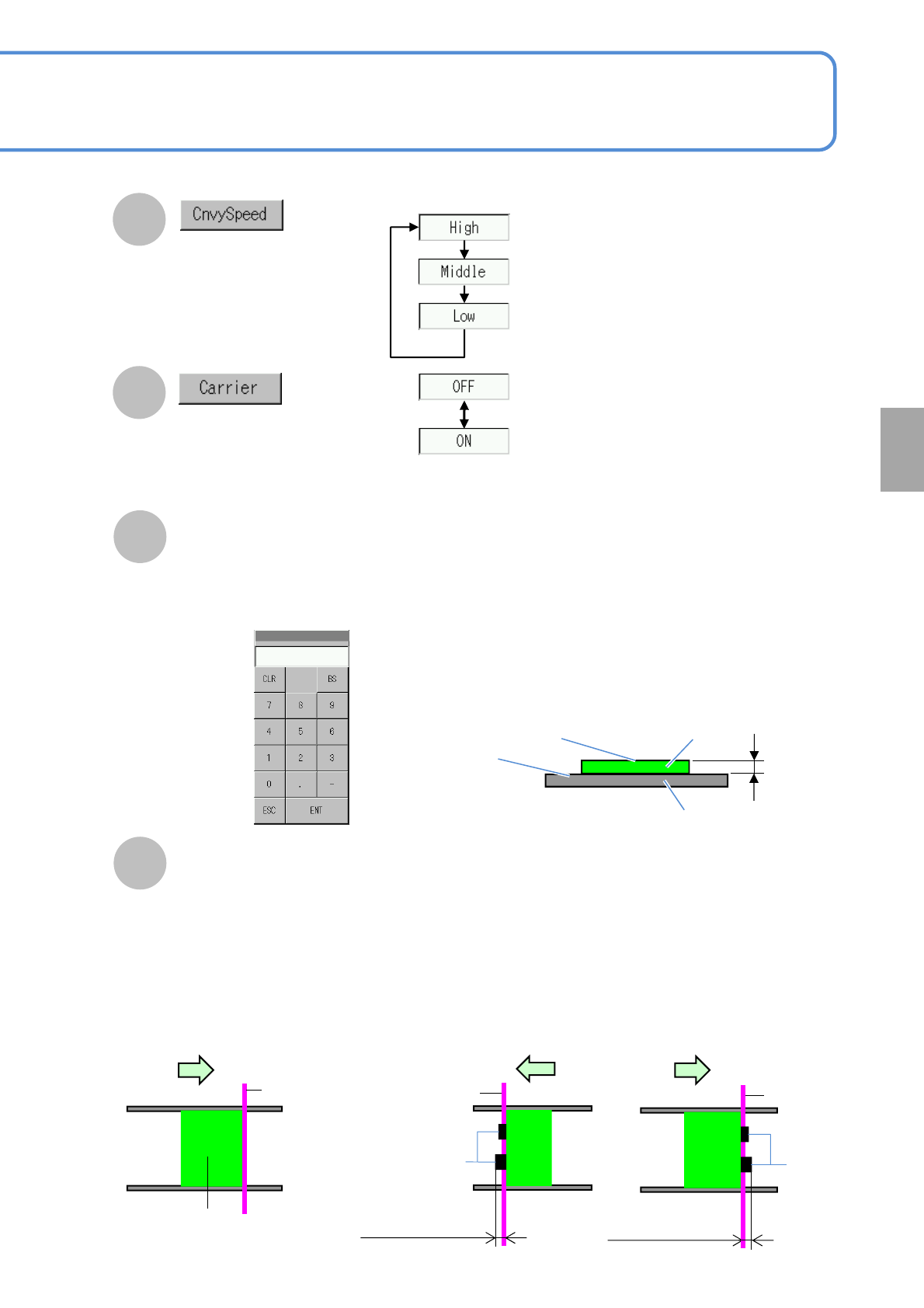
Choose whether to exist a carrier
PCB or not.
■Normal PCB positioning
■Placed component jutting out of PCB edges
PCB
Reference
Placed
components
Reference
Length of a placed
component jutting out (left)
G
Choose a PCB transfer
speed.
H
PCB flow direction
Placed
components
Reference
Length of a placed
component jutting out (Right)
PCB flow direction PCB flow direction
I
Touching the numerical part on the
screen opens the input window (See
below).
■When ’Yes’ selected
Height
●Enter the difference in height between a placement
surface and a clamp surface of the carrier PCB
when the carrier PCB is used. If the placement
surface is higher than the clamp surface, enter the
positive value, is it is lower, enter the negative
value.
Placement surface
Clamp surface
PCB
Carrier PCB
Height
●Height input (for positive value)
Setting
change
J
Jutting out Mount Length (Left, Right)
●If the placed component juts out from the PCB, the machine misjudges that the edge of the
placed component is the edge of the PCB, resulting in PCB recognition error.
So, entering the length of the jutting out placed component can carry out correct positioning.
●Enter max. length in cases where components already placed juts out of right or left PCB edges.
Input range : 0 to 9mm
NPM-TT2 EJM1EE-MB-04O-03
Data
editing
4-1-3-1
D
A
B
E
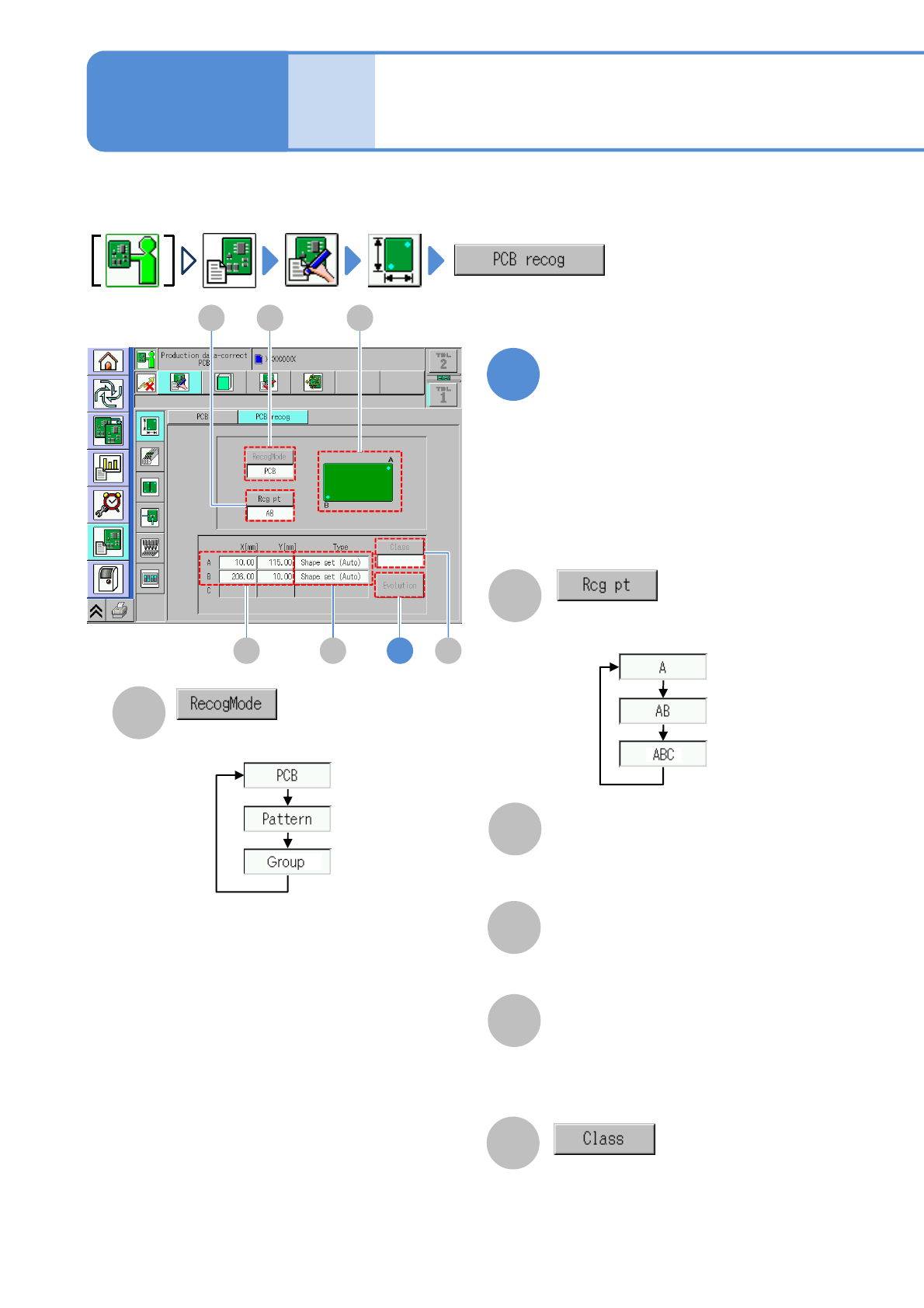
Choose a recognition mark.
X[mm], Y[mm]
D E
AB
If [Pattern] or [Group] is selected in the
recognition mode and there are several
types, choose the pattern number or
group number.
F
1
Edit the data of the desired
field on the screen
Choose a recognition mode.
●PCB: Recognizes the recognition mark
●Pattern: Recognizes the pattern mark
●Group: Recognizes the group mark
PCB recognition data
edit 1
Describes how to edit the PCB recognition data registered by DGS.
Enter the PCB recognition coordinates
(X,Y) of each recognition mark.
●Touching the screen opens the input
window.
F
Type
The recognition method for each
recognition mark. Pressing the [Type]
field causes the shape setting screen of
each recognition mark to appear .
C
C
Illustration of a recognition mark (A or B or
ABC).
Recognition position on a PCB
3
Operating procedure
4-1-3
If ‘Panel Fiducial before Pattern/Pattern
Group Fiducials’ of Software Switch in DGS
is set, you can select only [Pattern] or
[Group].