User Manual SIPLACE Linear Dipping Unit 2 X.pdf - 第23页
3 Function description and structure 3.2 Structure User Manual SIPLACE Linear Dipping Unit 2 X 05/2020 23 1. Flux tank for Auto Cavity dipping plate 3.2.3 Park plate and drip tray 1. Park plate 2. Drip tray The park plat…
3 Function description and structure
3.2 Structure
22 User Manual SIPLACE Linear Dipping Unit 2 X 05/2020
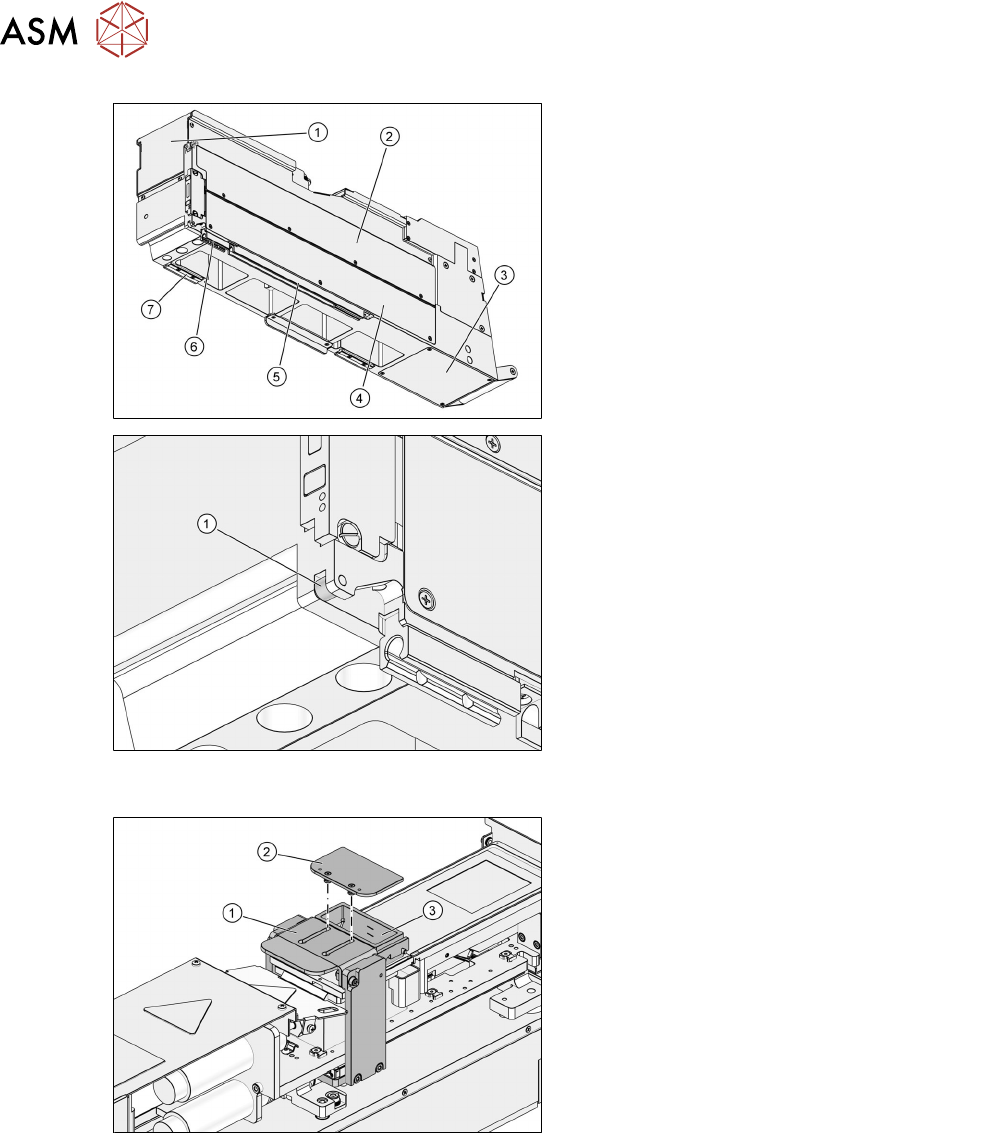
1. Front cover
2. Left side panel
3. Bottom cover
4. Cover of control board
5. Rear slide bar
6. Front slide bar
7. Support block
1. Locking roll
3.2.2 Squeegee
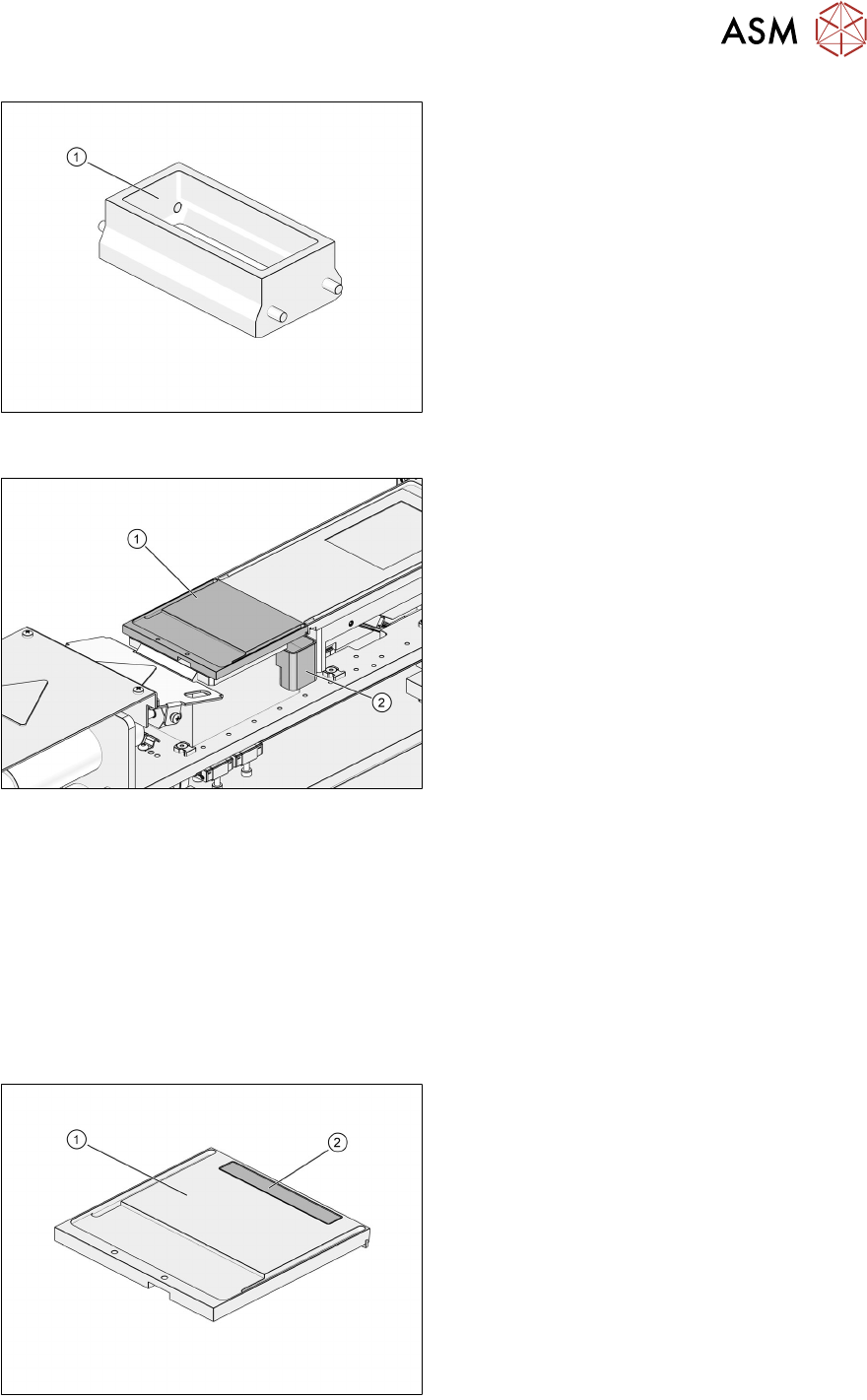
1. Downholder
2. Cover
3. Flux tank
The removable cover of the flux tank prevents anything from falling in the flux tank. The down-
holder holds the flux tank in the correct position. By pressing on the downholder the flux tank can
easily be removed.
These flux tanks are available for the LDU:
●
Standard tank [00117107-xx]
●
Small tank [00117108-xx]
Flux tank for LDU 2 X with Auto Cavity option
Using an Auto Cavity dipping plate requires a special flux tank [03154869-xx] which covers a larger
area on the dipping plate. This is important for catching any overflow of flux material if the cavity
plate moves up for application.
3 Function description and structure
3.2 Structure
User Manual SIPLACE Linear Dipping Unit 2 X 05/2020 23
1. Flux tank for Auto Cavity dipping plate
3.2.3 Park plate and drip tray
1. Park plate
2. Drip tray
The park plate is held in place by permanent magnets. The shape of the drip tray is asymmetric so
that it cannot be fitted wrongly. Two sensors on the base determine whether a park plate or a drip
tray is fitted.
3.2.4 Flux Level Sensor
During production, the amount of flux in the flux tank decreases. If the amount of flux is too low to
fill the cavity in the plate, components can no longer be coated with flux to the quality required. To
avoid this, the amount of flux in the flux tank can be monitored by the Flux Level Sensor.
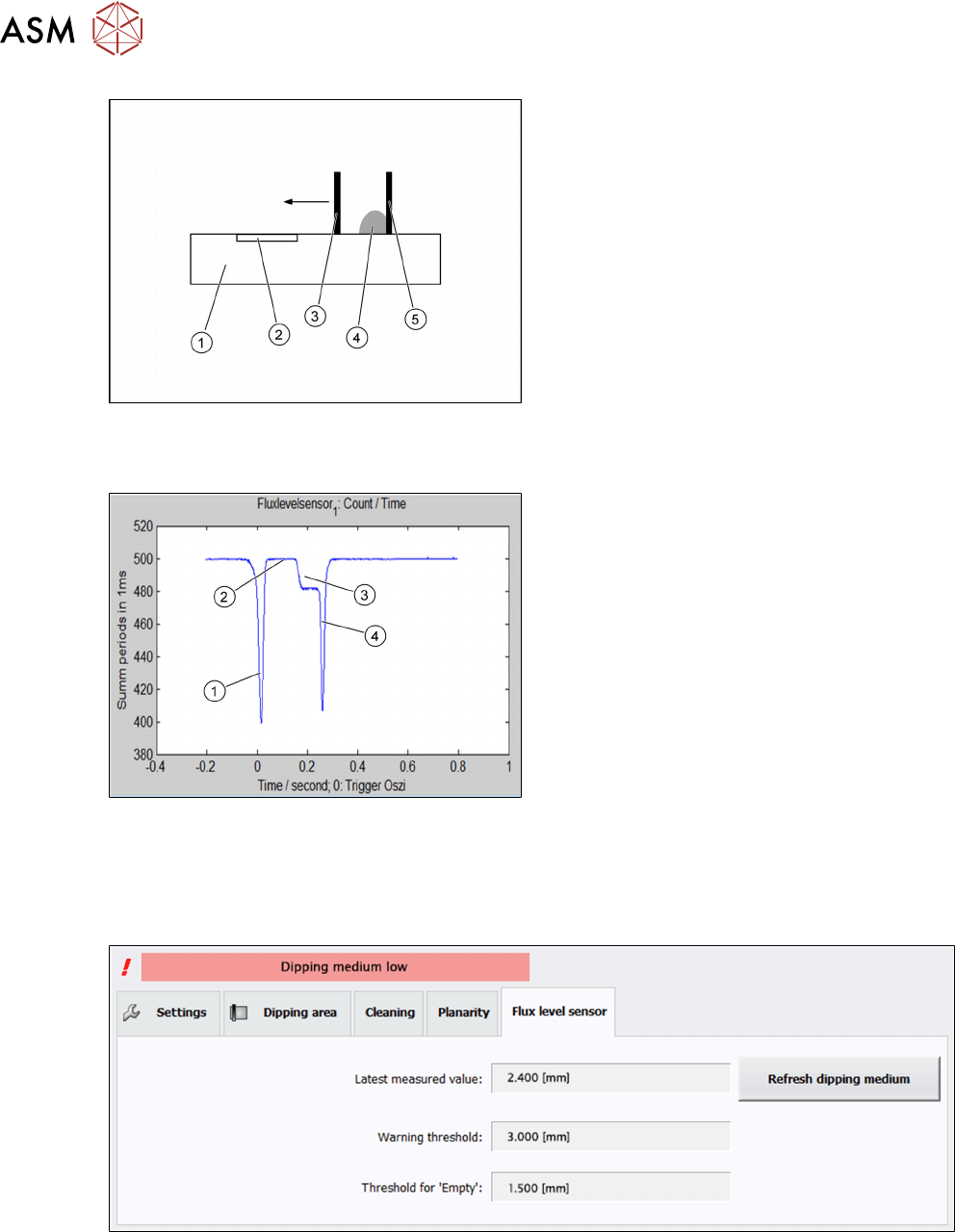
The Flux Level Sensor of the LDU 2 X is based on a capacitive structure, which generates an elec-
trical field. The capacitive structure is part of the top side layout of a PCB integrated in the park
plate.
1. Park plate
2. Flux Level Sensor
The capacitance of the Flux Level Sensor is affected by the permittivity of the flux or by any other
capacitive structure like the flux tank. When moving the flux tank, the flux forms a wave inside the
flux tank.
3 Function description and structure
3.2 Structure
24 User Manual SIPLACE Linear Dipping Unit 2 X 05/2020
1. Park plate
2. Flux Level Sensor
3. Front wall of the flux tank
4. Flux
5. Rear wall of the flux tank
When the flux tank crosses the Flux Level Sensor, the front wall of the flux tank is followed by a
gap, then by the flux, and at last by the rear wall of the flux tank. Each capacitive structure evokes
a characteristic signal at the flux level sensor.
Capacitance signals of:
1. Front wall of the flux tank
2. Gap between wall and flux
3. Wave of the flux
4. Rear wall of the flux tank
The width of the wave of the flux [in millimeters] is a measure for the amount of flux inside the tank.
Two thresholds can be assigned to every particular flux material: Warning level and error level.
Both values depend on the type of flux material and need to be determined empirically.
If the amount of flux falls below the Warning level, the station software displays a corresponding
status message: