CP-842E-842ME System Reference-SYS-CP842-10E.pdf - 第56页
Machine System >> Basic Operation 4-20 SYS-CP842-1.0E Procedure 1 At the [Main] screen press [Maintenance], t hen press [Configu ration] - [Stati sti- cal Nozzle Skip]. 2 At the [Statistical Nozzle Skip] settings s…

Machine System >> Basic Operation
SYS-CP842-1.0E 4-19
Skipping Nozzles Automatically (Statistical Processing)
The machine can be set to automatically skip nozzles which have a high rate of error.
Users can set a limit to the rate of errors (pick-up or inspection) caused by a particular
nozzle. If this limit is reached, the nozzle is skipped.
Nozzle statistical processing is based on a cumulative nozzle error count which is
cleared if the nozzle in question performs 16 consecutive successful pick and place
attempts. If the error limit is reached before the error count is cleared, that nozzle is
skipped.
Consider the following example where the error limit has been set to 4. Nozzle cycles
where a pick-up or inspection error occurred are marked with 5, nozzle cycles where
the part is successfully picked and placed are marked with 3.
In the case above, the nozzle in question is skipped when the fourth error occurs. The
machine can be set to automatically test the skipped nozzle again (Reject Nozzle
Check).
✓
✓
✕
✕
✓
✓
✓
✓
✓
✓
✓
✓
✓
✓
✓
✓
✓
✓
✓
✓
✓
✕
✓
✕
✓
✓
✓
✓
✕
✓
✓
✕
1
2
0
0
1
2
3
4
5
6
7
8
9
10
11
12
13
14
15
16
1
0
1
0
1
2
3
4
0
1
2
0
0
0
1
2
2
2
2
2
2
2
2
2
2
2
2
2
2
2
2
2
0
1
1
2
2
2
2
2
3
3
3
4
Part
Status
Successful
Attempt Count
Error
Attempt Count
16 consecutive successful
attempts clears the error count.
4 errors occur before the error
count is cleared, and the nozzle
is skipped.
C73OM024
Machine System >> Basic Operation
4-20
SYS-CP842-1.0E
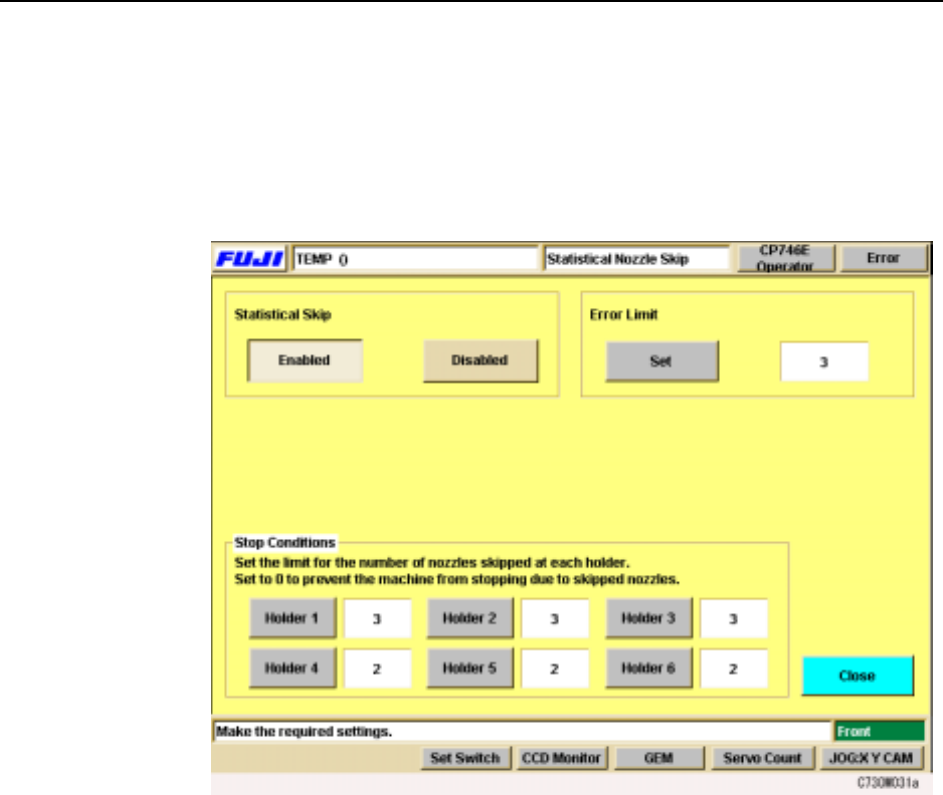
Procedure
1 At the [Main] screen press [Maintenance], then press [Configuration] - [Statisti-
cal Nozzle Skip].
2 At the [Statistical Nozzle Skip] settings screen, press [On] to enable the statisti-
cal monitoring of nozzles.
3 To change the error rate, press [Error Limit]. Input the error limit at the
numeric keypad.
4 At Stop, set a limit to the number of nozzles which can be skipped at each holder
before the machine stops. The machine will not stop if the limit is set to 0.
5 Press [Close] enter the settings and return to the [Configuration] screen.
Machine System >> Basic Operation
SYS-CP842-1.0E 4-21
4.1.6 Supply Unit Functions
Parts are supplied to the pick-up position from the two device pallets moving back and
forth on the D-axis at the rear of the CP-842E/842ME. This section describes func-
tions related to the supply of parts to the machine.
Loading and Unloading Device Pallets (CP-842ME Option)
The CP-842ME employ a pallet system for loading and unloading batches of feeders.
Each device pallet (device table) is loaded into the machine using the Pallet Change
Unit (PCU). The device table is moved to the production area for the supply of parts
for assembly. Commands at the machine are used to change a used device pallet with
a fresh one.
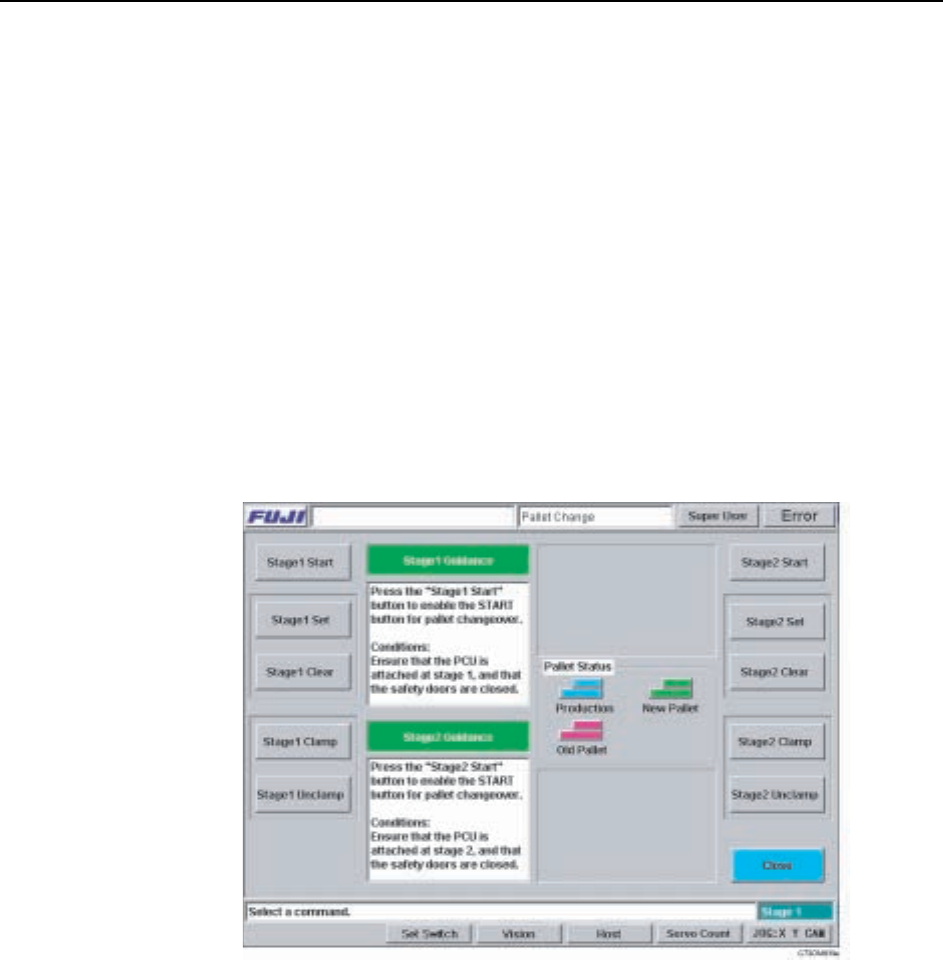
Procedure
1 At the [Main] screen, press [Change Pallet] to display the [Pallet Change]
screen.
2 Select the side of the machine to be changed ([Stage 1 Start] or [Stage 2 Start]).
The START button is enabled if the PCU is docked to receive the current device
table, and the safety cover on that side is closed. If one or both of these condi-
tions are not satisfied, the machine displays a message telling the operator
what action is necessary.
3 Press the START button to execute the changeover. The guidance area for that
device pallet describes the current operation. When the pallet is unclamped,
open the safety door and exchange device pallets using the PCU.
Note: Do not press [Close] at this screen until the changeover is complete.
4 Close the safety cover when the new device pallet is in the machine. The
machine automatically clamps the new device pallet and requests the operator
to press [Stage 1 Set] ([Stage 2 set]) to complete the operation. When [Stage 1
Set] ([Stage 2 Set]) is pressed, the device pallet is ready to be used in production.
To clear the ‘Set’ status of the pallet, press [Stage 1 Clear] ([Stage 2 Clear]).