03217917-01-01E By DEK Technical Reference Manual Vol 1_enPDFA.pdf - 第266页
17 CAMERA SYSTEM MODULE 17.3 ADJUSTMENTS AND SETTINGS 266 TECHNICAL REFERENCE MANUAL Vol 1 E By DEK 04/2019 17.3 ADJUSTMENTS AND SETTINGS 17.3.1 X Camera Home Positioning The position of the sensor and vane is fixed, the…
17 CAMERA SYSTEM MODULE
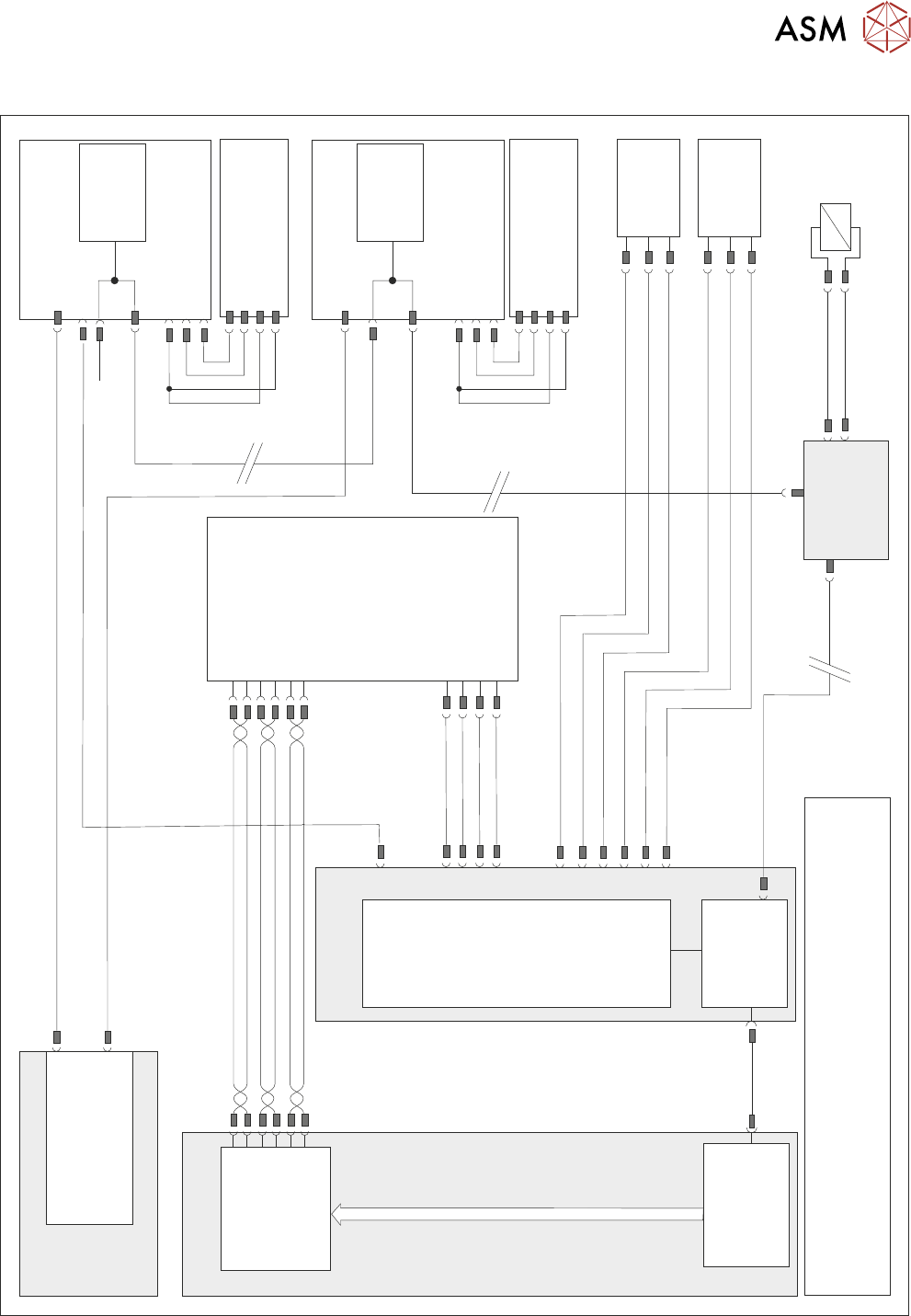
17.2 ELECTRICAL SCHEMATIC
TECHNICAL REFERENCE MANUAL Vol 1 E By DEK 04/2019 265
17.2 ELECTRICAL SCHEMATIC
M37 Power Supply Module
Power Distribution
PCB
CAN Terminator
N8SK2
Camera X Motor
Node 8
M37PL18
Servo DC Supply & 24V US (Motor Logic)
N8PL1
N8PL4
DIG IN 2
DIG IN 2
0V
0V
Signal
Signal
24V
24V
(L)
(L)
Camera X
Home 10SE01
Fork Opto
CAN
Encoder/
Decoder
N8SK3
CAN In
Camera Y Motor
Node 9
N9PL1
N9PL4
Camera Y
Home 10SE02
Fork Opto
CAN
Encoder/
Decoder
N9SK3
CAN In
CAN Out
M37PL19
PC
P
C
I
B
u
s
Motherboard
USB
Servo DC Supply & 24V US (Motor Logic)
N9SK2
M36 Machine
Control Enclosure
NextMove
Interface
NextMove ES
(I/O Node 1)
M36PL35
CAN Bus
Main Machine
I/O Node 2
N2SK2
CAN In
16SK14
16SOL14
Board
Stop
DIG OUT 10
N2PL4
0V
CAN
Out
N2SK3
Board Stop
Extended
10SE20
Board At
Stop
10SE07
10SK24
M36PL11
0V
+12V
DIG IN 8
+12V
0V
DIG IN 9
NOTE
The breaks in the CAN Bus chain reflect that additional I/O Nodes
may be fitted, refer to Machine Control chapter for the complete
CAN Bus chain.
Power
3PL55
GND
TP B-
TP B+
TP A-
TP A+
Digital
Camera
10PL17
10SK13
PCI Interface
Card
M36PL16
M36PL5
Trigger
0V
+24V US
0V

17 CAMERA SYSTEM MODULE
17.3 ADJUSTMENTS AND SETTINGS
266 TECHNICAL REFERENCE MANUAL Vol 1 E By DEK 04/2019
17.3 ADJUSTMENTS AND SETTINGS
17.3.1 X Camera Home Positioning
The position of the sensor and vane is fixed, therefore no adjustment is possible.
17.3.2 Y Camera Home Positioning
The position of the sensor and vane is fixed, therefore no adjustment is possible.
17.3.3 X Axis Parallelism
WARNING
BOARD CLAMPS. EXTREME CARE MUST BE EXERCISED WHEN WORKING IN
THE TOOLING AREA OF THE MACHINE TO AVOID INJURY. THE FOILS ON THE
FRONT AND REAR BOARD CLAMPS ARE VERY SHARP.
NOTE
The X axis parallelism is factory set and shouldn’t normally need to be adjusted.
► Select Open Cover Commands.
► Select Carriage To Rear.
► Select Unload Screen.
► Open the printhead cover.
► Remove the stencil from the machine.
► Close the printhead cover.
► Press the System button.
► Select Back.
► Select Maintenance.
► Select Diagnostics.
► Using the Next or Previous button highlight Rail System.
► Select Select Module.
► Ensure that Home Rail Width is highlighted.
► Select Run Diagnost.
► Select Exit.
► Using the Next or Previous button highlight Rising Table.
► Select Select Module.
► Using the Next or Previous button highlight Raise Table to Vision Height.
► Select Run Diagnost.
► Select Exit.
► Using the Next or Previous button highlight Rail System.
► Select Select Module. The board clamps are released.
► Open the printhead cover.
► Remove any tooling from the manual tooling plate.
► Remove the board clamp from the front transport rail, see 16.5.1 "Board Clamp Replace-
ment" [}253].
17 CAMERA SYSTEM MODULE
17.3 ADJUSTMENTS AND SETTINGS
TECHNICAL REFERENCE MANUAL Vol 1 E By DEK 04/2019 267
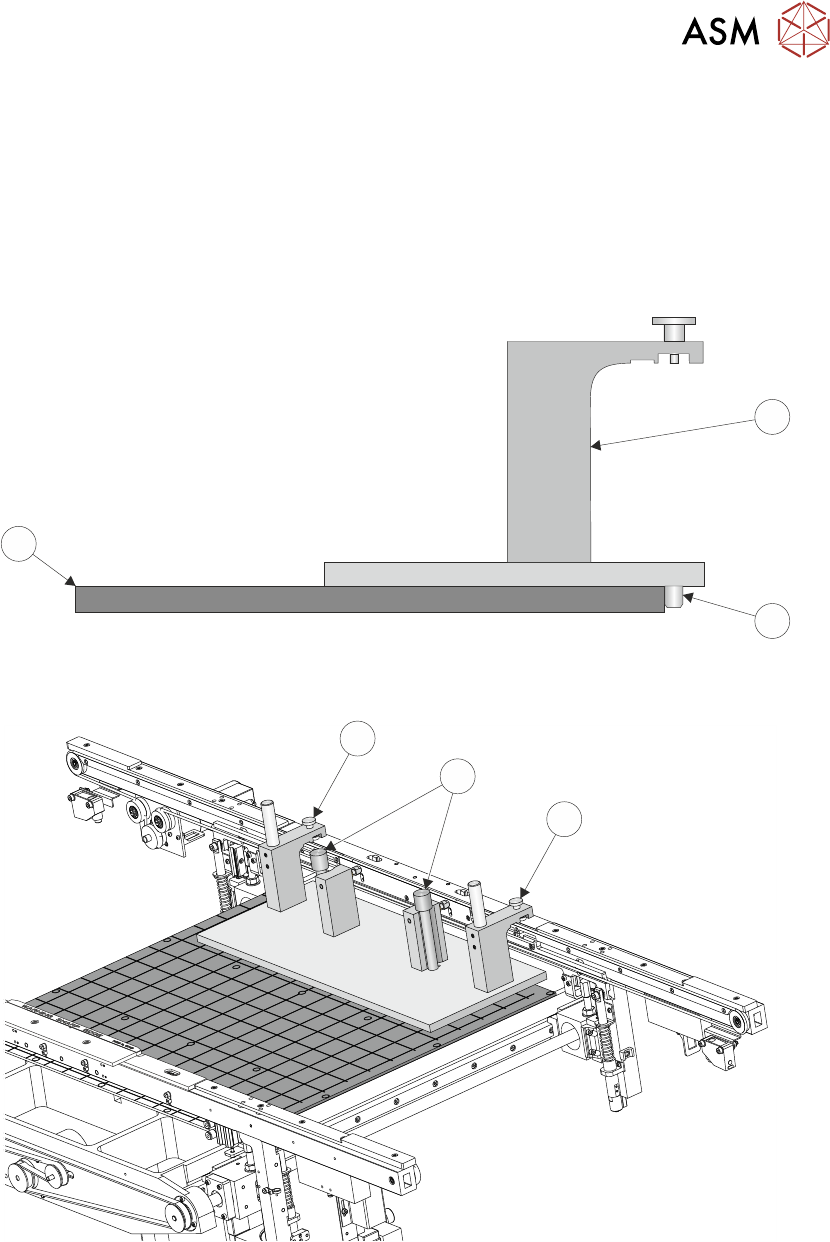
► There are two versions of the rail setting jig (Part No. 191156) and they are labelled:
●
Standard Rails (round belts)
●
Heavy Board Rails (flat belts)
► Confirm which type of rails are fitted to the machine and select the appropriate rail setting jig.
► Place the jig (1) on the manual tooling plate (3) ensuring that the location pins (2) on the un-
derside of the jig (1) are located in the holes on the manual tooling plate (3). Check there is no
gap using a 0.05mm feeler gauge.
3
1
2
► Secure the jig (1) to the front rail using the two jig to rail thumbscrews (4).
4
5
4
► Secure the jig (1) to the rising table using the two jig to table thumbscrews (5).
► Check that the location pins (2) are up against the front edge of the manual tooling plate (3)
using a 0.05mm feeler gauge.