6_PO-CON1602E.pdf - 第6页
© Shimadzu Corporation, 2016 First Ed i ti o n: March , 20 16 For Research Use Only. Not for use in diagnostic procedure. Not available in the USA, Canada, and China. This publication may contain references to products t…
4
High throughput analysis for novel oral anticoagulants using
LC-MS/MS system Integrated with automated sample preparation
Result and discussion
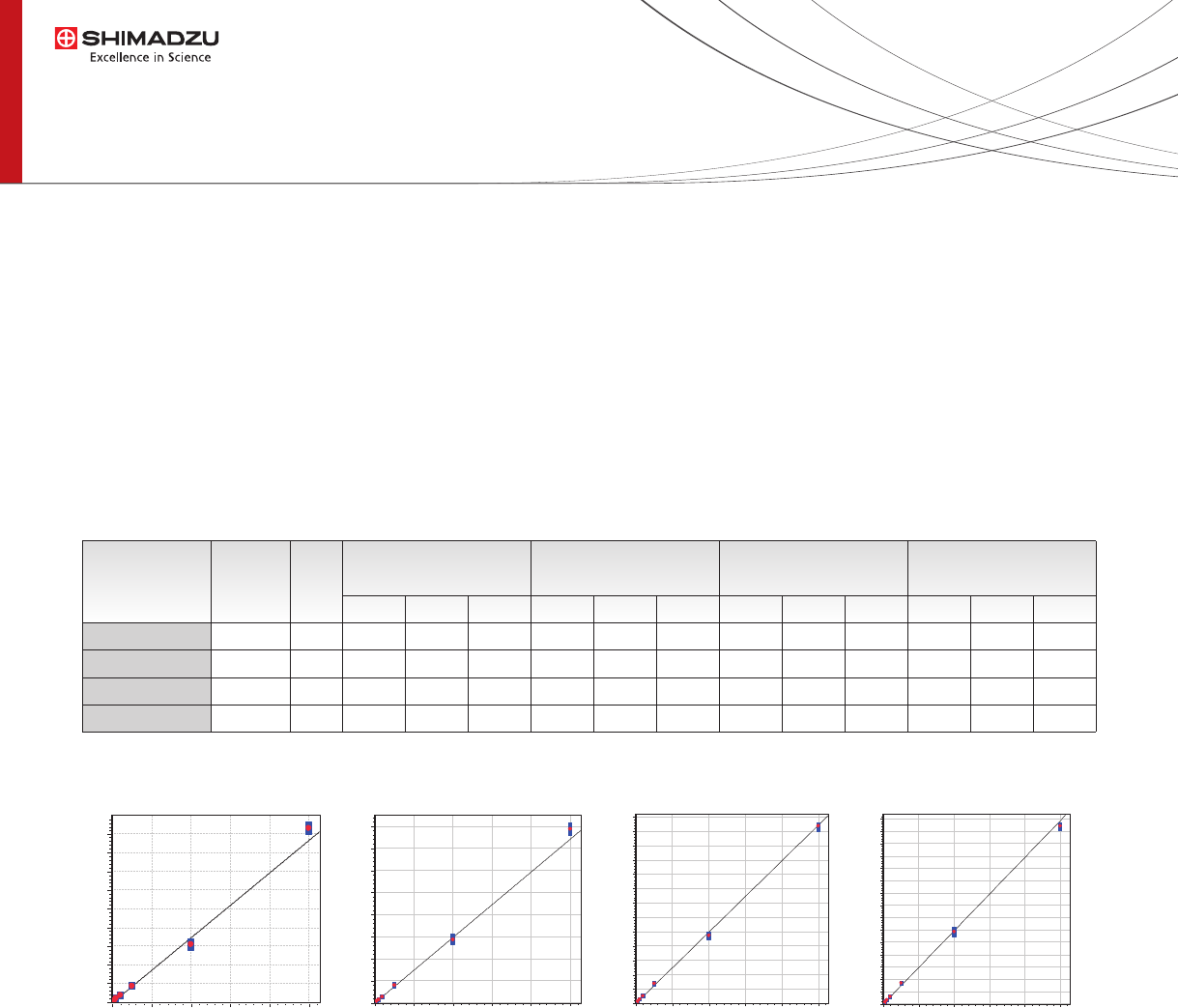
Each of the compounds were calibrated within the range
from 5ng/mL to 500ng/mL by the six calibration points
(5, 10, 20, 50, 200, 500ng/mL). Table 2 illustrates
linearity, accuracy and reproducibility of all compounds.
The calibration curves showed good linearity (R
2
>0.992).
The reproducibility (N=6) at six concentrations, including
LLOQ, of each compounds was excellent (CV<10%).
Different day reproducibility (N=6) for 5 days at three
concentrations (5, 50, 500ng/mL) as well (CV<15%).
Linearity, accuracy and reproducibility
Fig.3 Calibration curves for each compound
Table.2 Analytical performance
50
50
50
50
5
5
5
5
500
500
500
500
0.992
0.993
0.996
0.994
Concentrations of QC
samples (ng/mL)
LLOQ ULOQMiddle
4.95
5.84
2.92
2.19
9.16
4.65
2.52
0.85
1.53
2.21
1.26
1.05
% RSD (n=6)
LLOQ ULOQMiddle
10.44
7.20
5.49
5.54
13.74
12.30
8.64
7.28
14.23
6.20
5.61
6.22
% RSD (n=6)
LLOQ ULOQMiddle
r
2
Apixaban
Rivaroxaban
Edoxaban
Dabigatran
Compound
5 - 500
5 - 500
5 - 500
5 - 500
Range
(ng/mL)
99.1
107.8
109.1
111.4
95.7
104.8
100.0
101.7
107.1
106.0
99.2
96.9
Accuracy (%)
LLOQ ULOQMiddle
0 100 200 300 400
0
10000
20000
30000
40000
50000
60000
70000
80000
90000
2
3
4
5
6
7
0 100 200 300 400
0
25000
50000
75000
100000
125000
150000
175000
200000
2
3
4
5
6
7
Apixaban Rivaroxaban
0 100 200 300 400
0
50000
100000
150000
200000
250000
300000
350000
400000
450000
500000
550000
600000
650000
700000
750000
2
3
4
5
6
7
0 100 200 300 400
0
50000
100000
150000
200000
250000
300000
350000
400000
450000
500000
550000
600000
650000
2
3
4
5
6
7
Dabigatran
Edoxaban
Area
Concentration
Area
Concentration Concentration
Area
Area
Concentration
5
High throughput analysis for novel oral anticoagulants using
LC-MS/MS system Integrated with automated sample preparation
Apixaban
Table 4 The difference of the automated operation against the manual operation
93.7
140.5
196.6
306.5
234.1
207.7
106.4
Manual
(ng/mL)
109.4
145.3
201.4
353.7
261.3
183.8
123.9
CLAM
(ng/mL)
Difference
(%)
14.4
3.3
2.4
13.3
10.4
-13.0
14.1
1
2
3
4
5
6
7
ID
Edoxaban
186.7
337.9
35.5
108.9
26.5
Manual
(ng/mL)
169.6
319.1
38.6
102.0
29.8
CLAM
(ng/mL)
Difference
(%)
-10.1
-5.9
8.0
-6.9
11.2
1
2
3
4
5
ID
Dabigatran
20.6
51.5
19.8
136.4
Manual
(ng/mL)
21.8
56.9
22.4
159.5
CLAM
(ng/mL)
Difference
(%)
5.6
9.6
11.4
14.5
1
2
3
4
ID
Rivaroxaban
21.1
21.9
117.8
32.7
154.8
Manual
(ng/mL)
20.5
19.7
114.1
32.5
161.6
CLAM
(ng/mL)
Difference
(%)
-2.7
-10.1
-3.2
-0.5
4.5
1
2
3
4
5
ID
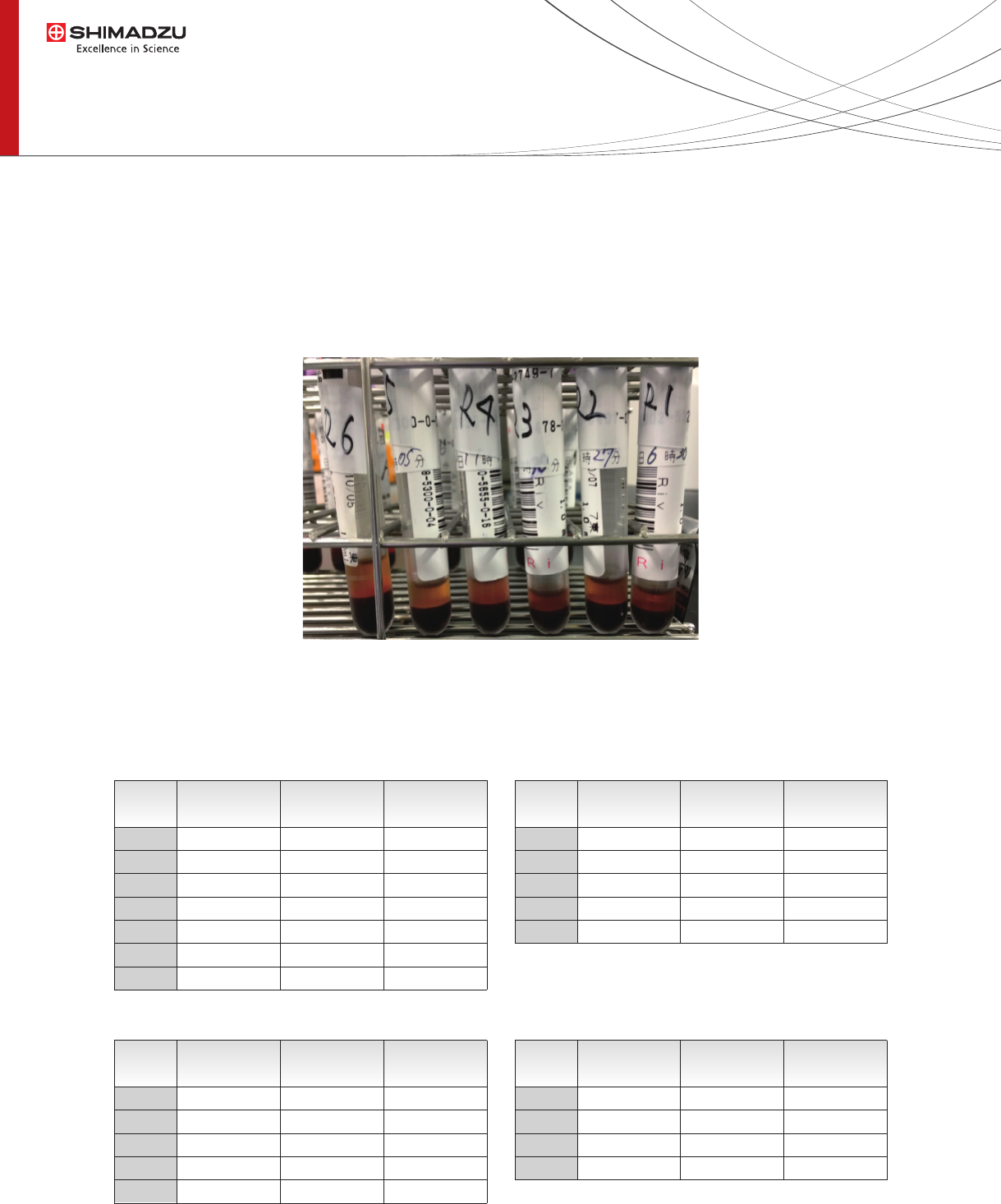
Comparison of concentration between manual sample preparation and automated sample preparation using plasma
from patients who are treated with NOACs shows good agreement. The difference of the automated operation against
the manual operation was between -15% and 15%
Comparison of concentration between manual sample preparation and
automated sample preparation
Fig.4 Plasma sample from subjects
© Shimadzu Corporation, 2016
First Edition: March, 2016
For Research Use Only. Not for use in diagnostic procedure. Not available in the USA, Canada, and China.
This publication may contain references to products that are not available in your country. Please contact us to check the availability of these
products in your country.
The content of this publication shall not be reproduced, altered or sold for any commercial purpose without the written approval of Shimadzu.
Company names, product/service names and logos used in this publication are trademarks and trade names of Shimadzu Corporation or its
afliates, whether or not they are used with trademark symbol “TM” or “®”. Third-party trademarks and trade names may be used in this
publication to refer to either the entities or their products/services. Shimadzu disclaims any proprietary interest in trademarks and trade names
other than its own.
The information contained herein is provided to you "as is" without warranty of any kind including without limitation warranties as to its
accuracy or completeness. Shimadzu does not assume any responsibility or liability for any damage, whether direct or indirect, relating to the
use of this publication. This publication is based upon the information available to Shimadzu on or before the date of publication, and subject
to change without notice.
www.shimadzu.com/an/
High throughput analysis for novel oral anticoagulants using
LC-MS/MS system Integrated with automated sample preparation
Conclusion
Table 6 Comparison of STAT sample result
30 min
Manual CLAM
12 minSTAT sample result
Table 5 Comparison of work time
60 min
Manual CLAM
10 min
Work Time
(ex.) Six calibration, ten patient samples and a STAT sample
In the routine work observation, we found that the work time of the technician for six calibration, ten patient samples
and the addition of a STAT sample was reduced from 60 minutes to 10 minutes by the automated system.
We also obtained a STAT sample result within twelve minutes after setting the sample into the system.
• NOACs analysis was successfully performed using a LC-MS/MS coupled to an automated sample preparation
system. The results show the capability of the system for large sample set analyses with improved accuracy and
precision.
• The system has the additional benets of exible conguration and programming, including incorporation of STAT
samples, as well as the elimination of human error associated with manual sample handling.
• CLAM-2000 sample preparation proved to be 6 x more efcient based on analyst work time for every day samples
and almost 3 x more efcient for STAT samples.
Disclaimer: Shimadzu LCMS-8040 CL is registered in the U.S. as a Class I device and is not specically cleared for epilepsy, anxiety, anticoagulation, or any other clinical applications.
CLAM-2000 is not registered as a Class I device, and it is available for Research Use Only (RUO). Not for use in diagnostic procedures.