00197961-01_UM_JTF-MW_on_SIPLACE_E_en_FINAL - 第20页
Operational Safety ESD Guidelines 2.3.5 Dispatching ESD Modules 20 User Manual JTF-MW on SIPLACE E
Operational Safety
2.3.2 Important Measures to Protect Against Static Charging ESD Guidelines
User Manual JTF-MW on SIPLACE E 19
2.3.2
2.3.2 Important Measures to Protect Against Static Charging
Important Measures to Protect Against Static Charging
► Most plastics can easily become charged and must therefore be kept away from at-risk components.
► Always ensure that people, the workplace and packaging are safely earthed when handling electro-
static sensitive components.
2.3.3
2.3.3 Handling ESD Modules
Handling ESD Modules
Do not touch electronic modules unless it is absolutely essential to do so in order to carry out other work.
If it is necessary, make sure that you do not touch the pins or printed conductors when you pick up flat
modules.
Do not touch components unless
▪ You are constantly earthed by an ESD wrist strap or
▪ You are wearing ESD shoes or ESD shoe earthing strips on an ESD floor.
Always discharge yourself before you touch an electronic module. To do this, simply touch a conductive
and earthed object immediately before you touch the module (such as unpainted parts of a switch cab-
inet, a water pipe, etc.).
Do not allow modules with chargeable and highly insulating materials to touch one another, e.g. plastic
films, insulating table surfaces or items of clothing made from synthetic fibers.
Always place the modules on a conductive surface (table with an ESD coating, conductive ESD foam,
ESD bag or container).
Do not bring modules near visual display units, monitors or televisions. Keep them at least 10 cm away
from the screen.
2.3.4
2.3.4 Measurements and Modifications to ESD Modules
Measurements and Modifications to ESD Modules
Measurements of the assemblies may only be taken if
▪ The measuring device has been grounded (e.g. via protective conductor) or
▪ The measuring head of the potential-free measuring device has been briefly discharged before
measurement (e.g. touching blank metal control unit housing).
► Always use an earthed soldering iron if you carry out any soldering work.
2.3.5
2.3.5 Dispatching ESD Modules
Dispatching ESD Modules
► Always store modules and components in conductive packaging (e.g. metallized plastic bags or met-
al sleeves) and dispatch them in conductive packaging.
► If the packaging is not conductive, place the modules in a conductive envelope before packaging.
Use conductive foam rubber, ESD bags, domestic aluminum foil or paper, for example. NEVER use
plastic bags or film.
► If the module has integral batteries, ensure that the conductive packaging does not touch or short-
circuit the battery terminals and, if necessary, first cover the terminals with insulating tape or mate-
rial.
Operational Safety
ESD Guidelines 2.3.5 Dispatching ESD Modules
20 User Manual JTF-MW on SIPLACE E
Technical Data of the SIPLACE JTF-MW
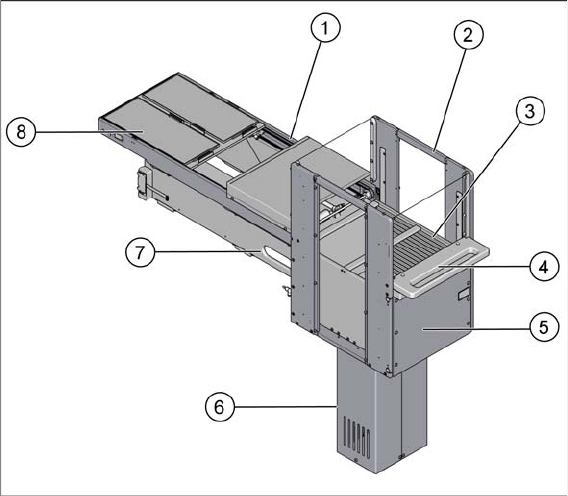
Overview the SIPLACE JTF-MW Feeder
User Manual JTF-MW on SIPLACE E 21
3
3 Technical Data of the SIPLACE JTF-MW
Technical Data of the SIPLACE JTF-MW
The following sections describe the general features of the SIPLACE JTF-MW as well as the technical
data.
3.1
3.1 Overview the SIPLACE JTF-MW Feeder
Overview the SIPLACE JTF-MW Feeder
Individual parts of the SIPLACE JTF-MW feeder
1. Conveyor
2. Lifting tower
3. Magazine
4. Feeder kicker
5. Access door
6. Lifting e-actuator
7. Adapter mounter
8. Tray carrier for 2 JEDEC trays