M3plus_OperationManual_e.pdf - 第76页
3 - 11 3 Creating the PCB data 3. Creating the PCB information 3.3 Offset parameters Selecting the [Offset] tab opens the screen for setting the offset data for each block relative to the reference block of a multi-block…
3 -10
3
Creating the PCB data
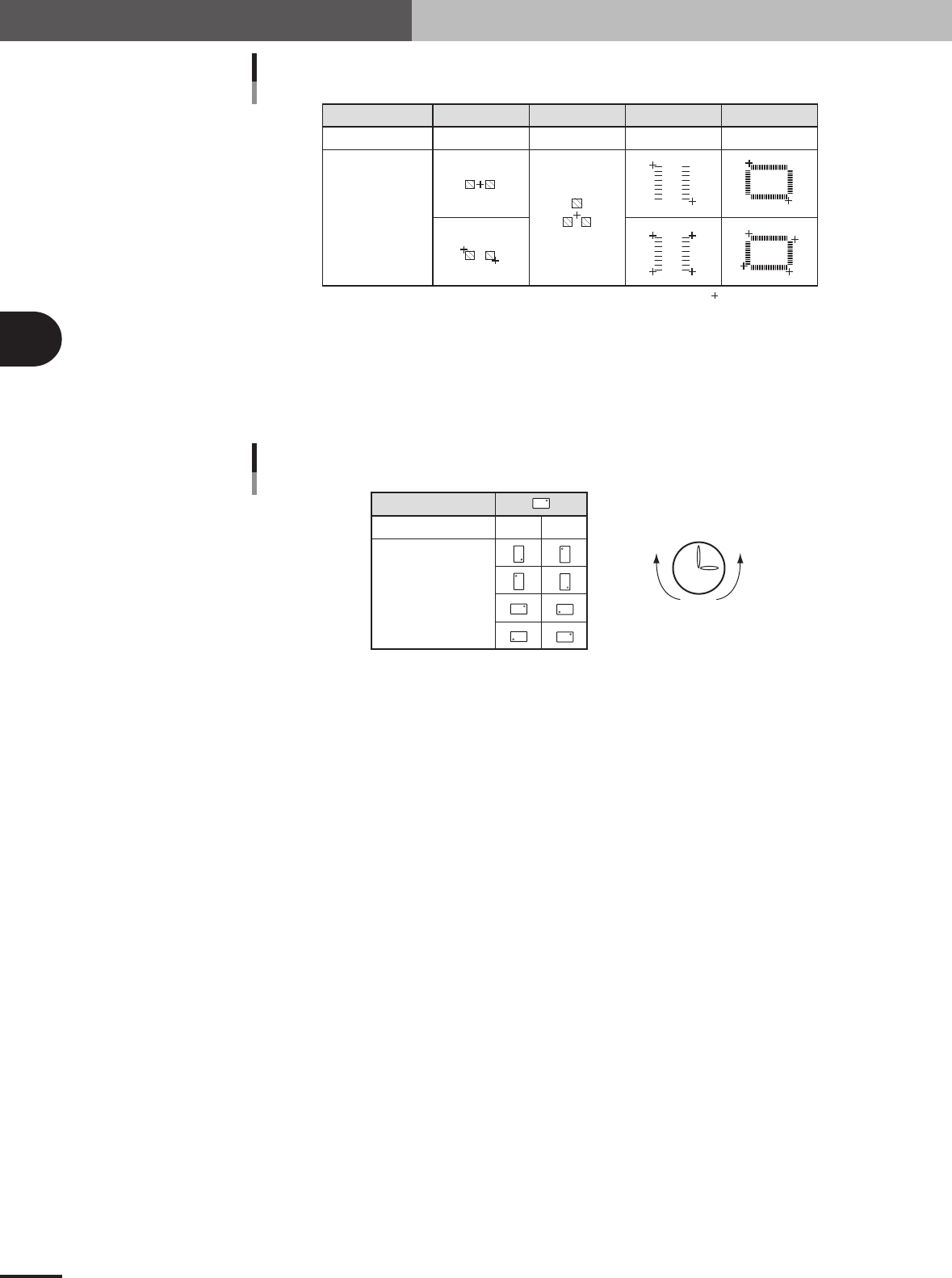
3. Creating the PCB information
Component type
Teaching method
Teaching point
Teaching method for different components
CHIP
1 or 2-point input
Tr.
1 or 3-point input
SOP
2 or 4-point input
QFP
2 or 4-point input
:
Teaching point
25401-5E-20
5 R
Enter the angle through which the component must be rotated after recognition before it is mounted
on the PCB. When the pickup angle is 0 deg., enter the rotating angle from the loading position, with
the counterclockwise direction specified as a plus value when viewed from above. When the pickup
angle is 90 deg. or -90 deg., see the table below.
Loading position
Pickup angle 90° -90°
Mounting angle 0°
180°
90°
-90°
Clock
PlusMinus
Mounting angle
23405-5E-20
6 P. No., Part Name
Enter the component number (data No. in the component information) to be mounted. The component
name will be input automatically according to the component number.
7 Head
Enter the head number to be used for mounting.
8 Bad (badmark)
Enter the number of the local badmark to be used for this mount data. Note that this setting is valid
only when necessary data is input on the Badmark tab screen. Enter "0" here when not using the local
badmark function.
9 Fid. (Fiducial mark)
Enter the fiducial mark number (point, local or 4-point fiducial) to be used for this mount data. Note
that this setting is valid only when necessary data is input on the Fiducial tab screen. Enter "0" here
when not using the fiducial function.
10 [Edit] button
Press this button when changing the "Execute/Skip" setting for component mounting. Selecting
"Skip" performs "pass operation" on the entire PCB without picking up and mounting components.
11 [Check Box] button
Pressing this button allows the Skip column to be edited. Pressing the [Check Box] button again
grays out the Skip column and making changes is no longer possible.
3 -11
3
Creating the PCB data
3. Creating the PCB information
3.3 Offset parameters
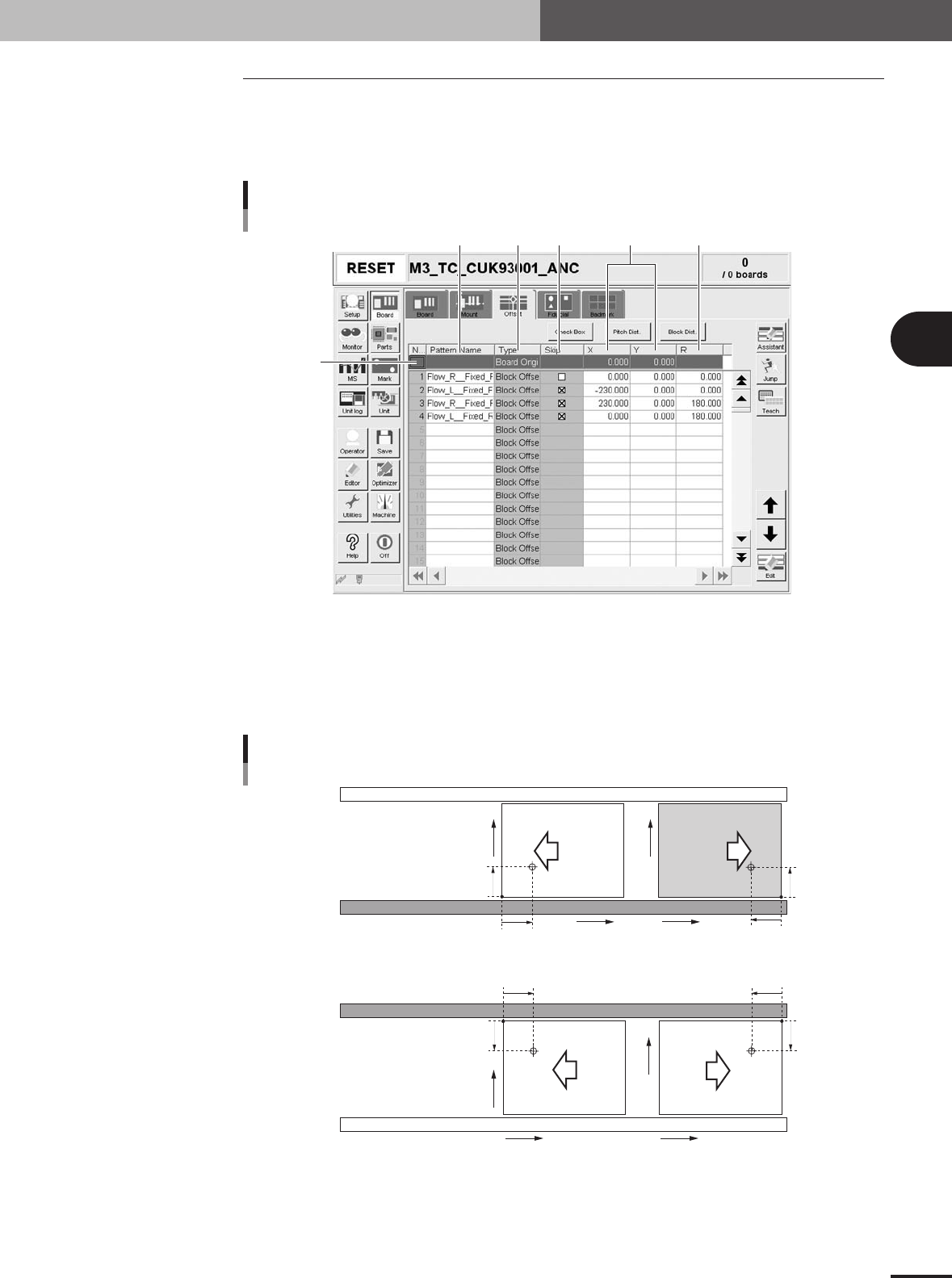
Selecting the [Offset] tab opens the screen for setting the offset data for each block
relative to the reference block of a multi-block PCB consisting of two or more indepen-
dent printed circuits of the same type. The XY coordinates of the PCB origin are also
specified here.
2
1
3 4 5 6
Offset parameter screen
27408-5E-20
1 Board Origin
On the top line of the parameter list, enter the XY coordinates of the PCB origin. For standard
machines with the front conveyor rail fixed, the center of the fixed locate pin is specified as X=0.00,
Y=0.00, which is 5mm (X and Y) away from the forward corner of the PCB on the front conveyor
rail side. The PCB origin is normally set to the same position as the center of the fixed locate pin.
PCB origin
5mm
5mm
X
Y
5mm
5mm
5mm
5mm
5mm
5mm
X
Y
X
Y
X
Y
Front conveyor rail fixed
Rear conveyor rail fixed
Direction of PCB flow
23406-5E-20
3 -12
3
Creating the PCB data
3. Creating the PCB information
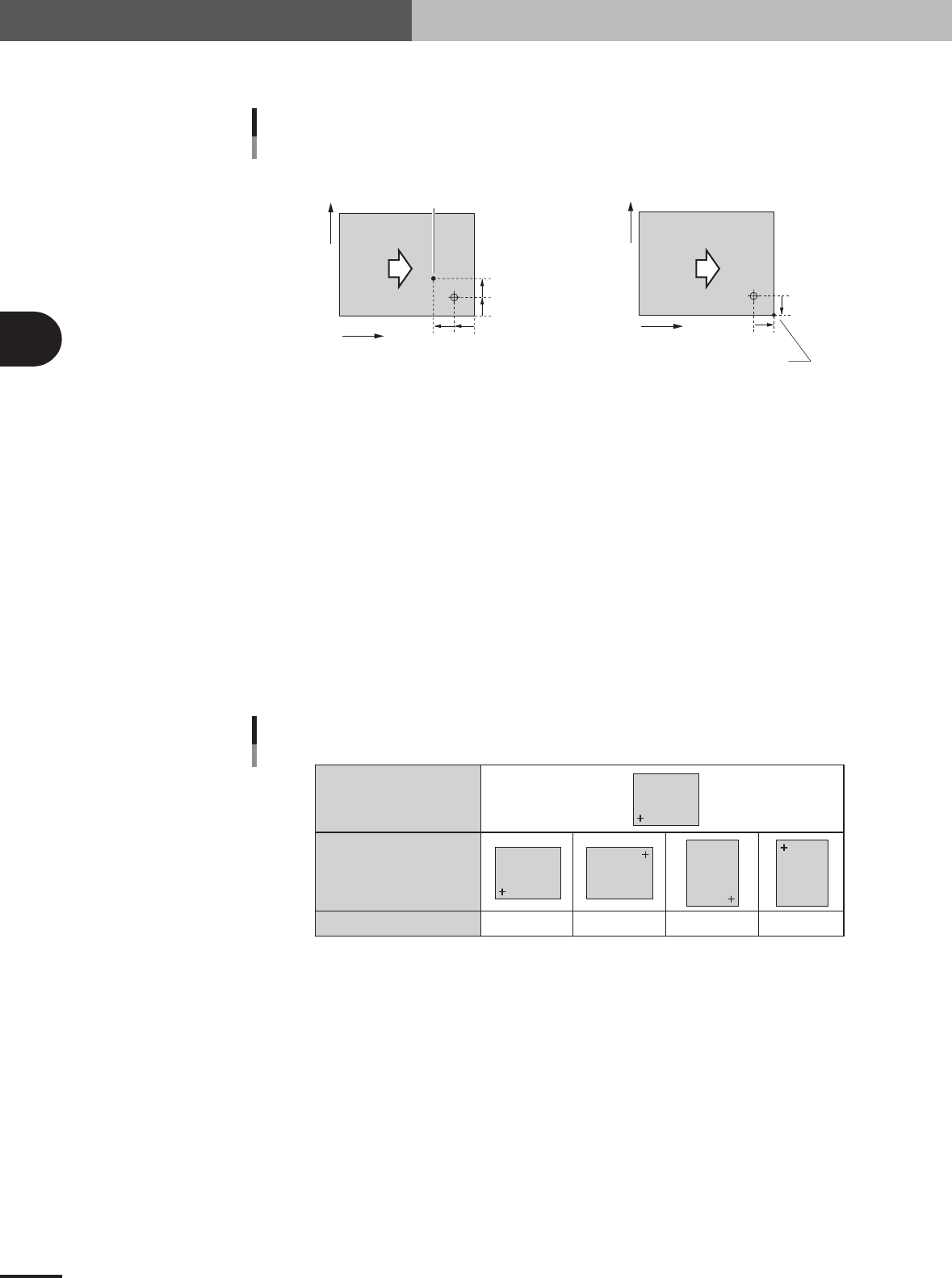
When setting the PCB origin at a position other than the locate pin as shown below, enter
the XY coordinates relative to the locate pin position.
Setting PCB origin at a position other than locate pin
When setting the PCB origin at
the corner of a PCB, enter
"X=5.00" and Y=-5.00.
5mm
5mm
X
Y
5mm
5mm
5mm
5mm
X
Y
Direction of PCB flow
When setting the PCB origin
at this point, enter "X=5.00" and Y=5.00.
• PCB origin ≠ Locate pin position • PCB origin = PCB corner
Direction of PCB
flow
23407-5E-20
2 Pattern Name
Enter the block name.
3 Type
The PCB origin is specified on the top line, and block offset data on the second and subsequent lines.
4 Skip
Place a checkmark when not mounting components in this block.
5 XY
Enter the XY coordinates of the origin in each block relative to the PCB origin. You can use the
[Teach] button to enter the XY data or trace the specified data.
6 R
Enter the rotation angle of each block with respect to the reference block. You can use the [Teach]
button to enter the R data or trace the specified data.
Reference block direction
Block direction
R data
R data
0° 180° 90° -90°
Block
Block
Block
Block
Block
25402-5E-20