ASM-SX-V3-设备性能参数-DMS - 第19页
19 Board conveyor Single and dual conveyor Single conveyor When using a single con- veyor, boards are moved behind one ano ther, along a conveyor lane and into the placement machine, wh ere they are placed. This con- vey…

18
Placement heads
Nozzle changer
Technical data
PLEASE NOTE: When you use the Smart Pin Support option, the maximum number of nozzle
changer magazines is reduced.
Nozzle changer for the SIPLACE SpeedStar
Number of magazines 4
a
a) All magazines in the nozzle changer must be configured.
Number of nozzle garages 80
Standard configuration 4 magazines with 80 nozzle garages
Nozzle types 60xx
Nozzle changer for the SIPLACE MultiStar
Number of magazines 4
a
Number of nozzle garages 69
Standard configuration 3 magazines with 60 x 20xx nozzle garages
1 magazine with 9 x 28xx nozzle garages
Nozzle types 20xx, 28xx
Nozzle changer for the SIPLACE TwinStar
Number of magazines Max. 8 magazines for max. 16 nozzle garages
Number of nozzle garages may be freely configured
Standard configuration 3 magazines with two nozzle garages each
1 magazine with one nozzle garage
Nozzle types 5xx (standard)
9xx with adapter
Special nozzle, gripper
19
Board conveyor
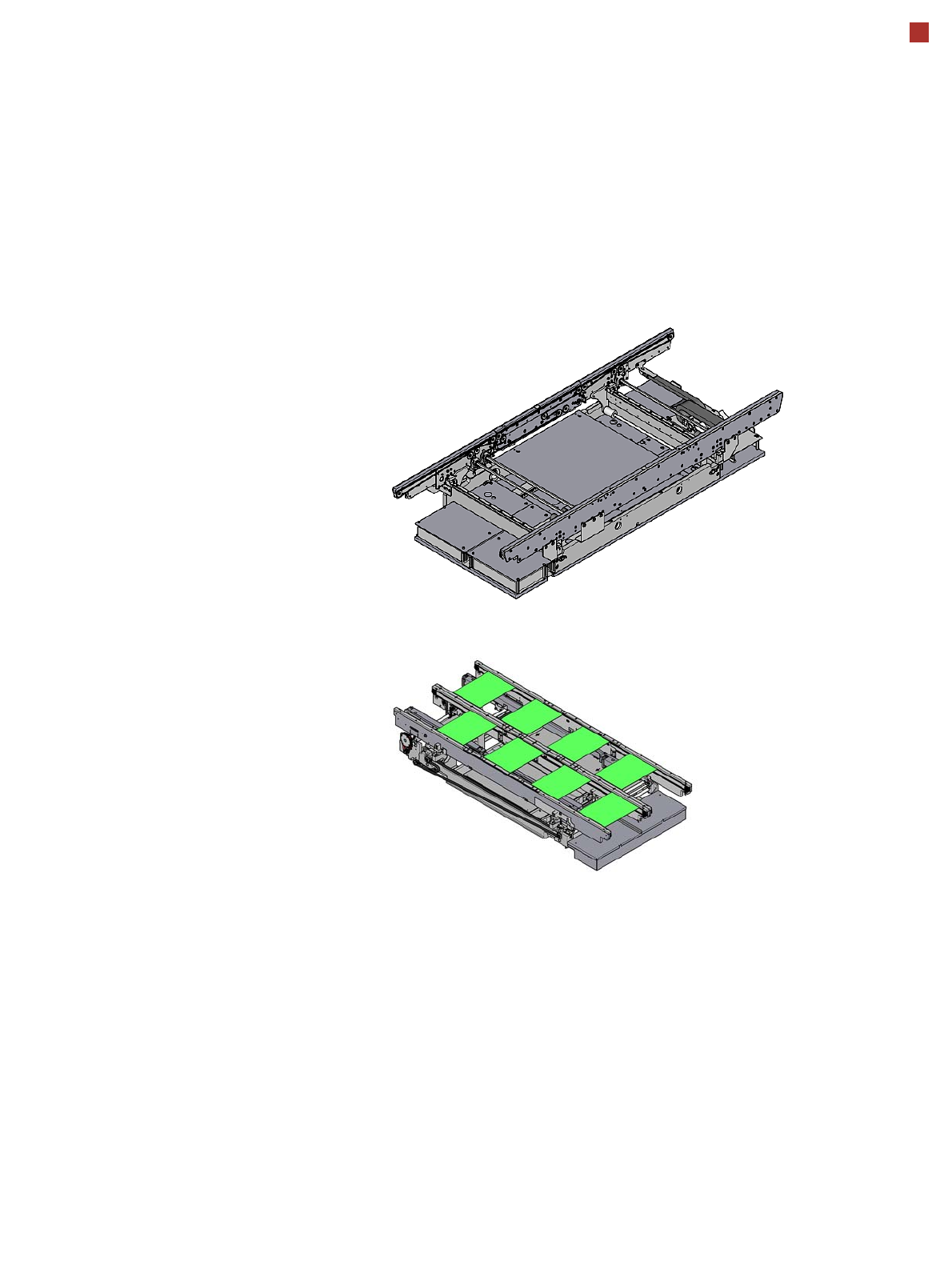
Single and dual conveyor
Single conveyor
When using a single con-
veyor, boards are moved
behind one another, along a
conveyor lane and into the
placement machine, where
they are placed. This con-
veyor variant is particularly
suitable for very wide boards.
Flexible dual conveyor
The flexible dual conveyor
has two conveyor tracks that
are electrically and mechani-
cally independent of one
another. The fixed conveyor
sides are both "outside" as a
default. As an option, the
fixed conveyor sides can be
selected as right/right or left/
left. The PCB dual conveyor
can also be operated as a
single conveyor, as an
option. In dual conveyor
mode, two boards are moved
into the placement machine
and placed either at the
same time (synchronous
mode) or alternatively (asyn-
chronous mode). This makes
it possible to process the top
and bottom sides of a board
in one line.
Single conveyor
Flexible dual conveyor
20
Board conveyor
Technical data
Single conveyor Flexible dual con-
veyor
Dual conveyor in single
conveyor mode
Standard dimensions
(length x width)
50 mm x 50 mm to
450 mm x 560 mm
50 mm x 50 mm to
450 mm x 265 mm
50 mm x 50 mm to
450 mm x 460 mm
Dimensions with “Long
Board”option
(length x width)
50 mm x 50 mm to
1525 mm
a
x 560 mm
a) With input/output conveyor only
50 mm x 50 mm to
850 mm x 265 mm
50 mm x 50 mm to
850 mm x 460 mm
Stationary conveyor side Right, left or outer
Automatic electrical width
adjustment
Standard
PCB thickness
Standard
"Thick board" option
0.3 mm to 4.5 mm
2.0 mm to 6.5 mm
Clamping length of board 450 mm
Space for positioning
support pins
440 mm
PCB warpage See page 23
PCB weight
b
b) The board weight value refers to the weight of the board plus the weight of the components.
Max. 3.0 kg Max. 2.0 kg Max. 2.0 kg
Clearance on PCB
underside
25 mm
PCB conveyor height
Option
Standard
Option SMEMA
900 mm
930 mm
950 mm
Type of interface SMEMA or IPC-HERMES-9852
Component-free PCB
handling edge
3 mm
PCB changeover time
Single conveyor
Dual conveyor
c
c) 0 seconds in asynchronous mode, otherwise 1.5 seconds.
< 1.5 seconds
0 seconds
IPC-Hermes-9852
A protocol for advanced development of Industry 4.0 in electronics production
The Hermes Standard, also published as IPC-HERMES-9852, is a non-proprietary open protocol,
based on TCP / IP and XML. This boosts the exchange of PCB-relevant data between the various
machines in the electronics production lines. The Hermes Standard was initiated, developed and
established and is still managed by a group of leading equipment manufacturers, who share their
know-how to achieve a significant step towards advanced process integration. It has been recognized
by IPC as the next generation solution for IPC-SMEMA-9851, normally known as "SMEMA standard".
The founding and defining body The Hermes Standard Initiative is available to all equipment providers
wanting to actively participate in using the benefits of Industry 4.0 for their customers.