Conformal-Coating-Process-Characterization-Considerations.pdf - 第2页
NordsonASYMTEK.com Conformal Coating Proc ess Characteriz ation Considerati ons Page 2 connectors. The coating also in hibits mechani cal motion once it’s cured so it is not applied to mounting points, potentiome ters, M…

NordsonASYMTEK.com
Conformal Coating Process Characterization Considerations Page 1
AUTHOR: Brad Perkins
General Manager
Nordson ASYMTEK
CONFORMAL COATING
PROCESS CHARACTERIZATION
CONSIDERATIONS
Introduction
Conformal coating is an enabling process that allows for the
ruggedizing of electronic devices and modules. As the process
increases the durability of electronics that are subjected to various
end-use environmental conditions, it adds value to the product. While it does add
value, consumers and manufacturers expect the electronics to work when subjected to
dirt, humidity, moisture, corrosive materials, and various other contaminants. This
expectation results in a drive to minimize the cost of the process. The lowest cost of
ownership for a conformal coating process occurs by utilizing automated selective
conformal coating equipment.
Selective coating equipment, in contrast to broadcast spraying or dipping that require
masking, only coats the needed regions of the board. The use of properly
characterized automated equipment is a reliable way to increase yield, increase
throughput, and reduce the cost of the conformal coating process. The cost can be
further reduced and the speed increased through understanding the capabilities of the
selective coating equipment and including those considerations at the design phase.
The conformal coating process provides surface level protection to the printed circuit
assembly (PCA) and does not cover the entire circuit board as there are areas where
coating is not applied, commonly referenced as keep-out zones. It prevents the
circuitry from having a reduction in the surface insulation resistance that can cause
shorts, arcing, and signal cross-transmissions. Because conformal coating is an
electrically insulating material it is not applied to areas where electrical transmission is
needed for the lifetime of the product; examples of this are test points and socket
NordsonASYMTEK.com
Conformal Coating Process Characterization Considerations Page 2
connectors. The coating also inhibits mechanical motion once it’s cured so it is not
applied to mounting points, potentiometers, MEMS, or devices that are designed with a
required motion component. Finally, because it is a coating, there are areas of the
board where it is not applied because it affects the optical performance, as with
displays and bar codes.
Selective Coating
Coating is applied selectively to the
board either through automated
selective coating equipment or a
masking process that is subsequently
removed after cure. For moderate to
high volume production, the lowest
process cost of ownership comes
when the coating is applied selectively
through automated equipment. The
masking process is done either
through mechanical masks that create
shadowed areas or by applying a masking material to the board and removing it after
coating. Both of these have drawbacks to the process. Mechanical masks, commonly
designed into a fixture, need to be cleaned frequently to remove build-up and still leave
an area in the shaded region where low viscosity coatings can flow into the keep-out
zones. In the case of masking material that is applied to the keep-out zones, there is
zero value-add to the final product because it is removed after the coating is cured.
Masking adds labor and material costs to the bill of materials (BOM) without adding
value to the final product.
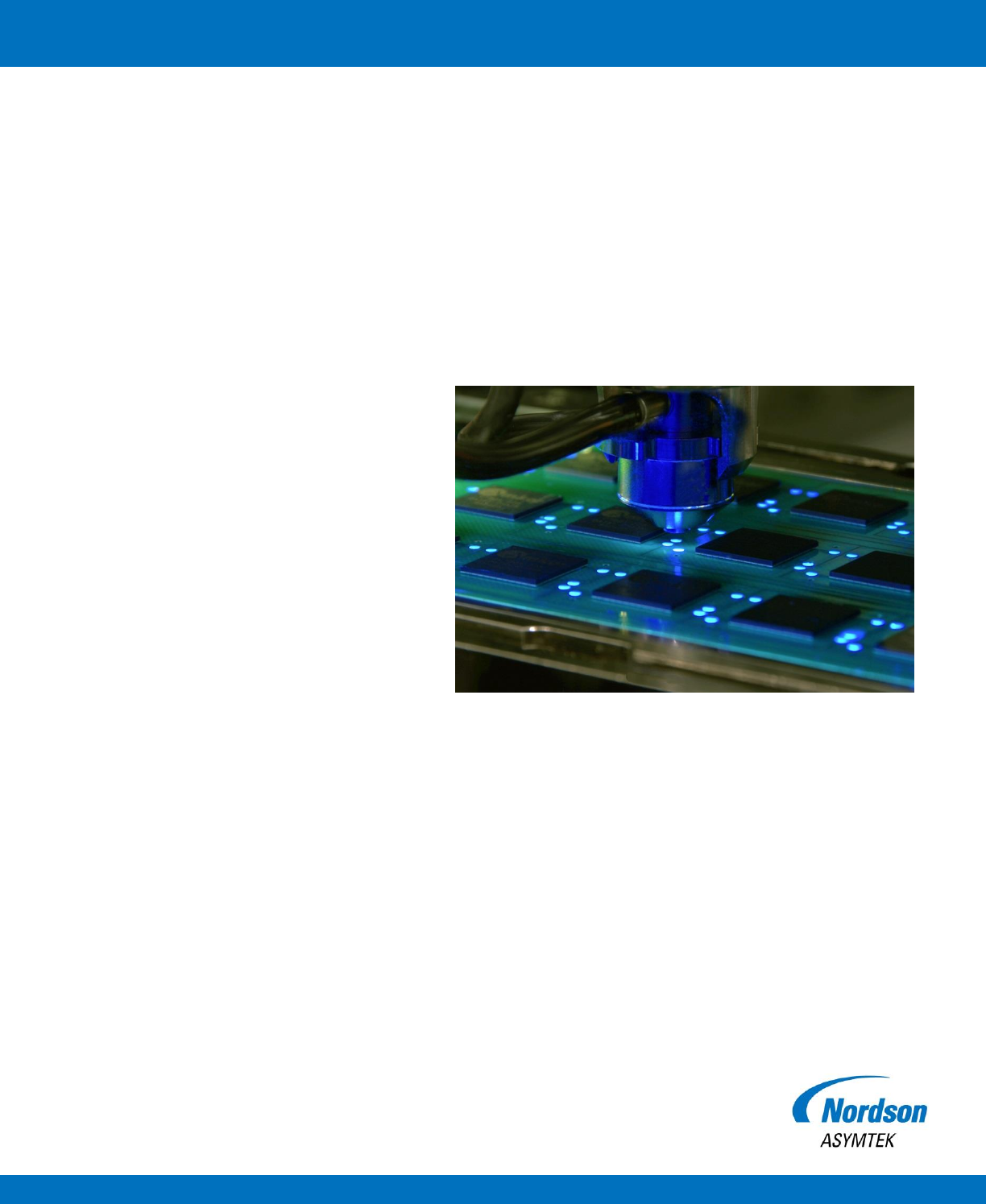
In contrast, selective conformal coating equipment applies coating only where it is
needed. This eliminates the need for labor to mask/de-mask as well as the cost of the
masking material itself. A complex board can require 3-10 minutes for the mask/de-

NordsonASYMTEK.com
Conformal Coating Process Characterization Considerations Page 3
mask process. The labor savings with selective coating is typically significant as is the
volume of products produced in a shift. In addition, the manual masking process
increases the opportunities for failure because of the additional board handling during
the assembly phase. Selective coating equipment only has the initial capital
equipment investment that is depreciated over the ten to fifteen year lifetime of the
24/7 capable equipment; the only significant reoccurring cost is that of the coating
itself. Using automated equipment eliminates operator-to-operator variation, further
increasing yield over manual processes.
Optimized Coating Processes
For optimized coating processes, the conformal coating material and the equipment
should be thought about collectively. Manufacturers commonly select a specific
conformal coating based on the cured properties of the material. This is a logical first
step as the conformal coating is in a cured state when the electronics are in their final
use model; however, the material is applied in a liquid state that is subsequently cured
by thermal, ultraviolet, moisture, and other solidifying processes. For a high yield
process a manufacturer also needs to strongly consider the material’s liquid properties
and to characterize the coating process in conjunction with the design phase to
minimize the PCA layout while respecting process tolerances. An understanding of the
specific material’s rheology allows for automated coating equipment selection and
defining process capabilities.
When considering design for manufacturing, some of the specific properties to
consider when selecting a conformal coating are the material’s viscosity, chemical
composition and associated work time, and environmental considerations. The
viscosity is important because it determines how the material will flow once applied to
the board as well as the type of applicators used to dispense the material. Low
viscosity coatings (typically less than 100 centipoise) can be applied with high speed,
highly selective non-atomized film coating technologies that can offer keep-out zones
less than 2mm in production.