QLF08_LaBel.pdf - 第2页
IC and Component Selection for Space Sy stems – Presented by Kenneth A . LaBel 2 Outline • Semiconductors: The Evolution of ICs – A vailability and T echnology • IC Selection Requirements - three fields of thought – T ec…

Considerations for IC and Component
Selection for Space Systems*
Kenneth A. LaBel
Co- Manager,
NASA Electronic Parts and Packaging (NEPP) Program
NASA/GSFC
ken.label@nasa.gov
301-286-9936
http://nepp.nasa.gov
Lewis M. Cohn
Defense Threat Reduction Agency
Lewis.Cohn@dtra.mil
703-767-2886
*focus is on active components and not passive

IC and Component Selection for Space Systems – Presented by Kenneth A. LaBel
2
Outline
• Semiconductors: The Evolution of ICs
– Availability and Technology
• IC Selection Requirements - three fields of
thought
– Technical – “The Good”
– Programmatic – “The Bad”
– Risk/Reliability – “The Ugly”
• Reliability and Radiation
• Radiation Perspective - Four methods of
selecting ICs for space systems
– Guaranteed hardness
– Historical ground-based radiation data
– Historical flight usage
– Unknown assurance
• Understanding Risk
– Risk trade space
• Example: ASICs and FPGA – sample selection
criteria
• Conclusions
IC and Component Selection for Space Systems – Presented by Kenneth A. LaBel
3
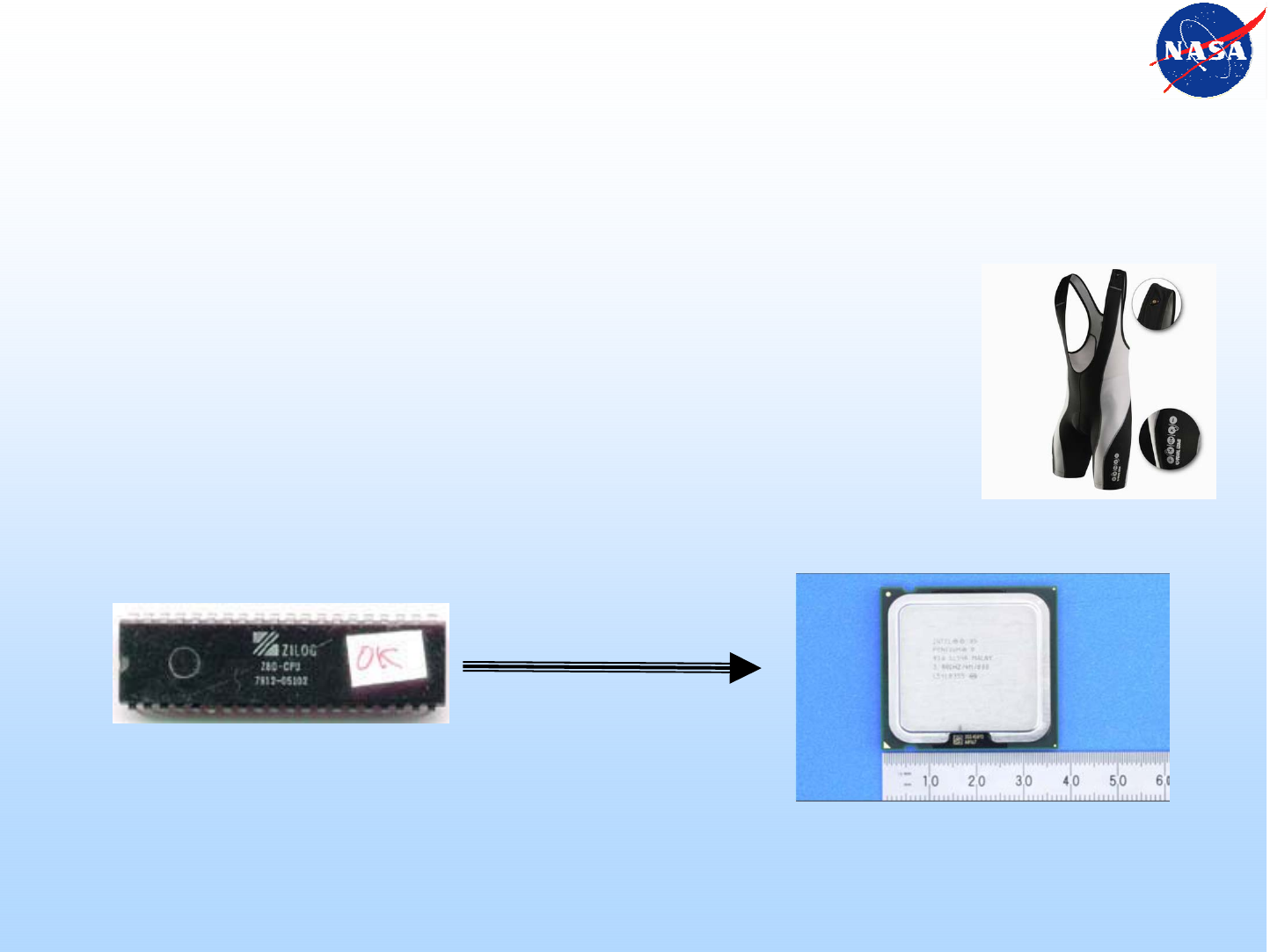
The Growth in IC Availability
• The semiconductor industry has seen an explosion in the
types and complexity of devices that are available over the
last several decades
– The commercial market drives features
• High density (memories)
• High performance (processors)
• Upgrade capability and time-to-market (FPGAs)
• Wireless (RF and mixed signal)
• Long battery life (Low-power CMOS)
Zilog Z80 Processor
circa 1978
8-bit processor
Intel 65nm Dual Core Pentium D Processor
circa 2007
Dual 64-bit processors
Integrated Cycling Bib
and MP3