Composite Material Testing v3.pdf - 第4页
www .nordson.com For more inf ormation, speak with your Nordson represent ative or c ontact your Nordson re gional oice Americas + 1 760 930 3307 sales@nordsondage. com Europe +44 1296 317800 globalsales@nordsondag e.co…
Composites and Structures Testing
Application Note
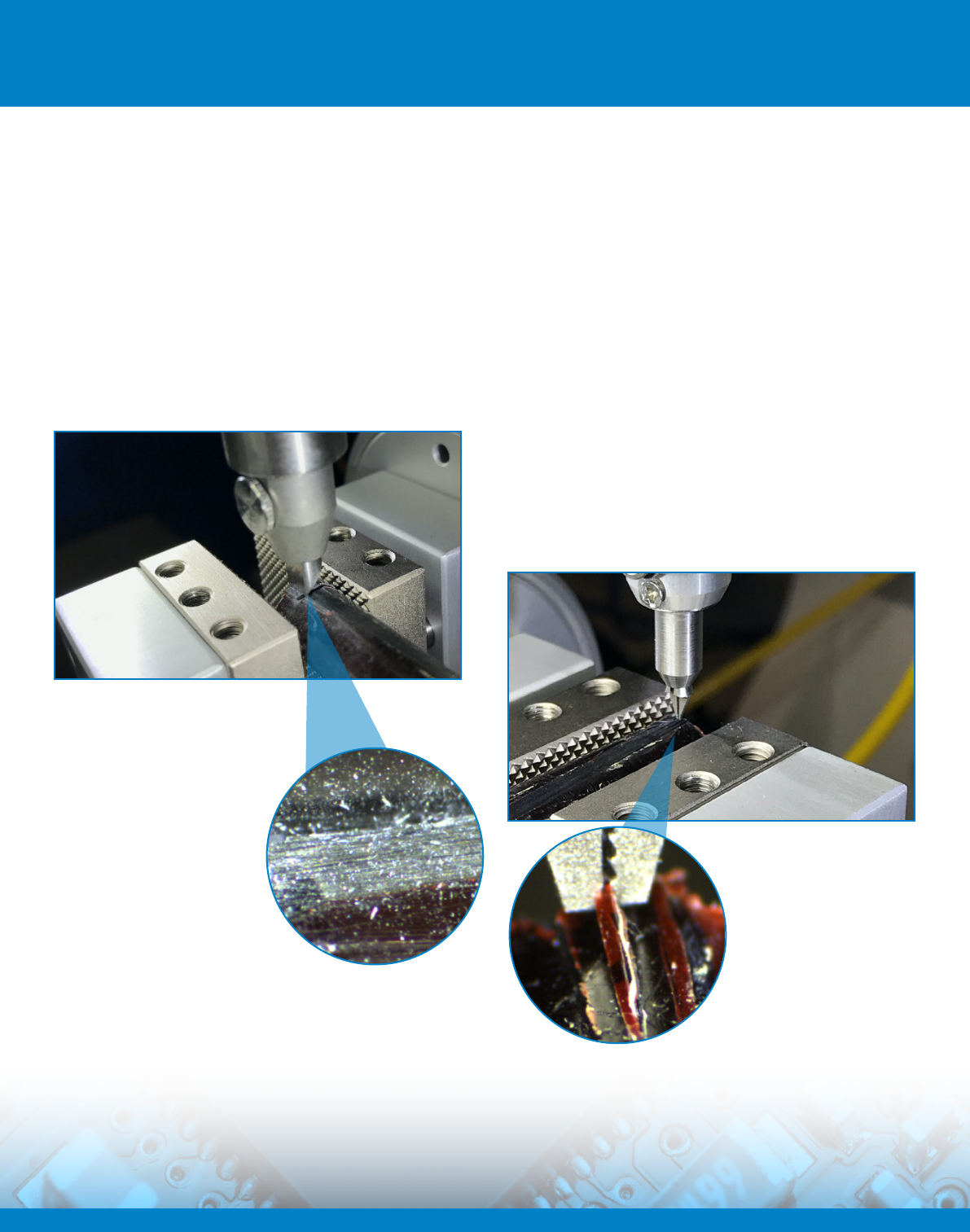
Shear Testing
Instead of manufacturing a testing component that can
be pulled in a uniaxial testing frame to investigate shear
properties, the shear strength can be determined directly
from a component using shear testing. The component
is clamped in a workholder mounted on an XY stage and
sheared against a tool that measures the load. All of
the movement is measured by high precision encoders
within the stage, and further measurements of strain can
be carried out using independent strain gauges that can
interface directly with the materials tester.
Peel Testing
Many components can only be peel tested by
manufacturing materials with two flexible sides that can be
peeled at 90
o
, or one very flexible part that is bent around
180
o
and pulled away from the component. These tests are
diicult to set up and were only developed to make use of
uniaxial machines.
The materials tester can clamp very small features with
its pneumatic jaws and peel material away from the
component at a constant angle of 90
o
by moving the stage
in tandem with the z-axis. This provides a true 90
o
peel test.
Epoxy resins are aected by moisture, which penetrates into
the matrix from the surface. The ability to test fibre-matrix
interactions at a microscale allows for an investigation into
the depth that the composite has been aected, instead of
only testing the bulk properties.
Right: A high magnification
image of the same shear test,
using the onboard trinocular
camera.
Above: Shear testing of fibres from
a golf club sha to determine the
matrix-fibre interaction.
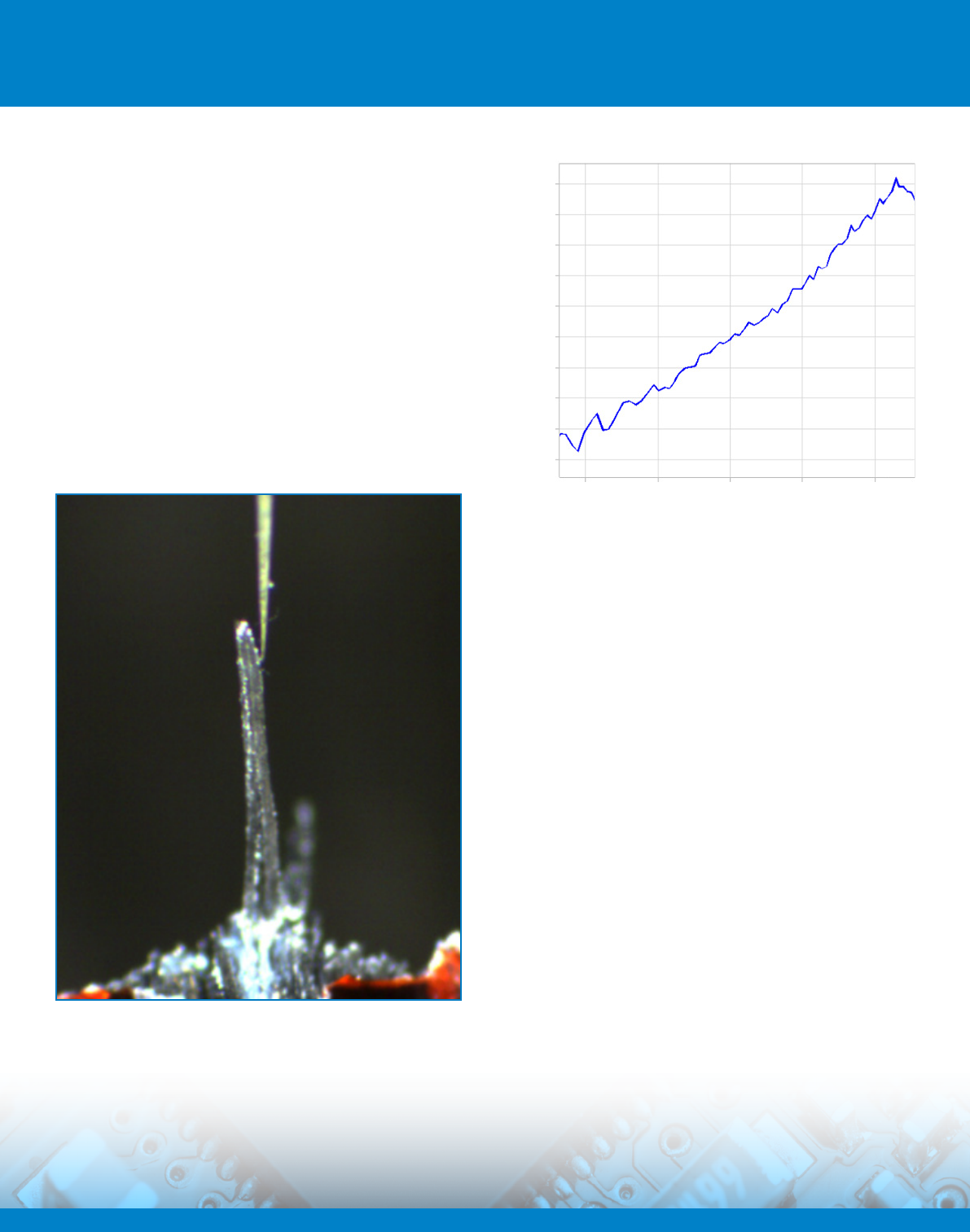
Le: A composite structure
is held rigidly in place using
high force pneumatic grips
and fibres are peeled from
the surface using precision
tweezer grips.
Bend Testing
While bend testing is more commonly available on
conventional machines, the materials tester can interface
with acoustic emission instruments, to allow cracking prior
to component failure to be detected. This gives a valuable
additional insight.
DAGE Paragon
TM
Materials soware automatically
co-ordinates the materials tester and acoustic emissions
instrument by sending a trigger signal as soon as a user
defined pre-load is achieved.
As well as conventional bending, DAGE Prospector
TM
can be
fitted with micro hooks that can be used to li fibre tows so
that the stiness can be measured.
Composites and Structures Testing
Application Note
Liing a 100 micron wide strip of carbon fibre from a
damaged component using a micro hook to investigate
local materials properties.
0.57 0.58 0.59 0.6 0.61
Axis Displacement (mm)
Force (gf)
1.5
1.45
1.4
1.35
1.3
1.25
1.2
1.15
1.1
1.05
www.nordson.com
For more information,
speak with your Nordson
representative or contact
your Nordson regional oice
Americas
+ 1 760 930 3307
sales@nordsondage.com
Europe
+44 1296 317800
globalsales@nordsondage.com
China
+86 512 6665 2008
sales.ch@nordsondage.com
Germany
+49 89 2000 338 270
sales.de@nordsondage.com
Japan
+81 120 537 555
sales.jp@nordsondage.com
Korea
+82 31 462 9642
korea.at.cs@nordson.com
South East Asia
+65 6552 7533
sales.sg@nordsondage.com
Taiwan
+886 2 2902 1860
globalsales@nordsondage.com
United Kingdom
+44 1296 317800
globalsales@nordsondage.com
Composites and Structures Testing
Application Note
Advantages to the Composites Industry
Uniaxial tensile testers are great for bulk material measurements, however they are
much less suitable for final product characterization.
• Test samples have to be specially manufactured for testing. This costs time
and money and is not appropriate for testing high volume manufacturing.
• Test samples may not exhibit the same behavior as the final composite
or structure.
With a DAGE Materials Tester, the real component can be tested in peel, shear, tension,
compression or torsion. Even biaxial testing is possible to test mixed mode
loading performance.
• Test the actual component, not a specially manufactured test sample.
• Perform accurate 90° peel testing.
• Get more information from your bend test with acoustic emissions.
The Prospector
TM
Micro Materials Tester is an
extremely versatile platform for performing
composite materials characterization.