SMTAI-PAPER-2020-Richter_Final-2.pdf - 第3页
Two commercial no -clean fluxes were run in this experimental series. One flux was a high-tack for mulation, the other was a standard for mulation. The gas- to -liquid removal unit was run in two different config uration…
deposit on the heat exchanger and cooled areas of the heat
exchanger box and then drip down to catch trays. These
systems are typically about 30% efficient in flux capture and
require a high level of maintenance to keep the heat
exchangers clean and unclogged of flux.
Catalytic oxidation is also currently being used in different
variations. These systems use a catalyst to promote
oxidation of organic compounds to carbon dioxide and
water by increasing the kinetic rate. The catalyst allows the
oxidation reaction to occur at relatively low temperatures of
about 340 to 500°C. As seen in the analysis of flux
effluents, the effluent product contains high and low
molecular weight hydrocarbon compounds and also a
significant amount of metals. Catalytic oxidizers can
effectively dissociate the low molecular weight
hydrocarbons into carbon dioxide and water, but are
ineffective at cracking high molecular weight resinous
species. Catalyst life is generally short due to catalyst
poisoning. Catalyst poisoning occurs when a compound
bonds to the catalyst’s active sites and chemically
deactivates the catalyst function due to the presence of
metals such as : copper, potassium, zinc, tin and iron.
Sometimes methods are used to pre-clean the gas before it
reaches the catalyst to try to extend the life of expensive
catalysts. Also, regeneration cycles can be used to
reactivate the catalysts. Resinous, metal laden flux effluents
are very difficult to clean out of the gas stream with
catalytic methods.
GAS-TO-LIQUID SEQUESTRATION
This is a new flux remediation technology that was
developed with the goal of providing a high-efficiency flux
capture method which requires minimal maintenance and
handling of flux residues. This system uses a dynamic
liquid filter to separate flux effluents from the oven gas
stream and suspend them in a liquid medium.
The liquid solution which acts as the transfer medium for
this system is water based, safe to handle, non-flammable
and low cost. The solution is comprised of water that is
provided to the system by plumbing directly to the plant
potable water supply and a concentrated detergent which is
automatically added to the water in the proper ratio.
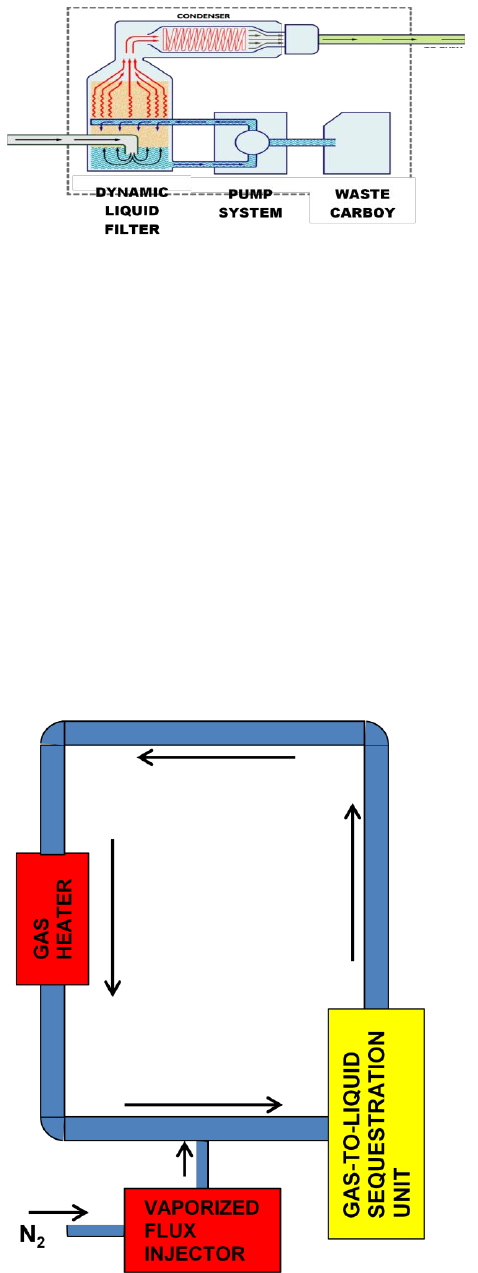
The gas-to-liquid sequestration unit functions by taking
effluent gas from the oven and passing it through a dynamic
liquid filter where the effluent in the gas stream interacts
with the moving liquid and is entrained and suspended.The
cleaned gas then passes through a condenser to remove
latent moisture from the cleaning process. The gas is then
recycled back to the oven process chamber (see Figure 1).
During operation, a small portion of the solution is diverted
to the waste carboy and then the level of solution is made
back up with an automatic addition of water and
concentrate.
Figure 1. Gas-To-Liquid Sequestration Diagram
RESULTS OF EXPERIMENTS
This data includes a determination of flux capture
efficiency, the ability of the gas-to-liquid method to capture
metals present in the process gas stream and a test to see if
this new process has any effect on solder wetting.
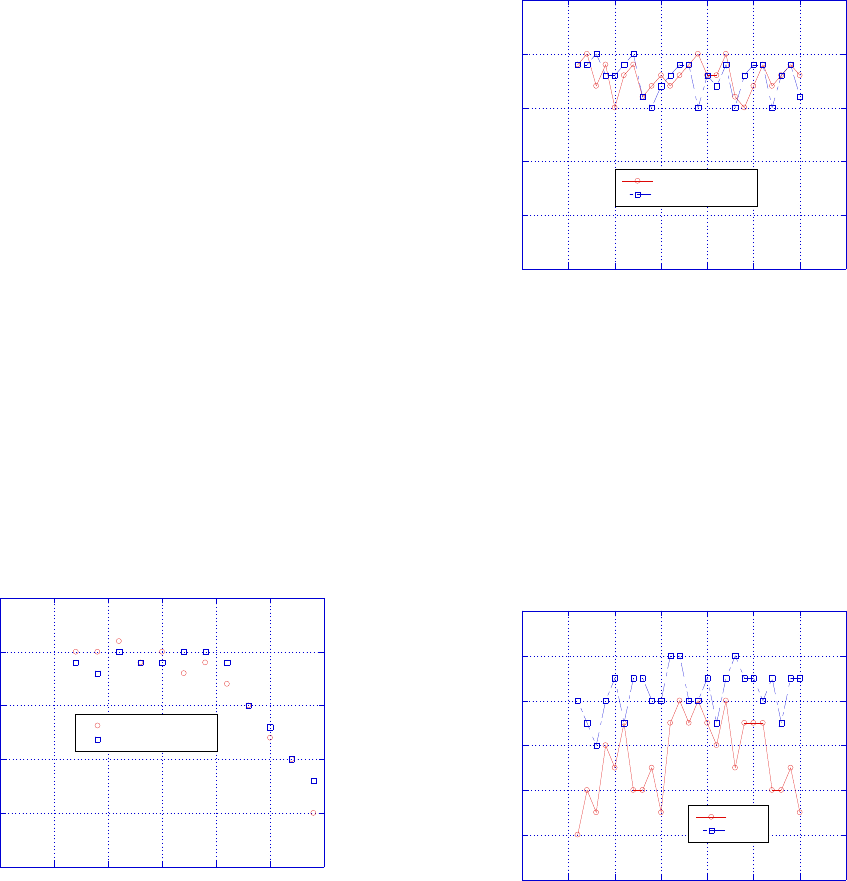
To investigate flux capture efficiency, a laboratory
apparatus was fabricated to simulate oven process gas
operation and introduce a precise amount of burnt and
vaporized flux effluent into the gas-to-liquid unit (see
Figure 2). With this closed circuit apparatus, the gas-to-
liquid sequestration unit was tested independent of any
influence that the oven might contribute. This apparatus can
be run in either nitrogen, or air atmosphere. For this
experiment, nitrogen was chosen to allow testing the system
for potential effect on oven oxygen level.
Figure 2. Test Apparatus Diagram
GAS
IN
GAS
OUT
Two commercial no-clean fluxes were run in this
experimental series. One flux was a high-tack formulation,
the other was a standard formulation. The gas-to-liquid
removal unit was run in two different configurations for this
testing. Configuration #1 was run without using the
drain/replenishment function for the liquid solution. The
reasion for running this configuration was to determine the
inherent capacity of the liquid solution to uptake flux. The
second configuration was run the same as the first except
with the automatic drain/replenishment function activated.
The reason for running this configuration was to test
efficiency during continous automatic operation. For this
series, process gas temperature was maintained at 320°C.
and flux was processed in 200 gram increments. The
capture efficiency was determined by separating captured
flux from the liquid solution and weighing it. The weight of
the captured flux was then expressed as a percentage of the
flux introduced into the test apparatus. Condition 1, running
with a fixed quantity of liquid solution, maintained stable
efficiencies of ~94% until 1600 grams of flux had been
injected into the apparatus (see Figure 3). As more flux was
introduced, a steady decline in efficiency (though still at
high efficiencies) occured as the solution began to saturate.
This result demonstrates a large inherent capacity of the
liquid solution for capturing and holding flux effluents.
Also of note is that both flux types tested performed
essentially the same.
Figure 3. Condition 1 Flux Capture Efficiency
Condition 2, was run in normal automatic mode and the
system was set to perform a partial drain/replenishment
cycle for each 200 gram addition of flux. 5 kilograms of
each flux type were processed in this test. The capture
efficiency for this run was determined by separating the flux
from the waste liquid released in the drain cycle and
normalizing for sample size, comparing it to the cumulative
input flux and again expressing as a percentage of input.
Results from this condition show continuous stable running
efficiencies of between 90 and 95% (see Figure 4). Again,
both fluxes performed essentially the same.
Figure 4. Condition 2 Flux Capture Efficiency
During these efficiency tests which were run in full
nitrogen, the oxygen level was monitored at both the gas
input and output ports of the flux sequestration unit. For
these test runs, oxygen levels were stable and measured at
between 40 – 48ppm (see Figure 5). The oxygen levels
were not negatively affected by the flux capture process.
Figure 5. Inlet and Outlet Oxygen Levels
To investigate the effectiveness of the gas-to-liquid
sequestration method at trapping the metals found in solder
flux effluents, a sample of liquid solution waste from a
sequestration unit running on a commercial reflow line was
prepared for ICP analysis. The results were consistent with
those seen on samples taken directly from the inside of an
oven (see Table 2). This was an interesting result which
indicates a capacity of the new technology to trap metals.
Future work is planned to quantify metals capture by using a
75
80
85
90
95
100
-0.5 0 0.5 1 1.5 2 2.5
Flux #1 (Hi-Tack)
Flux #2
Flux Capture Efficiency (%)
Cumulative Flux Added (Kg.)
75
80
85
90
95
100
-1 0 1 2 3 4 5 6
Flux #1 (Hi-Tack)
Flux #2
Flux Capture Efficiency (%)
Cumulative Flux Added (Kg.)
38
40
42
44
46
48
50
-1 0 1 2 3 4 5 6
Outlet
Inlet
Oxygen (ppm)
Cumulative Flux Added (Kg.)

known gas input metals load and then measuring metals
load in both the liquid capture solution and the sequestration
unit output gas.
Table 2. Liquid Waste ICP-MS Metals Survey
Element
Concentration
(ppm)
Cu
10000
K
1100
P
515
Si
610
Zn
375
Sn
295
Fe
187
Na
65
Al
5.5
Ca
7
Pb
3.4
Mg
2.7
Sb
1.7
A test of the effects of latent moisture from the gas-to-liquid
sequestration unit making it into the oven process chamber
was conducted. To investigate this scenario, an experiment
was run which analyzed solder joint test structures produced
at several oven atmosphere dew points. Trials were run in
full nitrogen and air with no-clean and water soluble fluxes.
Samples were produced at dew points ranging from +18C.
to -30C. The solder wet out performance of these samples
was evaluated by cross-section microscopy and contact
angle measurement (see Table 3). Wetting and structure at
all dew point conditions was normal and showed no
negative effects.
Table3. Solder Wetting Contact Angle
Contact Angle
Atmosphere
DEW
Point
ENIG
Tin
N2
-29.6 C
6.23
9.71
18.5 C
5.17
10.51
AIR
-14.8 C
12.48
15.6
18.3 C
10.88
9.94
MAINTENANCE
Routine maintenance servicing of the gas-to-liquid
sequestration technology is simple, clean and cost-effective.
Routine servicing does not require the oven to be shut down
and can be performed while the oven is operating and
without disrupting production on the line. Normal service
consists of only two operations: 1. Removing a portable
carboy containing the liquid waste and replacing it with an
empty carboy. 2. Topping off a reservoir containing the
detergent concentrate. Typical time-between -service is
about 10 days for heavy flux users and about once a month
for light users. The waste in the carboys is then transferred
to a 55 gallon drum for disposal by a waste handler.
OPERATING EXPENSE COMPARISON
An annual expense comparison was made between standard
condensation flux management and the gas-to-liquid
technology (see Table 4). For this analysis, a capital
expenditure of $8610 was used for the condensation system
and $25,000 was used for the gas-to-liquid system. The
capital was straight-line depreciated over a 5 year term and
added to the direct operating expenses. The difference in
labor expense is the most significant factor. Labor for the
gas-to-liquid method is estimated to be 1/10
th
of that
required to maintain a condensation system with no need for
constant disassembly and cleaning/replacement of filters,
heat exchangers and other components of the condensation
equipment. By this comparison, the gas-to-liquid approach
is economically favorable and operating expenses are over
50% less.
Table 4. Operating Expense Comparison
Annual Expenses
Condensation
Gas-to-Liquid
Sequestration
Depreciation (CAPEX)
$1,722 ($8,610)
$5,000 ($25,000)
Labor (rate $90/hr.)
$21,600
$2,160
Waste Disposal
$63
$288
Water
N/A
$221
Electricity
$240
$2,820
Liquid Concentrate
N/A
$166
Maintenance Parts
$1,500
$240
Total
$25,107
$10,895
CONCLUSIONS
Flux capture efficiencies of ≥90% were achieved in
automatic operation mode under controlled test conditions.
The liquid solution was observed to trap significant amounts
of metals present in the gas stream effluent.
The gas-to-liquid sequestration technology has been used
effectively with different flux types without changing
operating settings, or parameters.
Maintenance is simplified and can be conducted while the
oven is operating without disturbing production.
Finally, operating expenses for the gas-to-liquid system,
when compared to a condensation system are quite
favorable.