Selecting-the-Right-Dispensing-Equipment-for-Your-Process.pdf - 第3页
Diaphragm Valve One draw back of the pinch valve is that so me applications might required frequent pinch tube replacement. In such cases, the Diaphragm valve, shows in figure 4.0, is a perfect replacement. Due to the re…
widely used in most bench top applications because it has proven to be the most accurate
and repeatable in the market. Typical applications include: to dispense solder paste on
PCB for rework applications or to dispense all types of adhesive to bond parts together.
The disadvantage of the syringe system is that it depends on too many variables to
maintain good repeatability rate for the entire dispensing process. One of the variables is
the internal diameter of the syringe. If the internal diameter of the syringe is tapered too
much then the shot size will decrease as the fluid travels down toward the bottom. To
address this problem, OK International offers various series of TPD valve systems. A
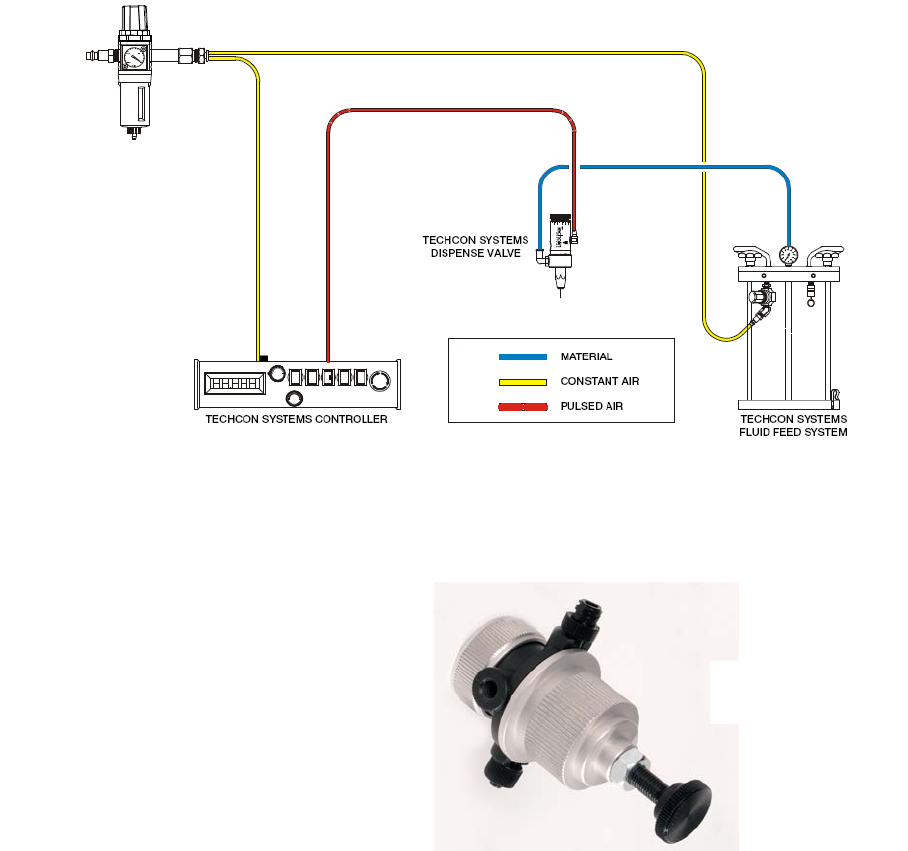
typical TPD valve system includes a pneumatic valve, a controller and a pressure
reservoir, show in figure 2.
Pinch Tube Valve
The simplest and most inexpensive TPD valve is the disposable pinch tube valve, shows
in figure 3. It is designed to dispense small dots or continuous beads of low viscosity
fluid. This air-actuated valve is operated by
automatically opening and closing (pinching) a
molded plastic tube assembly. The only part of
the valve making contact with the fluid is the
disposable pinch tube assembly. This unique
feature making the valve perfectly suited for
applications that use quick curing adhesives or
highly aggressive fluids that might damage the
valve body. This valve is commonly used to
dispense Cyanoacrylate (CA) for general bonding
applications, or dispense
two-component epoxies for potting applications.
Benefits include disposable path, light weight, compact size and simple operation.
Figure 2
A typical setup for a
pneumatic valve system
Figure 3
Pinch Tube Valve
Diaphragm Valve
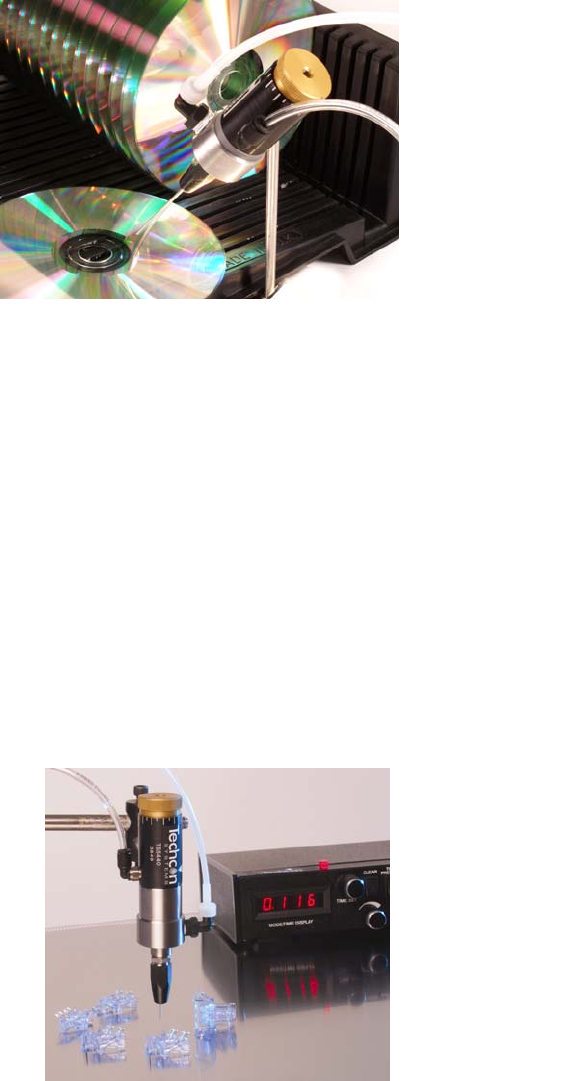
One draw back of the pinch valve is that some applications might required frequent pinch
tube replacement. In such cases, the
Diaphragm valve, shows in figure 4.0, is a
perfect replacement. Due to the resilient of
the diaphragm material, it can last for
millions of cycles before needing
replacement. This pneumatic valve uses a
diaphragm to open and close the fluid path.
During the dispense cycle, the air pressure
signal forces the diaphragm to pull back
creating an opening for the fluid to flow
through. When the air signal stops, the
internal spring pushes the diaphragm down
to the closed position. The unique component of this valve is the diaphragm. It is a
solid barrier made from Ultra High Molecular Weight Polyethylene (UHMWPE) to
prevent moisture from the air cylinder to coming contact with the fluid. This attribute
makes the valve an excellent choice to dispense moisture sensitive fluid such as
Cyanoacrylate. Other attributes that make this valve widely acceptable in the industry
are: compact size/light weight, simple and low maintenance, adjustable stroke control
that can produce shot size as small as 0.002 CC. Virtually any low to medium viscosity
fluid can be dispensed using one of the diaphragm valve variations. Applications of this
valve are ranging from dispense moisture sensitive adhesives for general bonding
applications, to dispense UV cured adhesives in the medical device industry, to spin
coating application in the DVD manufacturing industry.
Needle Valve
For applications that required micro dot size (less than 0.002CC), the microshot needle
valve is an ideal choice. Shot size as small as 0.0005 CC can be easily achieved thanks to
the unique designed of the shut off mechanism located inside the dispense tip that
virtually eliminate the “dead fluid” volume.
Smallest needle size of 32 gauge can be used
without dripping between dispense cycles. The
needle valve is a pneumatically triggered single-
acting valve. Air pressure signal lifts the piston-
driven needle away from its seat, allowing fluid
under pressure to flow through. When the cycle
is completed, the internal compression spring
pushed the needle back in the closed position.
Higher viscosity fluid, up to 100,000 cps, can be
dispensed accurately with this valve. However
moisture sensitive fluid and quick curing
adhesives are not to be used. Some recommended fluid are UV adhesive, solvents, inks,
oils, primers, activators… Typical applications include: dispense small amount of UV
adhesive to bond speaker of the hearing aid device, dispense a small dot of ink for
marking application.
Figure 4
A diaphragm
valve designed
to dispense
consistent
deposits of low
to medium
viscosity fluid
Figure 5
A microshot
needle valve
designed to
dispense 0.0005
cc shot without
dripping
Spool Valve
Valves described above have one thing in common is that they are not designed to
dispense high viscosity fluid in high volume applications. To fill this gap, OK
International offers the spool valve series. High
viscosity fluid, up to 3 million cps is dispensable
through a heavy duty spool valve version. The valve
uses an air-actuated piston to opens and closes the
fluid’s path. However, contrary to the needle valve, the
air pressure signal drives the piston down to open the
fluid path. When the dispense cycle is done, the
internal compression spring lift the piston up to keep the
valve in the closed position. The pull back action of the
piston in the closing cycle creates a natural “suck-back”
action. This feature is very effective for preventing
drips when dispensing high viscosity fluid such as
silicones, greases and sealants. Most use application of
this valve is to dispense sealant for form-in-place gasket
application. Other commonly applications that well
suited are: dispensing grease for automotive application, filling material into syringes or
cartridges for the material packaging industry.
Rotary Auger Valve
The common weak spot among pneumatic valves is that they are susceptible to fluid‘s
viscosity fluctuation. When the fluid become thicker or thinner, the fluid pressure needs
to be adjusted accordingly to keep the dispense repeatability rate stable. One way to
minimize this problem is to use the Rotary Displacement Dispensing technique.
Developed in 1987 by Techcon Systems, a division of OK International, this method uses
a rotary feed screw (auger) coupled with a precision DC motor to dispense fluid with a
rotary displacement action. The unique design ensures fluid
is constantly present at the feed screw inlet while the
controlled rotation of the feed screw dispenses fluid from the
feed point out to the dispense tip. Dot size of 0.010” (0.25
mm) in diameter can be achieved with high percentage of
repeatability rate.
Due to its versatility, high accuracy and easy to setup, the
TS5000 series rotary valve is the prefer choice in the
electronics industry. It can dispense virtually any fluid that
has viscosity of 30,000 cps or higher, including difficult
material to dispense like solder paste. In fact it is the only
valve that can dispense solder paste consistently.
Applications in electronics industry such as dispensing
surface mount adhesives, silver filled epoxies, encapsulant
materials, solder pastes… are excellent choice for the rotary
valve.
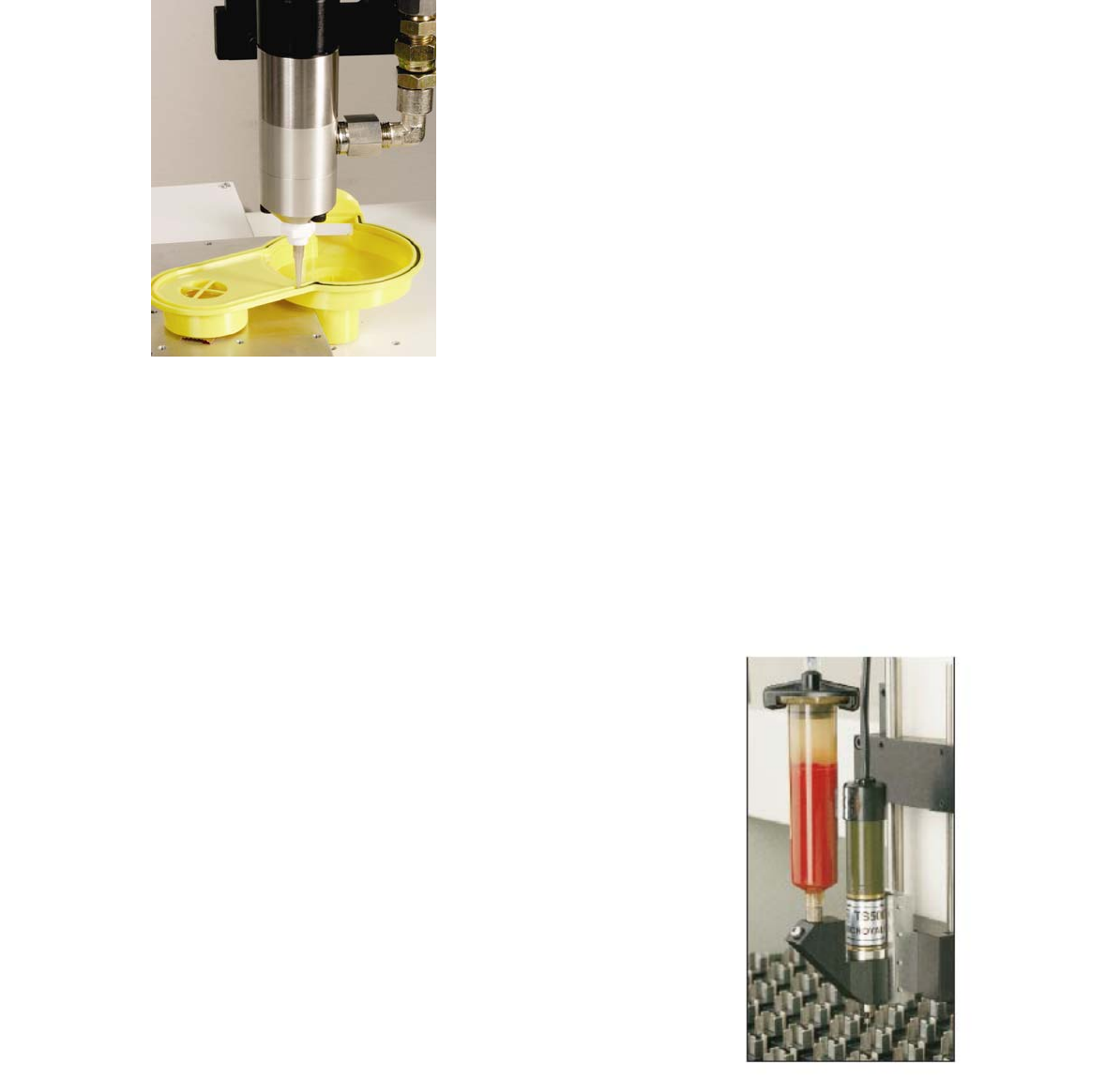
Figure 6
High pressure
spool valve is
an ideal choice
for high
viscosity fluid
Figure 7
A TS5000
Rotary Valve is
the favorite
valve in the
electronic
applications