Conformal-Coating-Process-Characterization-Considerations.pdf - 第5页
NordsonASYMTEK.com Conformal Coating Proc ess Characteriz ation Considerati ons Page 5 potential for cross contamination to other proce sses, and ventila t ion of the v apors. Finally, the cure mechanism i s determined b…
NordsonASYMTEK.com
Conformal Coating Process Characterization Considerations Page 4
Higher Viscosities
Higher viscosity coatings require the use of atomizing coating technologies that are
slower in coating rate and have keep-out zones typically greater than 3mm. Jetting or
needle dispensing technologies can be used to decrease the keep-out zones to the
1mm neighborhood and are generally used to precisely coat specific parts rather than
for coating an entire board. The addition of a second coating valve to increase
selectivity can decrease process throughput. Considering the need for conformal
coating, applying the required process tolerances for the material, and evaluating
conformal coating equipment and characterization at the design phase greatly aid in
manufacturability. It makes
the manufacturing process
less difficult, time-
consuming, and costly, and
avoids having to use
specialized equipment,
applying additional
conformal coating, or using
masks after the fact due to
unplanned for parts or
areas that have zero
tolerances.
Chemical Composition
The chemical composition is also very important as often materials have finite work
times, commonly referenced as pot life, before the equipment must be cleaned to avoid
curing inside the equipment. The presence of hazardous solvents is common, so
consideration needs to be given regarding process controls and the environmental
impact of these materials. This specifically applies to the health of the employees,

NordsonASYMTEK.com
Conformal Coating Process Characterization Considerations Page 5
potential for cross contamination to other processes, and ventilation of the vapors.
Finally, the cure mechanism is determined by the material as well, be it acrylics,
urethanes, silicones, or epoxies. The time to cure is related to the material itself, and
automated equipment selection depends on the cure mechanisms of the specific
material. To minimize the time to cure and the associated work in process as well as
line length, designers need to look at the specific
coatings and not the equipment.
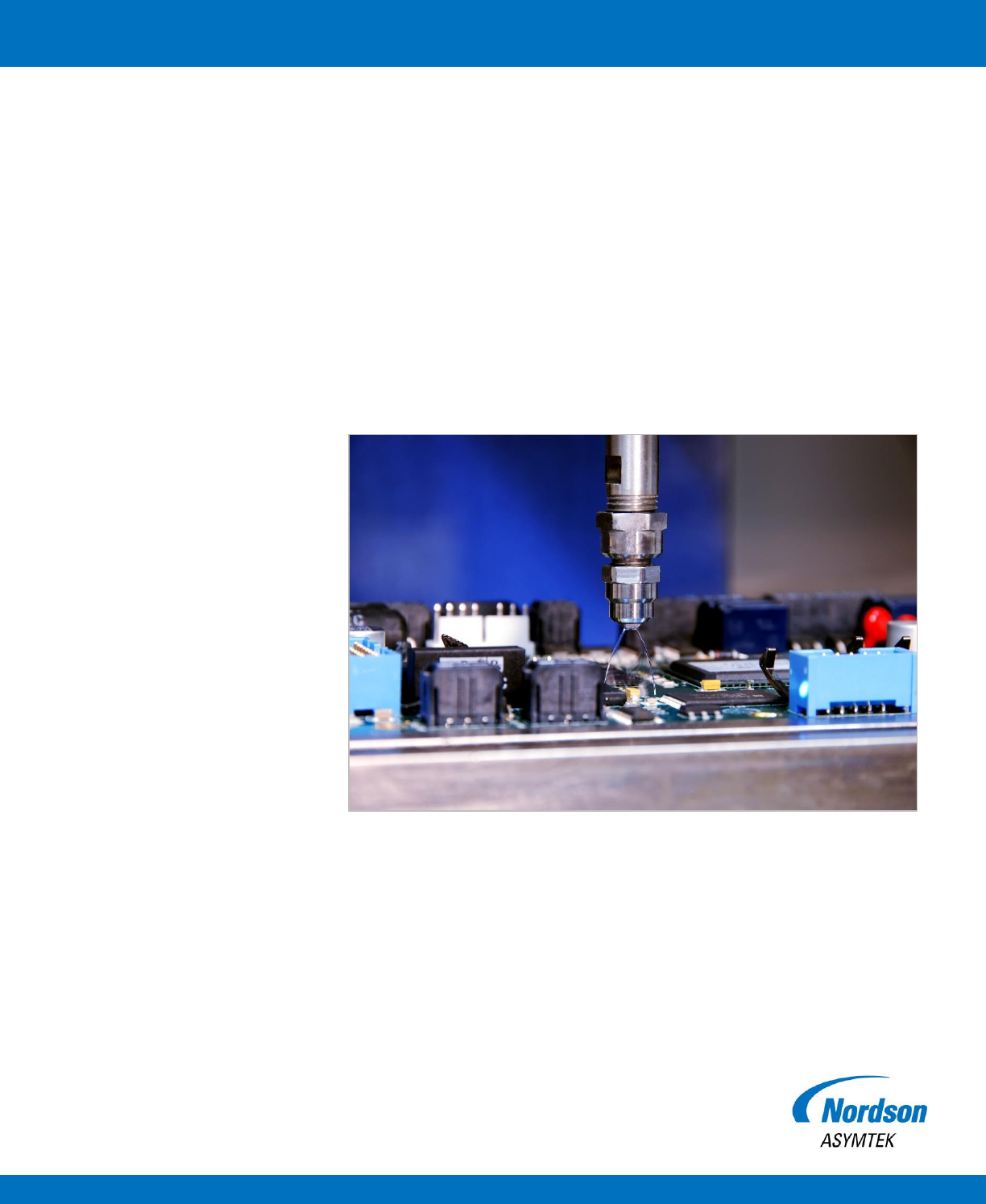
A high reliability coating process occurs most
efficiently when there is characterization of the
equipment prior to introducing the final product. The
equipment used to apply the conformal coating has
numerous input parameters to optimize the process;
some of these are the applicator selection, nozzle
orifice size, pressure causing the fluid to flow, the
transversing speed of the applicator, height of the
applicator from the substrate, and the overlap of
each pass, to name a few of the most critical. The
output of these variable settings provides the
coating thickness, repeatability, throughput, and
defects, such as bubbles and voids.
Curing the Coating
The equipment used to cure the coating material also has input variables depending on
the cure mechanism. For thermal cure materials these are typically the temperature of
the oven, belt speed, temperature ramps, and for some materials, the humidity inside
the oven. For UV cure materials they are the height of the UV lamp and the speed the
board passes through the oven. The output of these variable settings, in conjunction
with the material thickness, provides the throughput of the cured product as well as
defects, such as incomplete cure or over cure defects.
Input parameters to
optimize the process
include the applicator
selection, nozzle
orifice size, pressure
causing the fluid to
flow, the transversing
speed of the
applicator, height of
the applicator from
the substrate, and
the overlap of each
pass.

NordsonASYMTEK.com
Conformal Coating Process Characterization Considerations Page 6
Through first characterizing the equipment capabilities, the manufacturer is able to best
develop a high yield, maximum throughput process for the end product. There are
variables associated with coating a specific board due to board topography, keep-out
areas, surface wetting, cleanliness, moisture retention, and component placement.
Decoupling the equipment characterization from the final product enables higher
reliability coating processes in a shorter and less costly development timeframe.
Shorter because it is a simpler process without confounding variables, and less costly
because of engineering time-savings as well as reduced potential scrap product
generated in process development. Each coating material has slightly different
rheological characteristics. Understanding how those interact with the equipment input
variables subsequently provides the best manufacturing processes.
The majority of manufacturers who have successful coating operations manufacture
more than one product. With multiple products there is a need to develop a process
that works with many different selectivity requirements. By initially developing a
coating process that is end-product independent, it allows companies to introduce new
products more quickly because each product is not a unique project.
Final Considerations
Finally, the conformal coating process is a very dynamic process because there are
many tolerances that are inherent to it. Some of these are associated with the
acceptable limits of material viscosity variations, substrate surface energy affecting
wetability, surface cleanliness, fixture tolerances, and the coating equipment’s own
tolerances on volumetric dispensing. All of these processes can be characterized for
high yield; however, it is advantageous to have a basic characterization process that
can be referenced to have a standard to work from. The equipment can be selected to
have closed-loop heaters to control the viscosity, software controlled pressure
regulators to dynamically adjust the spray patterns based on closed-loop monitoring,
fiducial recognition for increased placement accuracy, bar code scanners for