RDS_Magazintrockner_en.pdf - 第3页
A new world of dr ying methods with the RDS magazine dryer from Rehm The new RDS magazine dryer from Rehm is the perfect sys- tem with inert gas operation for tempering power modules. The system can reach temperatures of…

Optimal for power modules
and high-temperature applications
ThedecidingcompetitivefactoroftheGermanenergysupplysystemisnolongerjustthe
cost.Innovativeperformance,reliabilityandlikelihoodofbeingacceptedontheglobal
marketarenowmuchmoreimportantfactors.Therefore,electroniccomponentsandthe
suitableoutlettechnologyandconnectiontechnologyhaveakeyfunction.
The rapid grid expansion for renewable energy, which followed the energy transition, presents
manufacturers of power electronic systems with the task of supplying the market with relia-
ble systems. The increasing demands of the energy suppliers and the demand for reliability
and sustainability present many challenges to system development. To achieve these perfor-
mance levels we must now enter into and extend offshore applications.
Rehm offers the new RDS magazine dryer for this area. The energy efcient and sustainable
system was developed as part of the HotAL research project (high temperature-optimised
AL-bonding technology for offshore applications). The goal is to optimise performance
electronics modules through the use of innovative materials and process management for
high-temperature applications. Along with Rehm, Fraunhofer IZM Berlin and the industry
partners Heraeus, SEMIKRON and F & K Delvotec Bondtechnik took part in this project that
was supported by BMBF.
Drying |
Hardening
New techniques for electronic
components in the high-performance area
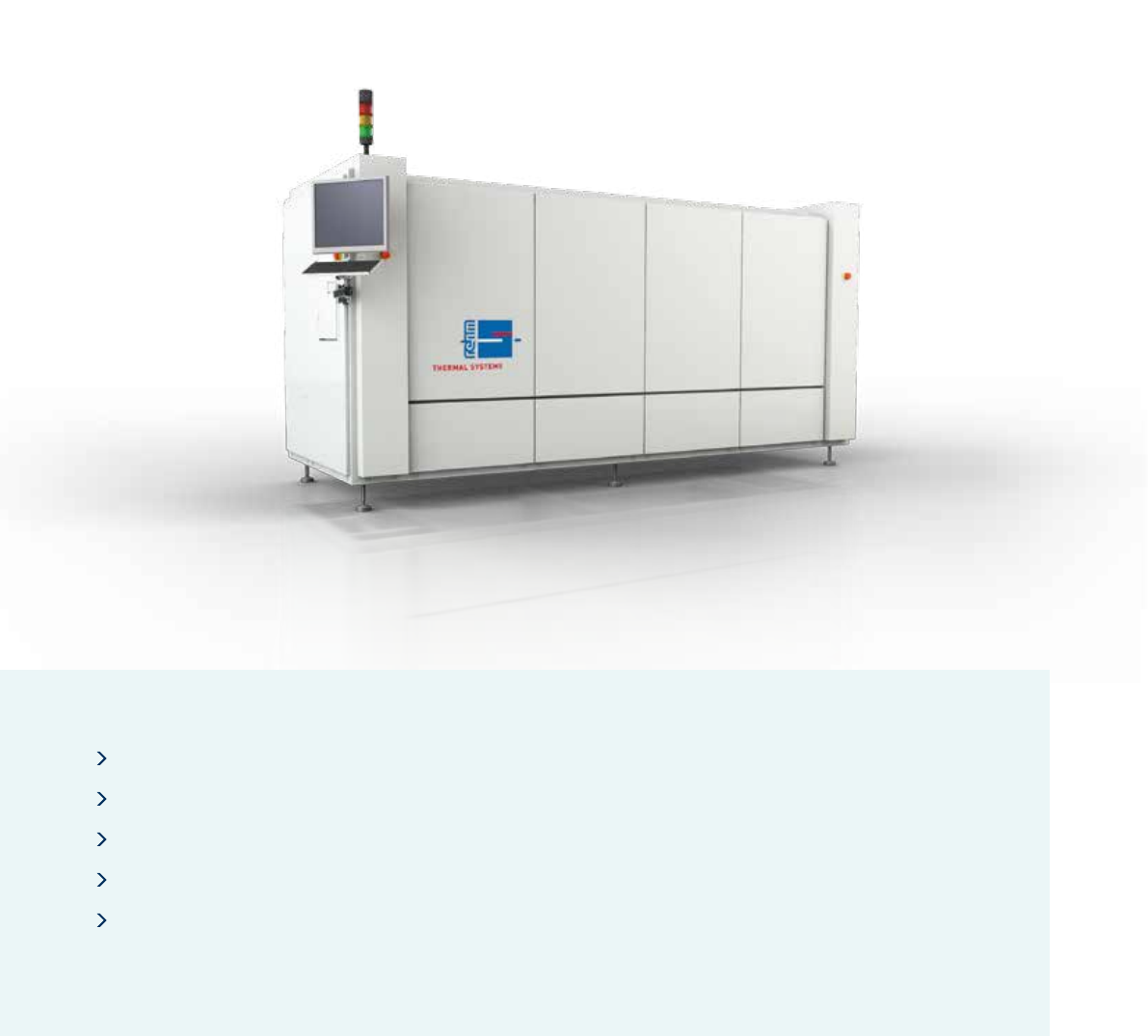
A new world of drying methods
with the RDS magazine dryer from Rehm
The new RDS magazine dryer from Rehm is the perfect sys-
tem with inert gas operation for tempering power modules.
The system can reach temperatures of up to 300 °C and re-
sidual oxygen values of less than 5,000 ppm O
2
. It impresses
with its innovative lock system as well as thermal insulation
that enables a stable elevation prole when in process. The
RDS magazine dryer is particularly suitable for the thermal
treatment of semiconductor applications, hybrid const-
ructions and electronic components that are transported
in magazines. Examples of these would include electronic
components in wind turbines, electric cars or inverters in the
solar energy sector.
Temperatures up to 300 °C possible
Residual oxygen values <5000 ppm O
2
possible
Stableelevationprolethroughlocksystemandgoodthermalinsulation
Steadyheatingofcomponentsatthelowest∆T
High-performancecoolingzoneswithtemperaturesof20°C
Technicaldetails
An overview of the RDS magazine dryer
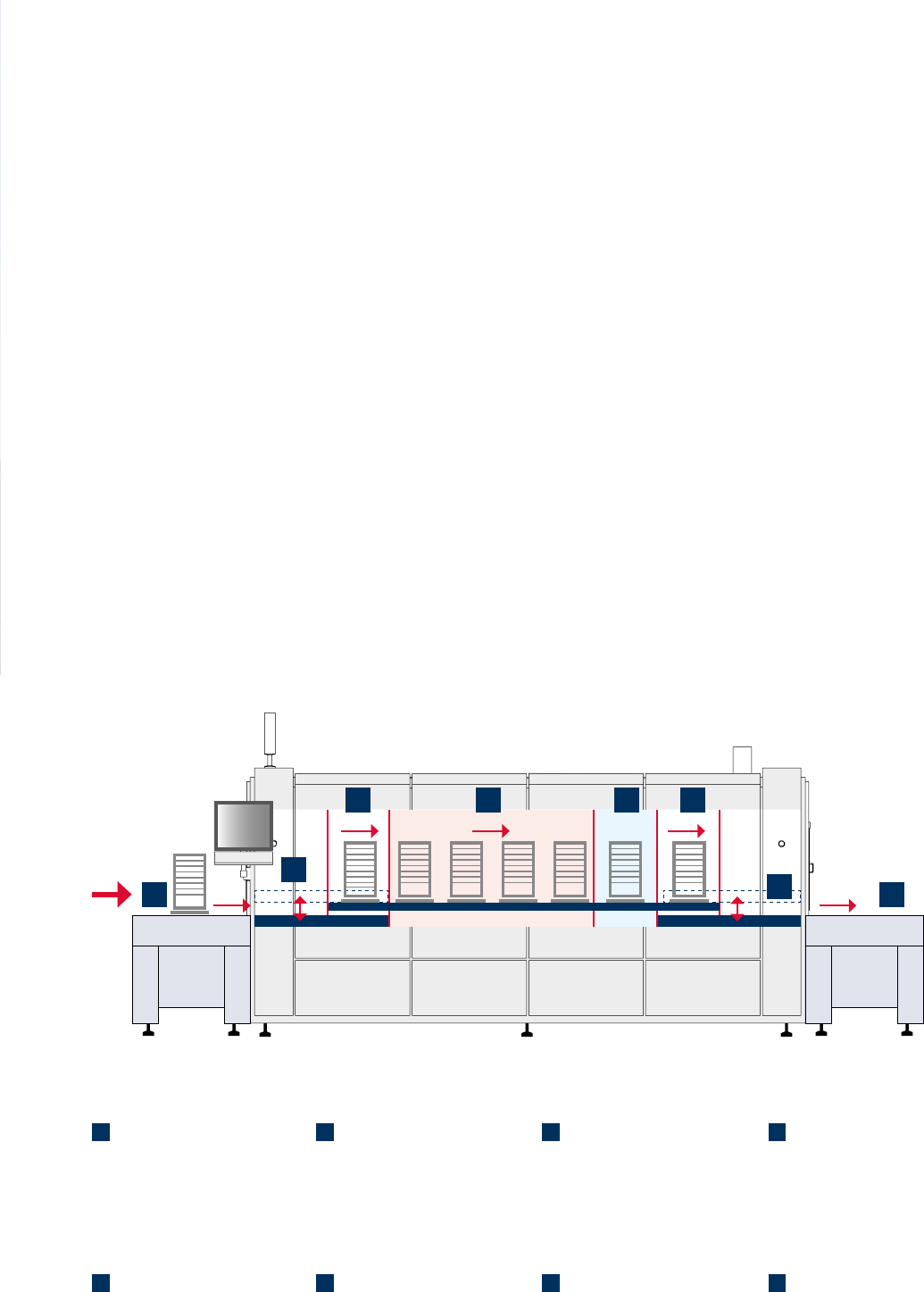
The system consists of a lock system at the inlet and the
outlet, four heat zones, and a cooling zone. In order to
achieve an atmosphere with low levels of oxygen, locks on
the magazine are necessary where possible. A three-part
handling process at the inlet and outlet guarantees that the
compartments can open and close independently of each
other. In this way, an inert process chamber is guaranteed
in every loading situation. The magazines are transferred
to the lock zones with a so-called lifting transport. During
the loading process, the lifting transport unit with the hoist
is lowered below the level of the transport chamber and
simultaneously unloads the magazine onto this. The maga-
zine is unloaded using the opposite principle.
The magazine dryer prototype can be loaded and unload-
ed manually. The system is designed so that it can be fed
using a handling system if necessary. Due to the flexible
transport options, a small throughput during prototype pro-
duction as well as a high throughput during future regular
service is possible. Magazines with the maximum dimen-
sions of 460 mm high, 240 mm wide and 240 mm deep
can be transported using a three-part handling process
with a base carrier plate. The cycle time can be a minimum
of 3 minutes up to a maximum of 24 hours.
There is good thermal separation from the process
chamber due to the compartments and the 80 mm thick
insulation. The exchange of hot and cold gas flows can be
effectively prevented which results in lower electrical power
consumption.
1.
Loading
Loading of the magazines by
hand or using a handling system
in the goods carriers with exact
positioning.
3.
N
2
tunnel
A low level of residual oxygen in
the N
2
tunnel is guaranteed due to
the lock system. Compartments
eliminate air leakage.
5.
Cooling
Optimal thermal separation is
achieved through a compartment
between the heat and cooling zone.
Cooling zone temperatures of 20 °C
are possible.
7.
Lifting transport/Outlet
The locks in the outlet area ensure
a lower ppm value in the process
chamber and a stable elevation
prole.
4.
Pre-heating/Heating
The four heat zones guarantee
steady heating of all the com-
ponents in the magazine at the
lowest ∆ T.
2.
Liftingtransport/Inlet
A lifting mechanism feeds the
magazines to the process cham-
ber transporter.
6.
N
2
tunnel
The locks in the outlet area
ensure a lower ppm value in the
process chamber and a stable
elevation prole.
8.
Unloading
Manual or automated unloading of
the magazine.
1.
6.
7.
8.
2.
3. 4. 5.