2011021008100302.pdf
Remanufactured single- and dual-beam GSM Platforms are flexible, fine pitch placement machines that meet the challenges of chang - ing electronic assembly requirements. Universal ’s Remanufactured GSM Platforms (the sing…
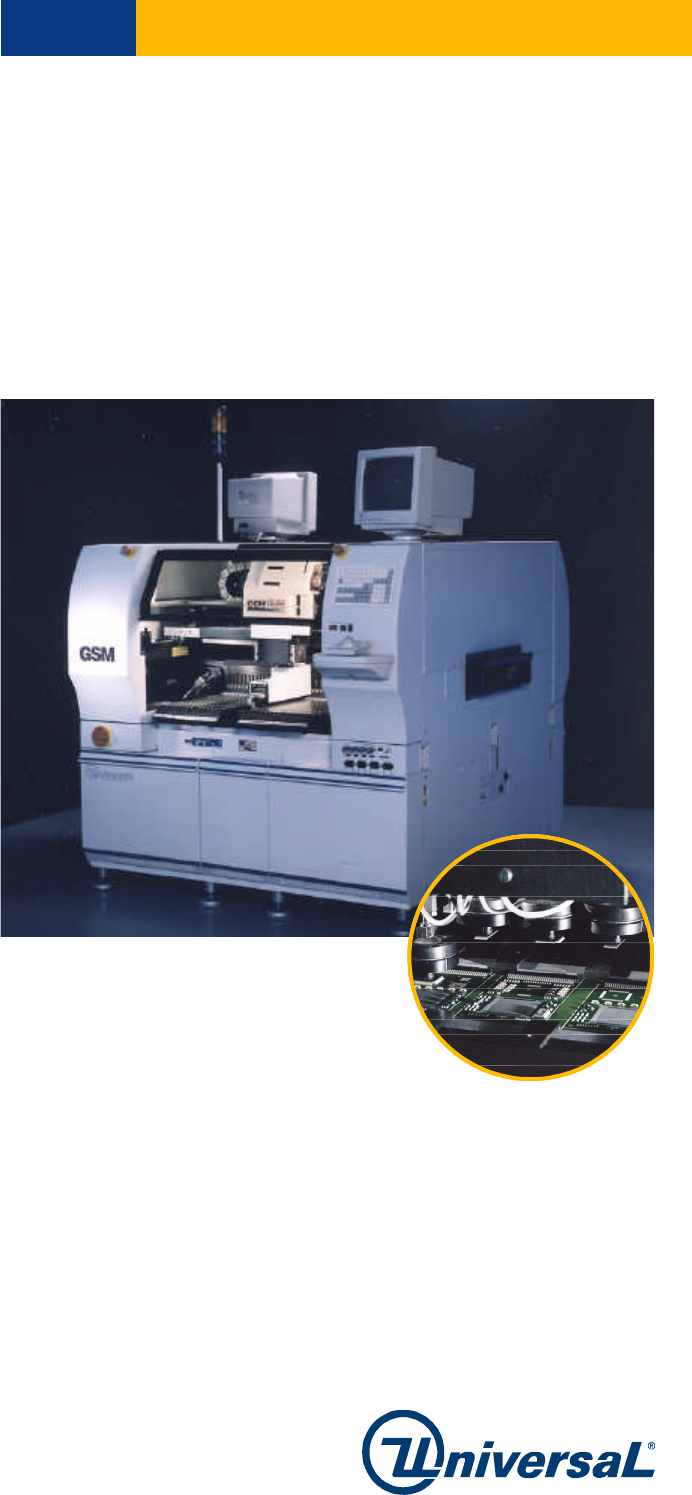
Remanufactured single- and dual-beam GSM
Platforms are flexible, fine pitch placement
machines that meet the challenges of chang-
ing electronic assembly requirements.
Universal’s Remanufactured GSM Platforms
(the single-beam RGSM1 Platform and the
dual-beam RGSM2 Platform) address the
entire spectrum of standard surface mount
components, while also placing a wide range
of odd form components and advanced
assemblies such as flip chips and other chip
scale packages.
Not only do Remanufactured GSM Platforms
meet today’s surface mount placement
needs, but they can also be adapted to meet
tomorrow’s requirements. With their modular
design, these platforms are easily upgraded in
the field with options and enhancements.
RGSM1 and RGSM2 Platforms use standard
user interfaces and interchangeable compo-
nent feeders, placement heads, and inspec-
tion cameras. They employ a high-precision
positioning system, advanced vision system,
and sophisticated control architecture,
providing the flexibility, speed, and accuracy
essential for future growth.
Key Benefits
Value
• Protects against capital equipment
obsolescence through field upgrades and
reconfigurations
• Adapts to changing assembly technology
with tooling elements common among GSM
Platforms
• Maximizes utilization by minimizing
setups and handling the widest range of
components in the industry
• Maximizes throughput with the industry’s
fastest large part tact time and vision-on-the-
fly component inspection
Remanufactured General Surface
Mount Application Machines
(Remanufactured GSM® Platforms)
RGSM1, RGSM2
Specifications
RGSM1 and RGSM2
• Optimizes productivity by interfacing to
factory data collection and automation
systems through optional GEM software
• Optimizes throughput with GSM Platform
production simulations and line balancing
utilities
• Minimizes changeover time and production
cost by using optional bank feeder changer,
Component Shuttle, and/or Platform Tray
Feeder
• Minimizes operator training and simplifies
operation with a graphical user interface com-
mon among GSM Platforms
• Minimizes support costs with replacement
parts, product training, and technical support
common among GSM Platforms
Positioning System
• One-piece, precision-machined base frame
supports an overhead gantry-style positioning
system using linear encoders and a patented,
software-controlled beam damping system
• X/Y linear Heidenhain scales offer repeat-
able, accurate performance over many years
• The drive system uses brushless, DC servo
motors providing optimal acceleration, decel-
eration, and reliability
Vision System
•Features a downward-look-
ing (pattern error correction)
fiducial inspection camera
•CAD download specifies the
shape and size of fiducials
•Automatically corrects for
board variations such as
stretch, rotation misalign-
ment, and skew
•Bad board reject identifies
and bypasses bad boards dur-
ing processing
Specifications
RGSM1 and RGSM2
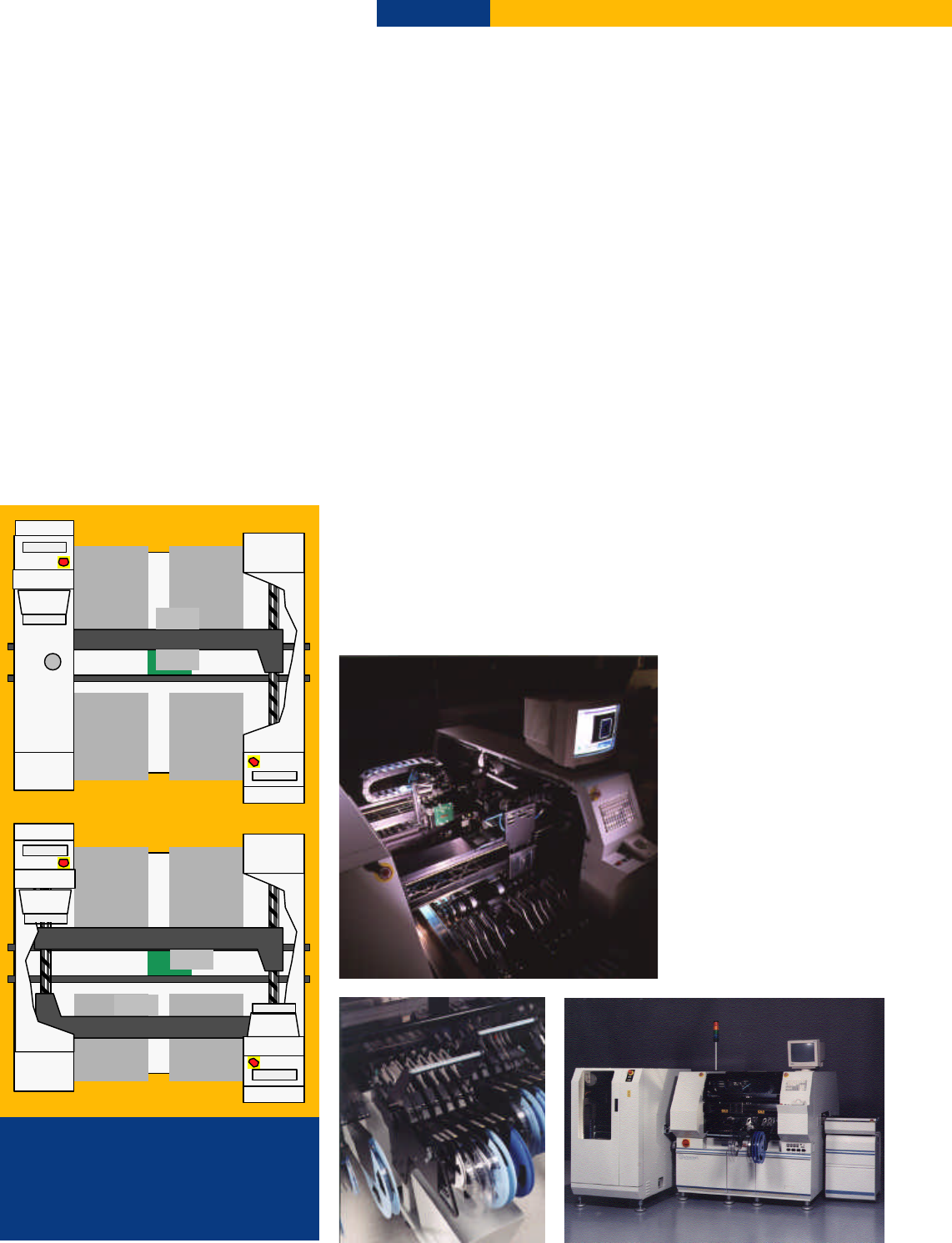
Although the RGSM1 Platform and RGSM2
Platform share the same footprint (66"W x
86"D/168 cm x 218 cm), the dual independent
positioning systems of the RGSM2 Platform
generate a significant increase in throughput.
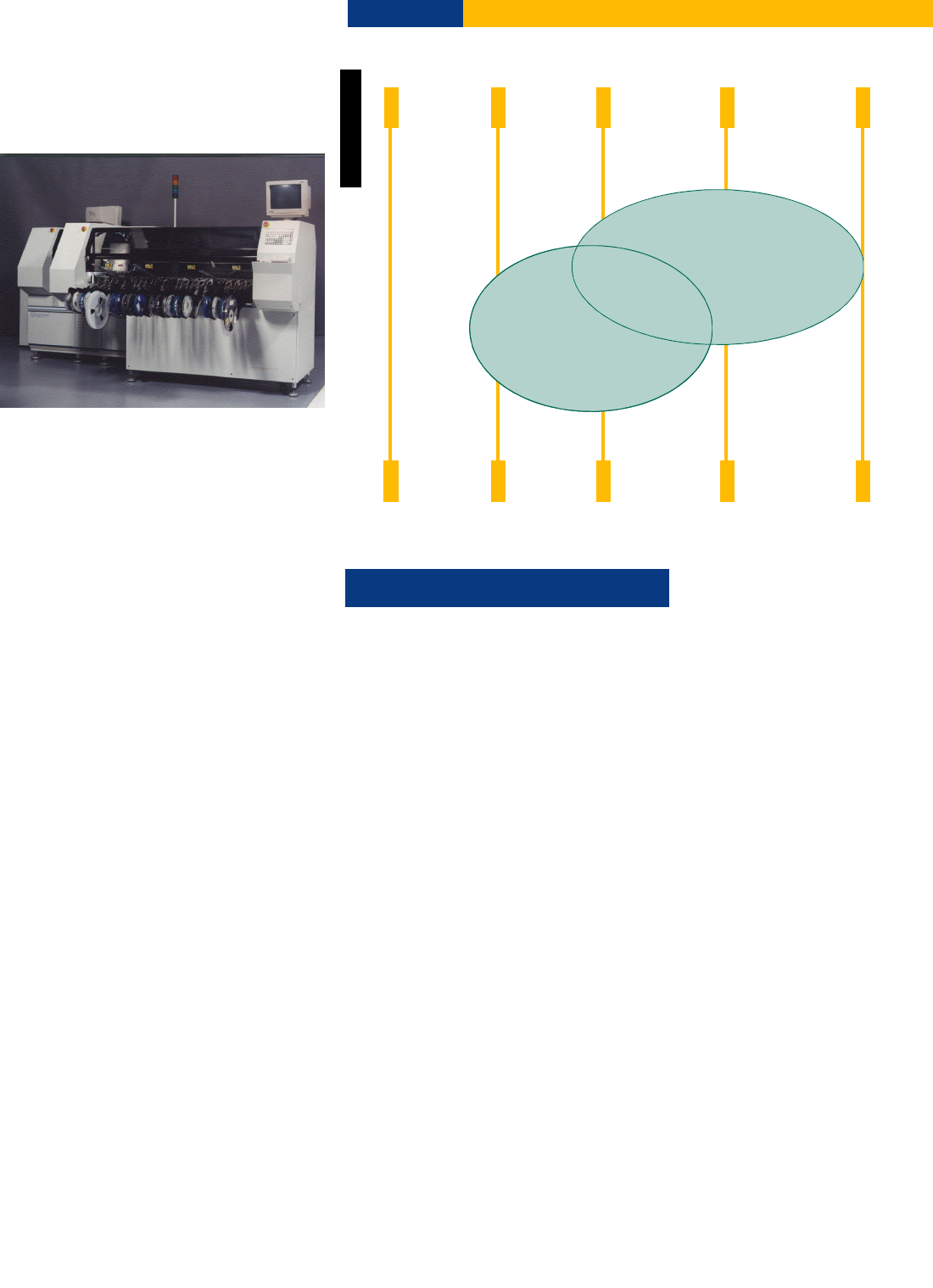
RGSM1 or RGSM2?
Both the RGSM1 Platform and the RGSM2
Platform are price-performance leaders. Your
choice depends on your requirements. The
RGSM2 Platform promotes increased through-
put over the slightly more flexible RGSM1
Platform. Both use common heads, feeders,
tooling, and cameras, and share an identical
footprint.
Board Handling
• Optional dual lane board handling elimi-
nates board transfer delays, dramatically
increasing throughput
• Programmable width control adjusts convey-
or width automatically for fast board
changeover
• Mechanical and optical board alignment
combine for accurate, reliable board location,
avoiding offset errors
• Edge clamping combined with pin-grid
board support compensates for board warp,
sag, and/or flex during dispensing for maxi-
mum flexibility and increased speed
• SMEMA compliant for ease of integration
User Interface
• Universal Platform Software (UPS) uses a
graphical user interface for ease of operation,
while a separate CPU drives a real-time
machine control system
• Standard UPS software can run on a PC or the
machine; programming for next board can be
performed while the current board is running
or off-line
• Complies with TCP/IP, Ethernet®, and GEM
protocols, making board transfer and other
communication issues trouble free in mixed
vendor environments
• On-line user help is provided through main-
tenance instructions, operating procedures,
drawings, complete operator manuals, and a
Web-based troubleshooting guide
Programming Interface
• Built-in performance optimizers and simula-
tors make programming and throughput
analysis quick, accurate, and easy to perform
Specifications
RGSM1 and RGSM2
Options
• GSM Platform Placement and Dispensing
Heads: Available for use on Remanufactured
GSM Platform machines are the FlexJet®
Head, Flex Head, High-Force Head, Ultrafine
Pitch (UFP300+) Head, Positive Displacement
Pump, and Archimedes Metering Valve.
• GSM Platform Feeders: Available for use on
Remanufactured GSM Platform machines are
standard feeders such as tape feeders, track
feeders, multi-tube feeders, and stationary
matrix tray feeders. Smart feeders, such as the
Component Shuttle and Platform Tray Feeder,
are also available. Finally, Universal’s
Applications Engineering Group can develop
feeders for special needs.
• Feeder Bank Changing: Feeder bank chang-
ers permit set up of alternative feeder banks
while the machine is operating.
• Feeder Storage Carts: Feeder storage carts
hold multiple feeders in place, away from the
machine when not in use.
• Board Support: Board support during compo-
nent placement minimizes the effects of
board warp, sag, and flex.
• Board Handling: Conveyors designed and
manufactured by Universal’s Applied
Conveyor Engineering Group transport PCBs
between individual machines within a system.
Components per hour (cph)
0 1,800 3,600 5,700 8,000
RGSM2
RGSM1