Cat.No_.NXTRA_2023.Apr_E.pdf - 第4页
Noz zl es a nd al so he ads c an h ave mainte nan ce p er for me d of f li ne. Using automation units ensures reliable maintenance without requir ing any skills. Linking these units with Nexim improves maintenance manage…
040403
±
15
µ
m
*
+
120,000 cph
*
510
370
510
750
370
280
280
750
610
370
750
610
1R 2R 1R 2R
1R 2R
Checks placement within placement machines
Z0
* This is the throughput in productivity priority mode for two robot modules.
Placement pressure
control
Placement pressure
control
High quality placementHigh quality placement
Maintaining a high level of quality on all placementsMaintaining a high level of quality on all placements
Support for various production typesSupport for various production types
Building production lines with the flexibility to handle various types of productionBuilding production lines with the flexibility to handle various types of production
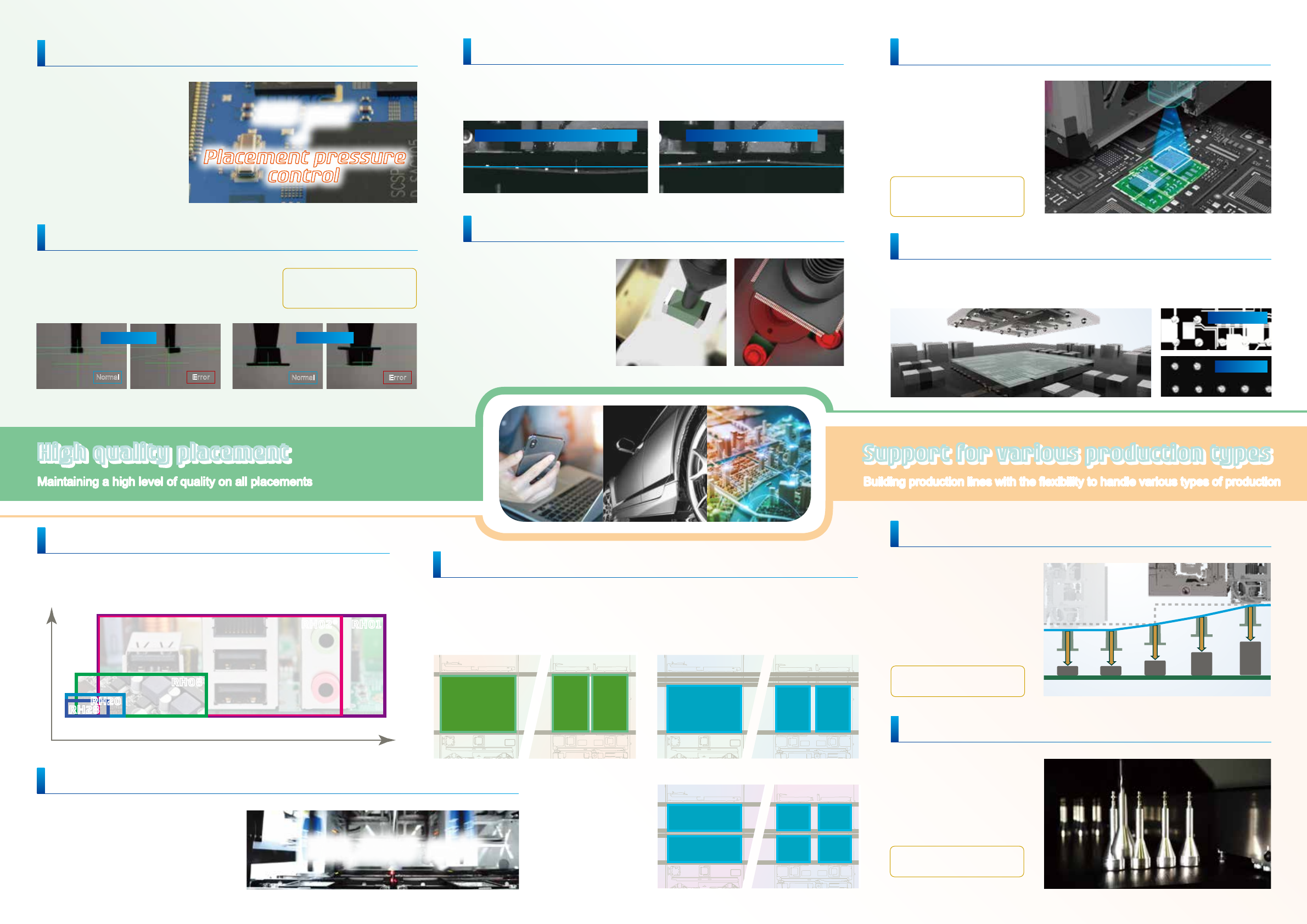
Offers high accuracy placement
Placements can be performed with an
accuracy of ±25 µm at all times
without constraints for the head type
or the parts to be placed. For parts
requiring higher accuracy, placement
with an accuracy of ±15 µm is possible
by using heightened accuracy mode.
Additionally, controlling the push-in
amount during placement allows for
placement with the appropriate
pressure.
Checks for tombstoned, missing, and upside-down parts
- Check for dropped parts
- Check of the part height
- Check for parts presence
- Check for parts remaining on nozzle
- Check for stuck nozzles
Intelligent parts sensor (IPS)
The placement stroke follows changes in the placement height due to panel warpage and distortions,
which allows the machine to control the appropriate push-in amount and moreover prevents
placement deviations and excess stress on parts and panels.
Downward warped panel Upward warped panel
Does not place without contacting the panel
Does not push on parts too much
Prevents defects associated with part properties
Placement defects caused by
operation errors and defective parts
are prevented by checking the
electrical properties of chip parts
with LCR checks and by checking
the leads and bumps on IC parts
with coplanarity checks.
(Option)
3D coplanarity checkLCR check
Various checks are available within
placement machines to verify the process
result shortly after that process: Checking
placement immediately following placement,
and checking placed parts before placing
shield parts, for example. This prevents
production of defective products and
reduces wasted time and parts.
- Part presence check
- Misaligned placement check
- Part direction check*
Mark and parts inspection (MPI)
Places WL-CSPs with high accuracy
The camera equipped with advanced lighting technology, ensures reliable vision processing of WL-CSPs and other
parts for which the background of parts are likely to be captured in acquired images. Using a high-resolution camera
enables reliable recognition of bumps as small as 45 µm in diameter. This results in high accuracy placement.
Existing camera
PC01 camera
Placement heads that demonstrate strong capability in production
The newly-developed heads are capable of handling an expanded part range. They contribute
to line balancing and flexible production without drops in production rates even when a different
set of parts is used in the next production.
World-class speed of placement
Fuji's unique rotary head technology with
simultaneous pickup and improved feeder
indexing speed provides 60,000 cph per
robot.This industry-leading placement speed
takes productivity to the next level.
Expanded conveyable panel size
The panel size coverage is expanded so that panels up to 750 x 610 mm are supported "with single conveyors"
and up to 370 x 280 mm "with double conveyors" when using dual lane production. From large panel production to
highly-efficient production of producing panels in the same size, NXTR line configurations are capable of
supporting a greater variety of production.
Single conveyor
Single conveyance
Double conveyor
Single conveyance
Dual conveyance
Double conveyor
( mm )
Previous action
Optimal placement actions tailored to the part
Operation can be optimized in
various ways to suit the part being
placed, such as by selecting stable
and optimal operation speeds and
streamlining Z direction strokes in
view of the part height. In addition
to making it possible to support
various parts, this also improves
cycle time as well.
- Multi-level transfer speed
- Shortest Z stroke control
Automatic pin allocation even for soft backup pins
The appropriate hard-type or
soft-type backup pins are allocated
automatically.This function is an
effective measure to reduce work
and prevent mistakes during
changeover.
(Option)
- Program-based positioning
- Auto allocation position check
Normal
Error
Normal Error
Pickup deviation
Upside-down part
Supported part range
Supported part height
0201
(008004
"
)
7 x 7 45 x 38 135 x 120 180 x 35 200 x 150
6.5
14
38.1
( mm )
RH02
*
RH02
*
RH08
RH08
RH01
RH01
5 x 5
5
RH28RH28
RH20
RH20
*Maximum part sizes include 175 x 50 mm and 167 x 74 mm in addition to the above.
Placement height adjustment
Not affected by changes in the surface height
* Heightened accuracy mode
* Under development
The installed IPS system can cater to a wide range of checks,
from part pickup stance to parts remaining on nozzles, as well
as upside-down checks for minimold parts. It prevents
placement defects attributed to packaging, nozzles, and parts.
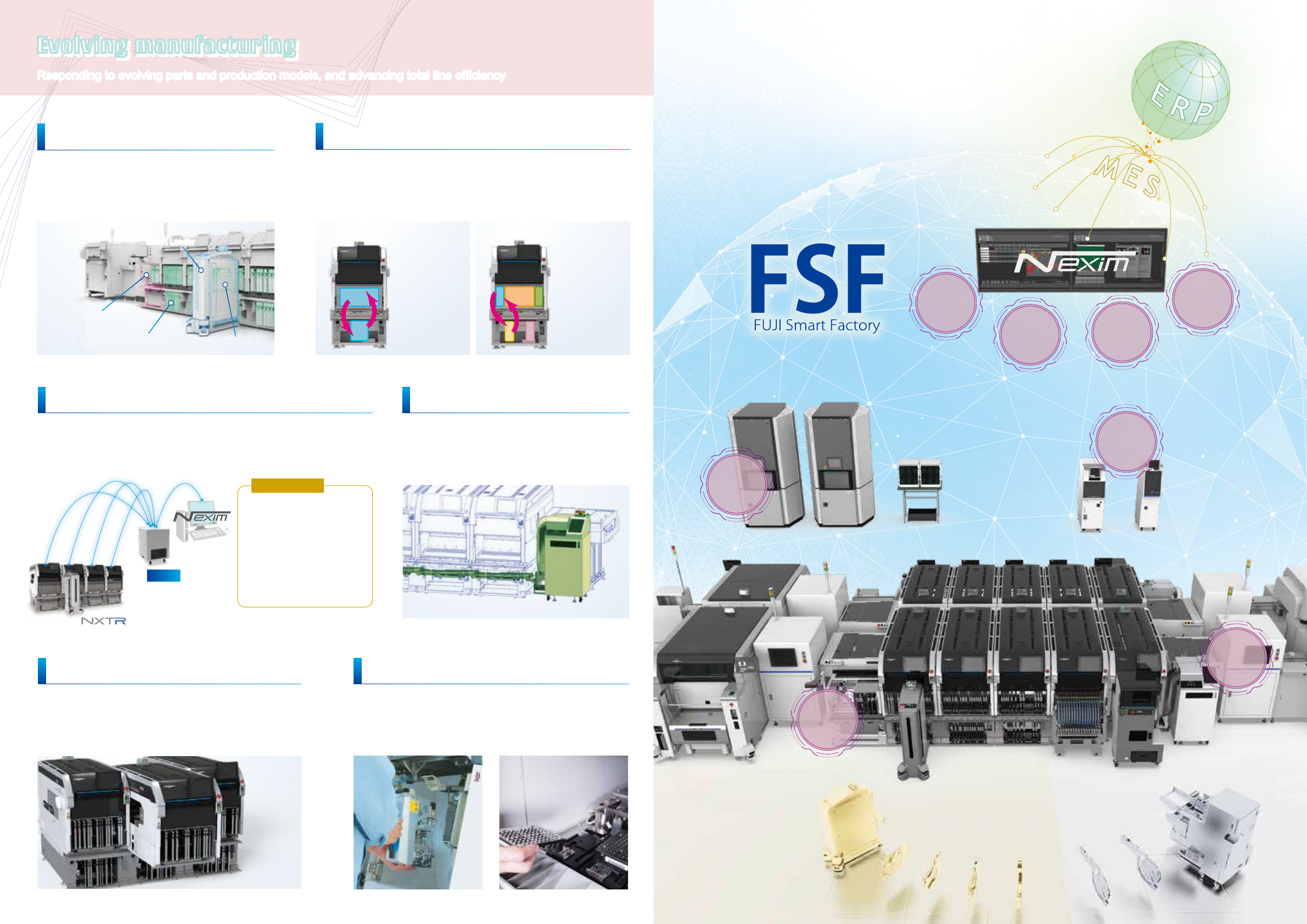
Nozzles and also heads can have maintenance performed offline.
Using automation units ensures reliable maintenance without requiring
any skills. Linking these units with Nexim improves maintenance
management.
LCU
Smart Loaders exchange feeders during production, preventing production stops. A
production method in which parts are supplied from the base buffer during production
is effective for mass production. For high-mix, high-volume production, Smart
Loaders enable changeover during production by changing the different parts only.
Automatic
setup units
M2M
control
Predictive
maintenance
solutions
Dashboard
Traceability
Preparation
schedules
Implementation
schedules
Inventory
control
A
A
DC
B
A
’
Common parts
among multiple
production
models are
shared and only
parts that are
different are
exchanged
Placement with
feeder allocation
optimized for
each production
model or in a
shortest cycle
time
A
model
S
model
0605
Responding to evolving parts and production models, and advancing total line efficiency Responding to evolving parts and production models, and advancing total line efficiency
Evolving manufacturingEvolving manufacturing
Manufacturing sites are all unique, and they have different ways of
production that involve a variety of issues.
Fuji Smart Factory aims to solve these issues, which in turn improves
factory productivity and flexibility as well as maximizes the QCD
performance of manufacturing.
Reducing changeover work
By simply setting cassette-type feeders at buffer stations, the
Smart Loader automatically exchanges the feeders in production
slots and base buffers according to parts out warnings and the
changeover schedule.
Cassette-type feeder
Smart Loader
Smart Loader
Base buffer
Buffer stationBuffer station
Production methods utilizing Smart Loader
For high-volume production For high-mix production
Common
parts
Towards non-stop production
By automatically saving logs and image data, signs of issues that would cause machine
stops and information that would lead to problem solving is not missed, leading to error
prevention and faster recovery times.
- Collects logs automatically
- Saves all images
- On-machine editing
- Multiple language support
- Remote operation
*
- Responds to network issues
*
- Collects logs automatically
- Saves all images
- On-machine editing
- Multiple language support
- Remote operation
*
- Responds to network issues
*
LCU functions
* Under development
Collects waste tape automatically
Waste tape is collected automatically into one place to
reduce operator work that previously needed to be
performed regularly for each module.
Easy maintenance
Pulling forward the module opens up access to the inside the machine
with ease from both sides. This makes it possible to exchange heads
and other units and perform maintenance work with a comfortable
posture.
Automatic, easy, and reliable maintenance offline
Cat.No.NXTRA_2023.Apr_E
© 2023 FUJI CORPORATION. All Rights Reserved.
- The contents of this catalog are subject to change without notice due to constant product development.
- The information in this catalog is current as of April 2023.
19 Chausuyama, Yamamachi, Chiryu, Aichi 472-8686 Japan Tel: +81 566 81 2110
https://www.fuji.co.jp/en/
( mm )
RH28
55,000 cph
60,000 cph
±0.015 mm 3σ
RH01
6,000 cph
-
RH28
RH20
RH08
RH02
RH01
Standard
Sidelight
High resolution
RH28 type
RH20 type
RH08 type
RH02 / RH01 type
795
1,480
45 45
1,590
1,740
39
969
2,471
1,220
External dimensions
Cassette-type feeder
(WA08a to WA56b)
Feeder magazine-65
Buffer stationSmart Loader
Feeder magazine changer
External conveyor
Feeder magazine
65
29
65
29A
WS
CS
Bases
Modules
1R module
2R module
Module change unit
Conveyors
Single
Double
One module base
Two module base
LCU
Waste tape collection unit
Single
Double
Feeders
Nozzles
Nozzle stations
Heads
Parts camera
φ0.2 to φ20.0
Wide range
(S, M, L)
Mechanical chucks
Picker nozzle
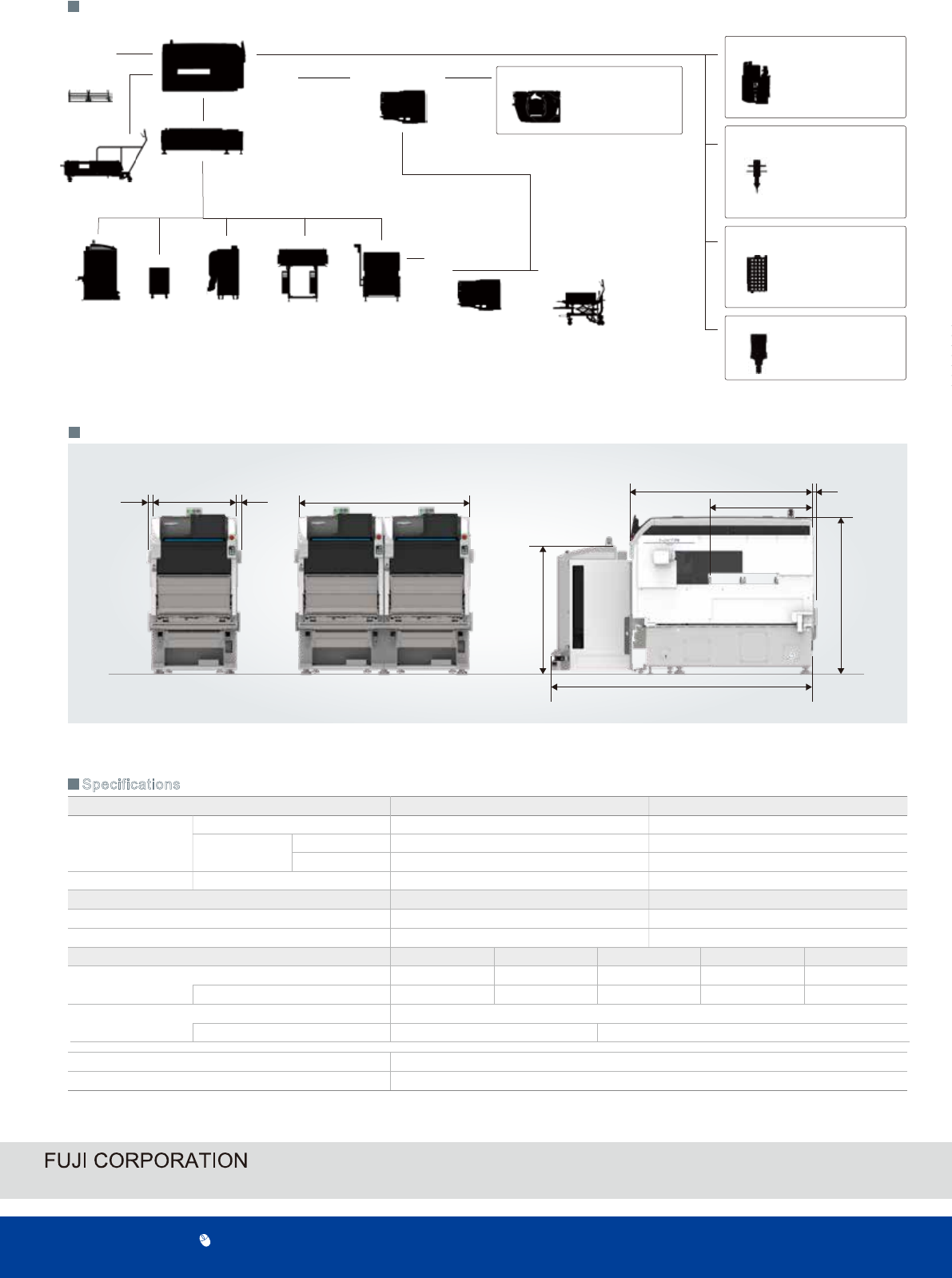
System overview
Module
Panel size (L x W)
Weight
Base
Air consumption
Weight
*1
Head
Throughput
*2
Placing accuracy
*2
Single conveyor
Double conveyor
Double conveyor
Productivity priority mode
Heightened accuracy mode
Specifications
1R module
48 x 48 to 750 x 610 mm
48 x 48 to 750 x 510 mm
48 x 48 to 750 x 280 mm
680 kg
One module base
70 L/min (ANR)
480 kg
RH20
50,000 cph
55,000 cph
RH08
30,000 cph
-
±0.025 mm Cpk
≥ 1.00
3-phase AC 200 to 230 V ±10 V (50/60 Hz)
0.4 MPa
RH02
9,000 cph
-
-
2R module
48 x 48 to 370 x 610 mm
48 x 48 to 370 x 510 mm
48 x 48 to 370 x 280 mm
800 kg
Two module base
140 L/min (ANR)
910 kg
*1 The two module base dedicated for 1R modules is 890 kg.
*2 Under optimum Fuji conditions.
Power
Air
Single conveyance
Dual conveyance
NXTR A model