00198523-01_UM_LDU_E_DE_EN_ZH.pdf - 第84页
2 Operational safety 2.4 ESD guidelines 84 User Manual / Bedienungsanleitung / 用户手册 SIPLACE Linear Dipping Unit E 12/2018 2.4.5 Dispatching ESD modules ► Always store modules and components in conductive packaging (e.g. …

2 Operational safety
2.4 ESD guidelines
User Manual / Bedienungsanleitung / 用户手册 SIPLACE Linear Dipping Unit E 12/2018 83
2.4 ESD guidelines
2.4.1 What does ESD mean?
Fig.1: ESD label
Almost all of the modules in use today are equipped with highly integ-
rated Metal-Oxide-Semiconductor (MOS) blocks and components.
The manufacturing techniques used mean that these electronic com-
ponents are extremely sensitive to overvoltage and thus to electro-
static discharge.
The abbreviation for such modules is "ESD" (Electrostatic Sensitive
Device). "ESD" is used internationally. The following symbol on cab-
inet rating plates, racks or packaging indicates that components
which are sensitive to electrostatic discharge have been used and
thus that the modules concerned are also touch-sensitive.
ESDs can be destroyed by voltages and power levels that are far below the level that can be per-
ceived by humans. Such voltages occur if a person touches a component or module without
earthing themselves. Components that are exposed to such overvoltages do not generally appear
to be defective immediately - incorrect behavior starts after the component or module has been in
operation for some time.
2.4.2 Important measures to protect against static charging
► Most plastics can easily become charged and must therefore be kept away from at-risk com-
ponents.
► Always ensure that people, the workplace and packaging are safely earthed when handling
electrostatic sensitive components.
2.4.3 Handling ESD modules
Do not touch electronic modules unless it is absolutely essential to do so in order to carry out other
work. If it is necessary, make sure that you do not touch the pins or printed conductors when you
pick up flat modules.
Do not touch components unless:
●
you are constantly earthed by an ESD wrist strap or
●
You are wearing ESD shoes or ESD shoe earthing strips on an ESD floor.
Always discharge yourself before you touch an electronic module. To do this, simply touch a con-
ductive and earthed object immediately before you touch the module (such as unpainted parts of a
switch cabinet, a water pipe, etc.).
Do not allow modules with chargeable and highly insulating materials to touch one another, e.g.
plastic films, insulating table surfaces or items of clothing made from synthetic fibers.
Always place the modules on a conductive surface (table with an ESD coating, conductive ESD
foam, ESD bag or container).
Do not move the assemblies near to data view devices, monitors or television units. Keep a min-
imum distance of 10 cm to monitors.
2.4.4 Measurements and modifications to ESD modules
Do not take measurements on the modules unless the following conditions are fulfilled:
●
The measuring device is earthed (e.g. via PE conductors) or
●
You discharge the measuring head just before taking measurements with a potential-free
measuring device (e.g. by touching an unpainted metal part of the controller casing).
► Always use an earthed soldering iron if you carry out any soldering work.

2 Operational safety
2.4 ESD guidelines
84 User Manual / Bedienungsanleitung / 用户手册 SIPLACE Linear Dipping Unit E 12/2018
2.4.5 Dispatching ESD modules
► Always store modules and components in conductive packaging (e.g. metallized plastic bags
or metal sleeves) and dispatch them in conductive packaging.
► If the packaging is not conductive, place the modules in a conductive envelope before pack-
aging. Use conductive expanded rubber, ESD bags, domestic aluminum foil or paper, for ex-
ample. NEVER use plastic bags or film.
► If the module has integral batteries, ensure that the conductive packaging does not touch or
short circuit the battery terminals and, if necessary, first cover the terminals with insulating
tape or material.
3 Function description and structure
3.1 Function description
User Manual / Bedienungsanleitung / 用户手册 SIPLACE Linear Dipping Unit E 12/2018 85
3 Function description and structure
3.1 Function description
The LDU is set up on a changeover table in the same way as any other feeder module. The line
software (SIPLACE Pro) can be used to select components for dipping and to set the relevant
parameters. The LDU makes the flux available in a certain area, in the pre-defined amount (layer
thickness). The layer of flux is always renewed by automatically performed application runs. This
ensures that the components are dipped in a fresh layer of flux and that consistent process condi-
tions are maintained.
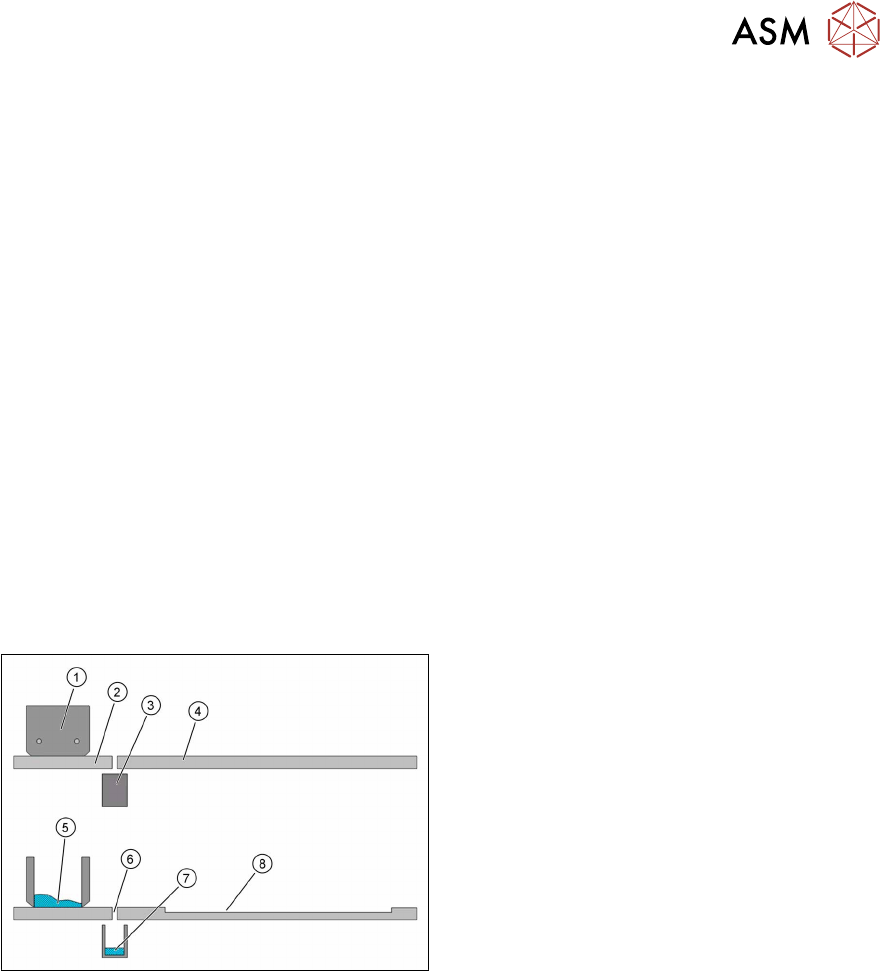
The LDU can be roughly divided into a mechanical section - an application unit - and an electrical
section - the so-called control unit.
Control unit
The control unit contains the electrical parts, such as the power supply, interfaces, the control sys-
tem and the operating unit.
Application unit
The application unit has two movement axes. The squeegee axis moves a slide unit back and forth.
The lift axis moves the lift unit up and down. Both of these axes are driven by electrical motors and
a spindle system. A rotary encoder on the motor shaft determines the current position of the
spindle. Both axes have sensors which indicate when the axis reaches its end position.
The application unit of the LDU consists of the
following main parts:
1. Flux tank
2. Park plate
3. Drip tray
4. Dip plate
5. Flux
6. Interface
7. Flux in the drip tray
8. Cavity