AD-31 Handguns Manual.pdf - 第5页
5 108 835A Safety Thermoplastic Hot Melt Material NOTE: Always refer to the material manufacturer ’s Material Safety Data Sheet (MSDS) or material information sheet before working with any hot melt material. S Ensure the…
4
108 835A
Safety
Danger of Burns
Contact with hot melt materials or hot areas of the unit
may produce a severe skin burn.
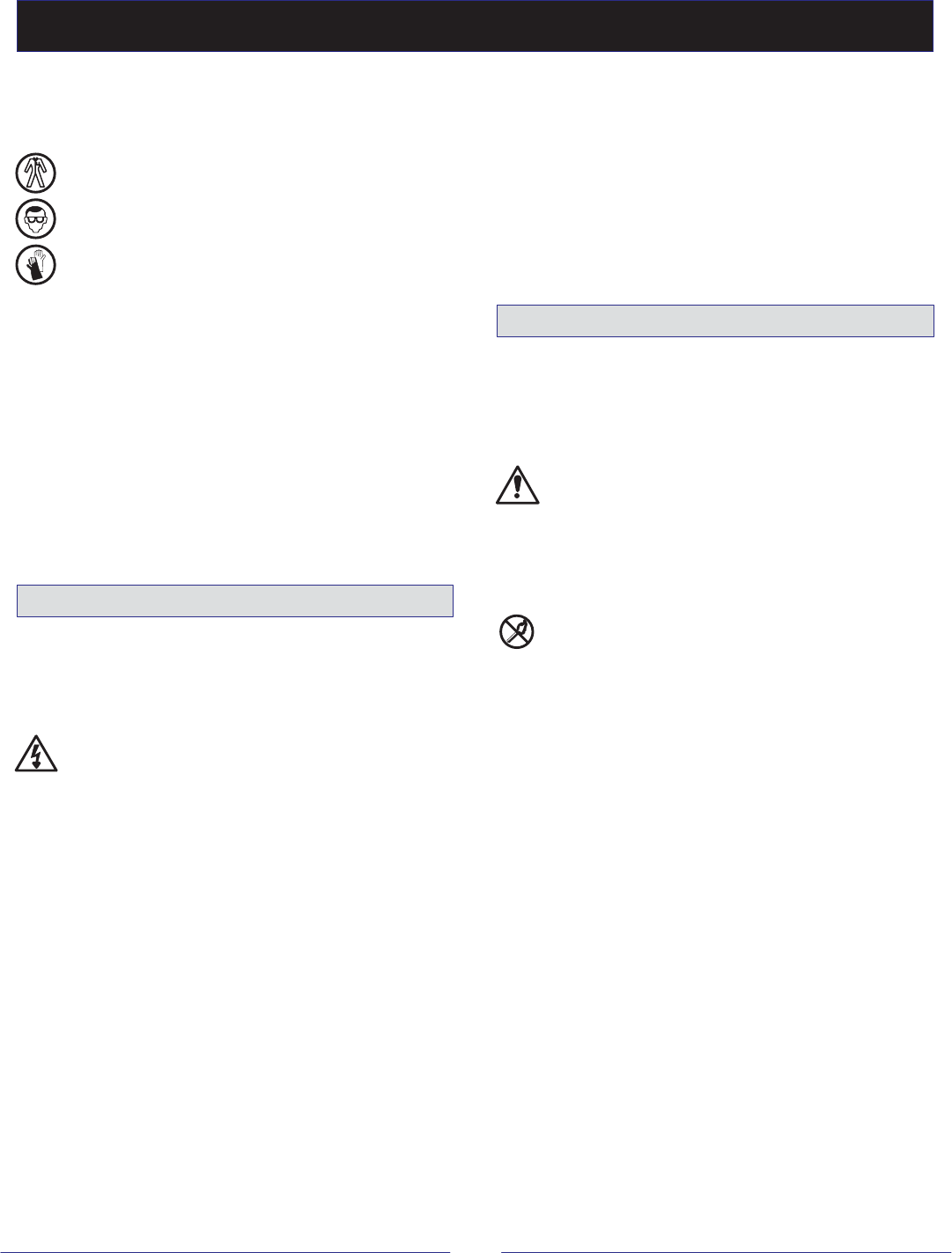
WARNING: Hot! Risk of burns. Wear
heat-protective clothing, safety goggles, and/or
heat-protective gloves.
S Be extremely careful when using hot melt material.
Even solidified material may still be very hot.
S Always wear protective clothing which safely covers
all exposed parts of the body.
In case of burns:
S Immediately cool affected skin areas using cold,
clean water.
S Do not forcefully remove hot melt material from the
skin.
S Immediately seek medical attention.
Maintenance/Repair
Allow only qualified personnel to perform the
procedures described in this document. When
performing such tasks, wear protective clothing and
equipment.
WARNING: Even when the circuit breaker or
main power switch is OFF, the unit is still
electrically energized. Complete the following
steps prior to maintenance or repair:
S Disconnect, lock out, and tag external power
supply.
S To ensure the external power supply is
disconnected, attempt to operate the unit. If the unit
does not energize, proceed with maintenance or
repair work.
S If the unit energizes, repeat the disconnect, lock
out, and tag procedure. Re-test the unit.
S Follow the specific instructions provided in this
manual to release the system pressure in the entire
unit.
S Secure pneumatically- or hydraulically-operated
equipment against uncontrolled movement.
S Only use parts which do not compromise the safety
of the unit. Only use genuine Nordson parts.
S Always use tools with insulated handles when
removing or installing components.
Cleaning
NOTE: Always refer to the material manufacturer’s
Material Safety Data Sheet (MSDS) or material
information sheet before working with any hot melt
material.
WARNING: Never clean any aluminum part or
flush any system using halogenated hydrocarbon
fluids. Examples of common halogenated
hydrocarbons are: dichloromethylene,
1,1,1-trichloroethylene, and perchloroethylene.
Halogenated hydrocarbons may react violently
with aluminum parts.
WARNING: Fire, open flame, and smoking are
prohibited when cleaning fluids are used.
Observe all explosion prevention regulations.
Cleaning fluids may only be heated using
temperature-controlled and explosion-protected
heaters.
S Never use an open flame to clean the unit or
components of the unit.
S Use only cleaning fluids designed or intended to be
used with the hot melt material being used in the
unit. Never use paint fluids under any
circumstances.
S Note the flash point of the cleaning fluid used. Only
use a controlled heating method to heat fluids.
S Ensure sufficient room ventilation to draw off
generated vapors. Avoid prolonged breathing of
vapors.
5
108 835A
Safety
Thermoplastic Hot Melt Material
NOTE: Always refer to the material manufacturer’s
Material Safety Data Sheet (MSDS) or material
information sheet before working with any hot melt
material.
S Ensure the work area is adequately ventilated.
S Do not exceed recommended processing
temperatures. Doing so creates a danger to
personnel due to decomposition of the material.
Equipment and Material Disposal
Dispose of equipment and materials used in operation
and cleaning according to local regulations.
Polyurethane Reactive (“PUR”) Hot Melt Material
NOTE: Always refer to the material manufacturer’s
Material Safety Data Sheet (MSDS) or material
information sheet before working with any hot melt
material.
WARNING: Exercise extreme caution and
always provide adequate ventilation when using
reactive materials.
WARNING: Only use PUR material in units that
are designed to process such material. Using
PUR material in units that cannot process them
can cause damage to the unit and premature
reaction of the hot melt material.
WARNING: PUR material contains isocyanate
ingredients which will irritate skin, mucous
membranes of eyes and respiratory passages.
WARNING: Persons with existing asthmatic
conditions may experience difficulty in breathing.
Because isocyanate ingredients are found in various
concentrations in reactive materials produced by
different manufacturers, it is imperative that the material
manufacturer’s MSDS or material information sheet be
consulted BEFORE using reactive material. Pay
particular attention to the discussion of material toxicity,
health effects, and reactivity condition.
There are certain universal safety guidelines that should
be followed when using any reactive material:
S Recommended processing temperatures must not
be exceeded.
S When handling and using reactive material, always
wear thermally protective gloves and long-sleeved
clothing.
S Wear chemical goggles to reduce the potential of
eye contact.
S Have eye washes available and provide a cold
water source for burn treatment.
S The regular use of barrier cream for hands and face
is recommended for skin protection.
S Do not eat, drink, smoke, or store food in working
areas where PUR material is being processed.
S Wash hands thoroughly after working with reactive
material.
S Remove hot melt material vapors using suitable
extraction ventilation equipment.
S Use appropriate respiratory equipment where there
is the danger of inhaling isocyanate vapors or other
ingredients contained in the PUR material in
concentrations exceeding permissible limit values.
S In case of very high concentrations of harmful
substances, or if you are unsure of the
environmental conditions, respiratory protective
equipment (operating independent of the
surrounding air) must be used.
S Do not operate the unit with PUR materials if you
are unsure that ALL adequate safety measures
have been taken.
6
108 835A
Description
3
4
5
6
7
1
2
4203001
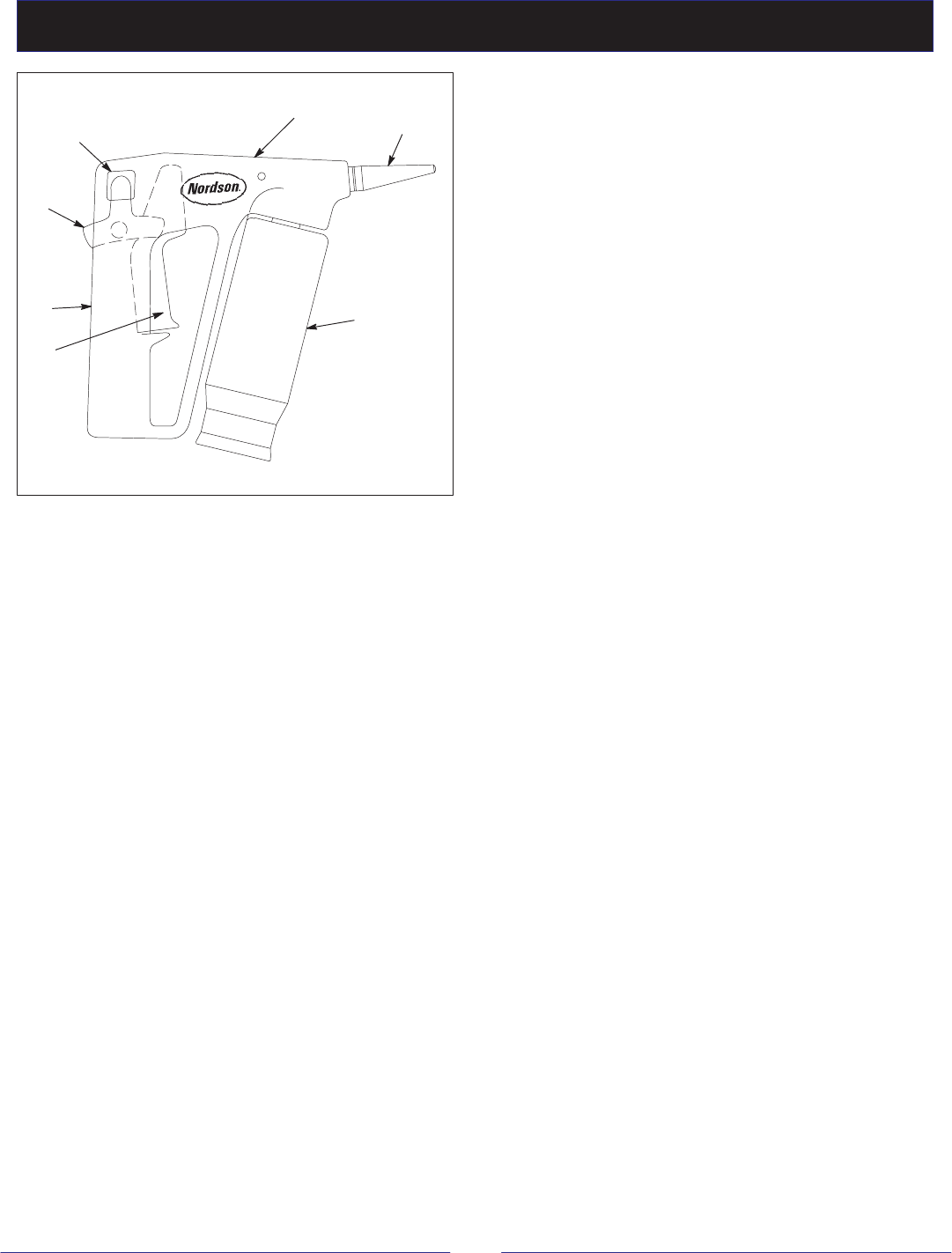
Figure 1 Typical AD-31 Handgun
1. Gun Body
2. Nozzle
3. Pivot Sleeve
4. Trigger
5. Handle
6. Trigger Lock
7. Gun Slot (for hanging
gun)
Nordson Series AD-31 Handguns may be used only for
manually dispensing hot melt adhesives, sealants, and
other thermoplastic materials.
The Series AD-31 Handguns include several models for
a variety of dispensing patterns, including solid or
foamed extrusion beads, atomized spray patterns, and
swirl spray patterns. For handling high viscosity or filled
materials, the AD-31 LBS extrusion handgun
incorporates a large ball-and-seat and larger flow paths.
Depending on the applicator design, handguns employ
either a preset thermostatic temperature sensor or an
RTD (resistance temperature detector) sensor. RTD
sensing provides temperature control precision by
reducing temperature fluctuations that could negatively
affect flow and cause char formation. A wide operating
temperature range of 65_ to 230 _C (150_ to 450 _F)
provides additional application versatility.
A typical AD-31 extrusion handgun is shown in Figure 1.
The gun consists of the following components:
S Gun Body
S Handle
S Pivot Sleeve
S Trigger Lock
S Trigger
S Nozzle
S Gun Slot (for hanging gun)