AD-31 Handguns Manual.pdf - 第8页
8 108 835A Daily Operation Relieving Hydraulic Pressure Remove system pressure before disassembling and replacing any gun components. 1 . Heat the system to operating temperature. W ARNING : System or material pressurize…
7
108 835A
Daily Operation
Startup
WARNING: Hot! Risk of burns. Wear
heat-protective clothing, safety goggles and/or
heat-protective gloves depending on the symbol
shown.
1. At the applicator, bring the adhesive to application
temperature.
WARNING: Do not swivel or trigger the gun
while it is cold.
2. Turn on the applicator pump. Adjust the system
hydraulic pressure to the value required for the
application. The recommended adhesive
hydraulic pressure range is 2.41 - 4.83 MPa (350 -
700 psi).
WARNING: For most extrusion applications,
adhesive should not project further than 18 in.
from the nozzle when the gun is fired in the
horizontal position. Otherwise, system hydraulic
pressure may be too high, resulting in poor
pattern control and harm to personnel or
equipment.
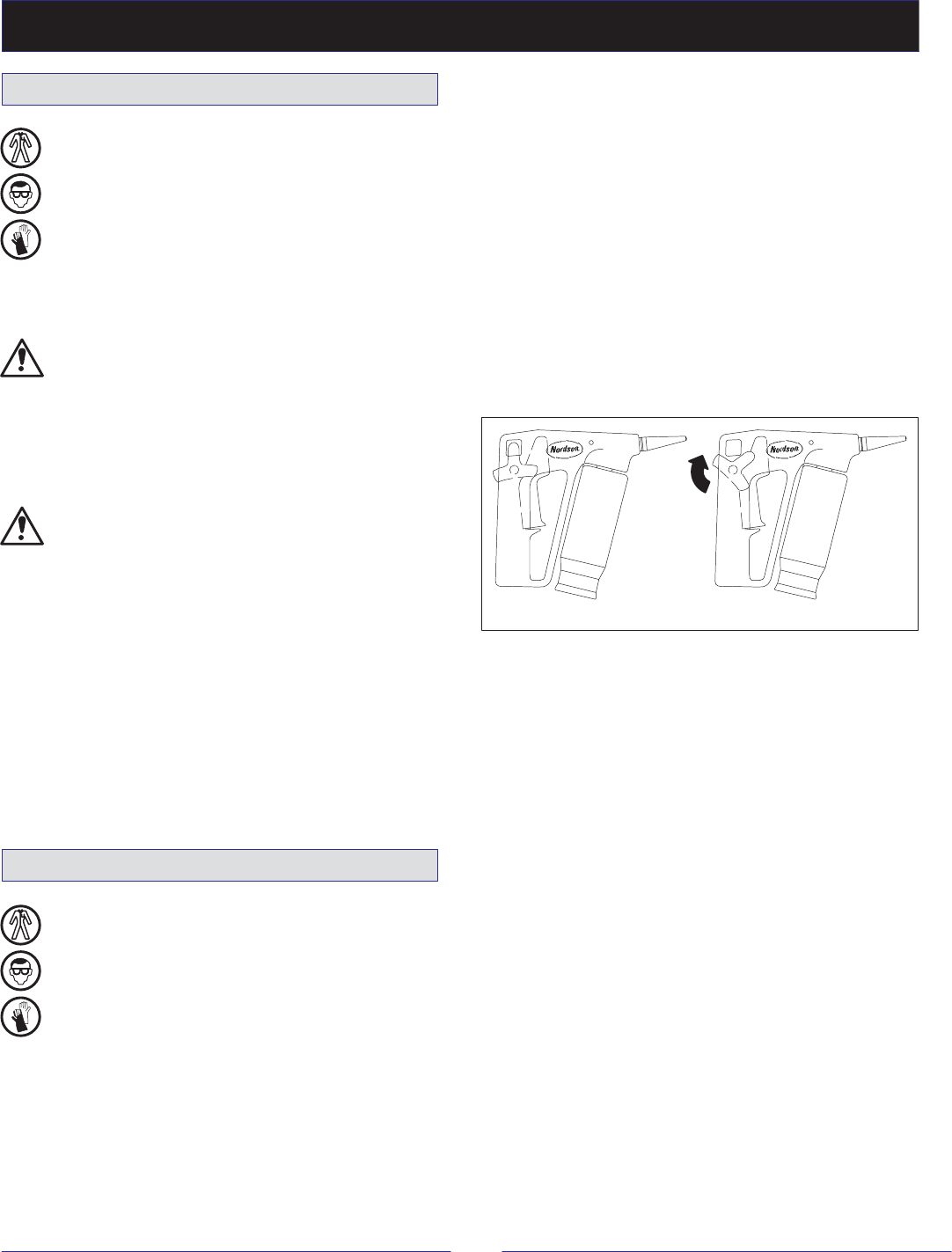
3. Place the trigger lock in the unlocked position (see
Figure 2).
4. Aim the handgun so the nozzle is pointing at the
substrate.
5. Begin dispensing adhesive by squeezing the
handgun trigger toward the handle.
6. Stop dispensing adhesive by releasing the trigger.
Shutdown
WARNING: Hot! Risk of burns. Wear
heat-protective clothing, safety goggles and/or
heat-protective gloves depending on the symbol
shown.
1. Place the trigger lock in the locked position
(see Figure 2).
2. Turn off power to the applicator pump as
described in your applicator technical manual.
S Systems with a piston pump:
Reduce pump air pressure to zero and
disconnect the supply air line to the pump.
Place the air pump ON/OFF switch in the
OFF position.
S Systems with a gear pump:
Turn the motor speed dial to 0%.
Place the motor ON/OFF (or START/STOP)
switch in the OFF (or STOP) position.
3. Place the trigger lock in the unlocked position
(see Figure 2).
4203002
12
Figure 2 Lock Positions
1. Unlocked position 2. Locked position
4. Place a suitable waste container, capable of
withstanding adhesive temperatures of 230 _C
(450 _F), on the floor near the dispensing point.
5. Aim the gun so the nozzle points into the
container.
6. Drain adhesive from the handgun by squeezing
the trigger toward the handle. Continue
dispensing adhesive until system hydraulic
pressure is relieved and the gun is drained of
adhesive. Properly dispose of the drained
adhesive.
7. Place the trigger lock in the locked position
(see Figure 2).
8. Hang the handgun by the gun slot at the top of the
handle.
9. Relieve any residual hydraulic pressure as
described in the following topic.
10. Shut down the applicator as described in your
applicator operator instructions or technical
manual.
8
108 835A
Daily Operation
Relieving Hydraulic Pressure
Remove system pressure before disassembling and
replacing any gun components.
1. Heat the system to operating temperature.
WARNING: System or material pressurized.
Relieve pressure. Failure to observe may result
in serious burns.
2. Follow the procedures described in your applicator
technical manual to relieve system pressure. In
general, relieving system pressure requires that
you perform all of the following actions that are
appropriate for your unit:
S Systems with a piston pump:
Reduce pump air pressure to zero and
disconnect the supply (incoming) air line.
Place the air pump ON/OFF switch in the
OFF position.
S Systems with a gear pump:
Turn the motor speed dial to 0%.
Place the motor ON/OFF (or START/STOP)
switch in the OFF (or STOP) position.
3. Shield the area and the operator.
4. Trigger all handguns to relieve any trapped
hydraulic pressure.
5. Place the trigger lock in the locked position
(see Figure 2).
6. Reduce air pressure to the handgun by reducing
gun air pressure to zero at the regulator (spray
and swirl guns only).
WARNING: Hot! Risk of burns. Wear
heat-protective clothing, safety goggles and/or
heat-protective gloves depending on the symbol
shown.
7. Wear heat-protective safety gloves.
8. Place a pan under the drain valve and drain the
unit manifold by following the procedure described
in the applicator technical manual.
CAUTION: Equipment damage can occur if the
applicator drain valve is turned with anything
other than a screwdriver. Use only a screwdriver
to turn the drain valve.
9. Use a screwdriver to open the drain valve.
10. Allow the manifold to drain as completely as
possible.
11. Use a screwdriver to close the drain valve.
12. Properly dispose of the drained adhesive.
Daily Maintenance
Cleaning Exterior Surfaces
Clean all exterior gun and nozzle surfaces daily. Use a
cleaning fluid such as Nordson Type R fluid.
Accumulated hot melt material forms char, which can
cause unreliable operation of the applicator.
WARNING: Risk of death or serious injury from
explosion or fire if Nordson Type R fluid is heated
above 245 _C (475 _ F). Do not use Type R fluid
on surfaces that are above 245 _C (475 _ F).
9
108 835A
Weekly Maintenance
Cleaning the Nozzle
Clean gun nozzles weekly unless operating experience
indicates that a different schedule must be followed.
Depending on several factors, nozzle cleaning may be
required more or less frequently than once a week.
Among the factors affecting cleaning frequency are the
plant environment and the adhesive used.
CAUTION: Gun nozzles can be damaged if an
open torch, drill, or broach is used for cleaning.
Use only a pin-type probe to clean a nozzle.
To clean a nozzle on a Series AD-31 Handgun:
1. Heat the system to the adhesive manufacturer’s
recommended application temperature.
2. Relieve the system hydraulic pressure. (Refer to
Relieving Hydraulic Pressure in Daily Operation.)
3. Disconnect and lock out power to the main circuit
breaker for the applicator input power line.
4. Place the trigger lock in the locked position
(see Figure 2).
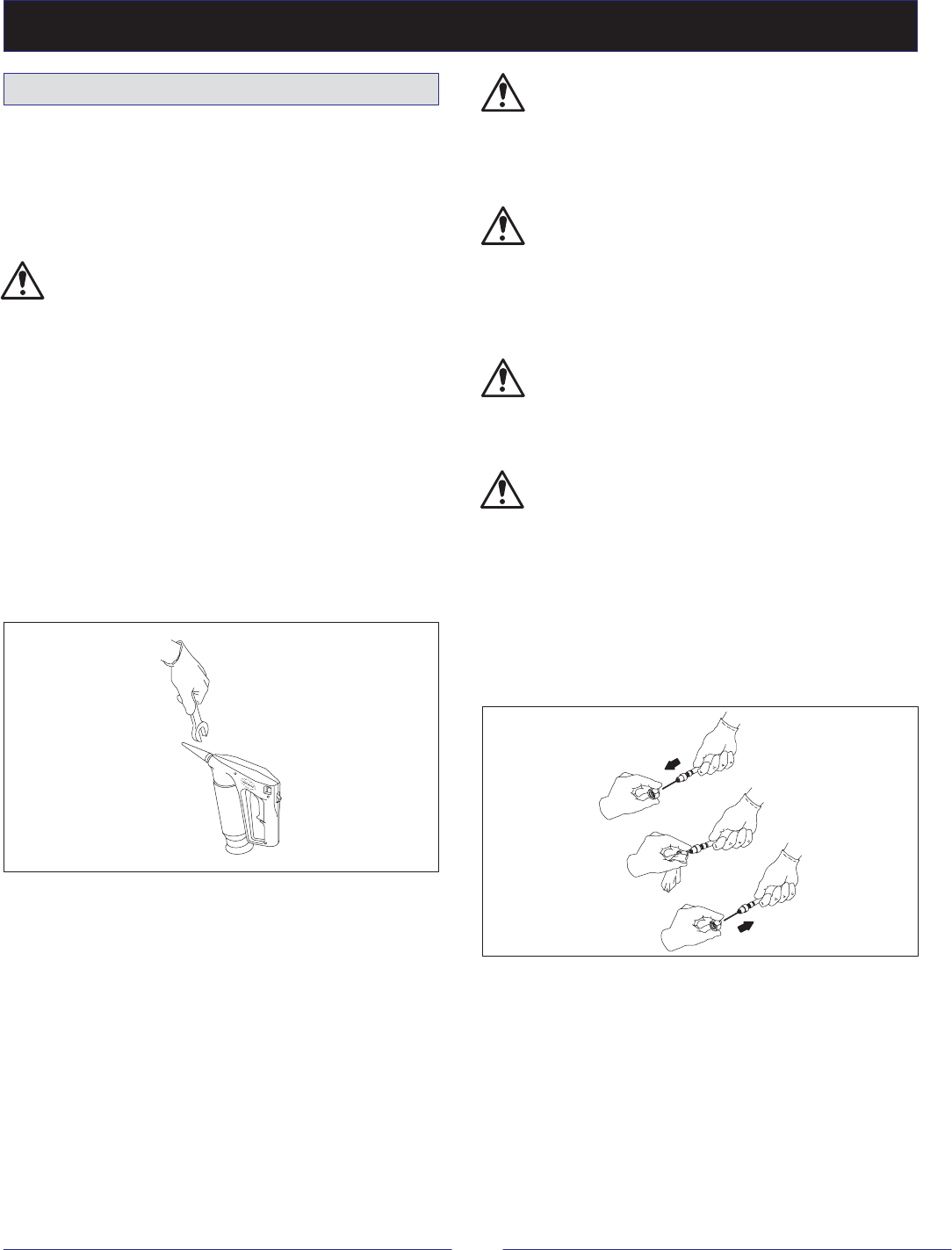
5. Use an appropriate size wrench to loosen the
nozzle.
4203003
Figure 3 Removing a Nozzle
6. Remove the nozzle.
7. Place the nozzle in a container of Nordson Type R
fluid and heat the container to the adhesive
melting point using a controlled heating source.
WARNING: Risk of death or serious injury from
explosion if Nordson Type R fluid is heated
above 245 _C (475 _ F). To maintain Type R fluid
at a safe temperature, use a controlled heating
source, such as a deep-fat fryer or hot plate with
a temperature controller.
WARNING: Risk of death or serious injury from
fire hazard if Nordson Type R fluid is heated
using an open flame or an unregulated heat
source. To maintain Type R fluid at a safe
temperature, use a controlled heating source,
such as a deep-fat fryer or hot plate with a
temperature controller.
WARNING: Risk of death or serious injury from
fire or toxic fumes. Use extreme care in selecting
a cleaning fluid other than Type R fluid. Cleaning
fluids other than Type R may present a toxic or a
fire hazard, even at room temperature.
CAUTION: Sludge formation can occur on a
nozzle if an incompatible cleaning fluid is used
with the hot melt adhesive. If a fluid other than
Nordson Type R fluid is used, test the fluid with a
small sample of the adhesive for compatibility
before using the fluid in the hot melt system.
NOTE: Another method of cleaning nozzles is to
place them in an ultrasonic cleaner filled with Type
R fluid.
8. Clean the nozzle bore by using a pin-type probe.
4204026
Figure 4 Cleaning a Nozzle with a Pin-type Probe
9. Reassemble the nozzle onto the gun.
10. Restore the system to normal operation by
following the startup procedures in the applicator
technical manual.