Viscom_Case_Studies_SP_Deltec_170116_en.pdf
Case Study DEL TEC Intelligently networked 3D inspec tion 3D AX I 3D SPI 3D MXI 3D AOI 3D AX I 3D SPI 3D MXI 3D AOI
Case Study
DELTEC
Intelligently networked
3D inspection
3D AXI 3D SPI 3D MXI3D AOI 3D AXI 3D SPI 3D MXI3D AOI

DELTEC Automotive GmbH & Co. KG,
located in Furth im Wald in Bavaria,
Germany, is an electronics manufac-
turing services (EMS) provider known
throughout Europe. With approximately
250 employees, the company can realize
even the most complex orders with the
highest quality. This requires end-to-end
stability in the series process. For their
SPI, AOI and AXI/MXI inspection technol-
ogies, DELTEC relies on 3D systems from
Viscom AG.
The products manufactured at
DELTEC range from safety and medical
technology through office and data
communication. The company’s larg-
est customer group, however, is the
automotive sector. Components from
DELTEC are found in vehicles from the
most popular European automotive
manufacturers. These components
range from sensor, ignition and control
technology to charging adapters and
window closing systems. Headlights
and taillights make up a significant
portion of their products. This is why
DELTEC experiences the ongoing
changes in the lighting technology
field every day.
Decisive high quality
Until very recently, the LEDs installed
in vehicles typically had a classical
component body with leads on the
sides. New types of LED components,
for example, the chip-scale packages
(CSP), no longer have sheathing that
extends past the light source. The
illuminant surface dictates the size
of the component. In SMD produc-
tion (surface-mounted device), this
change resulted in new challenges to
be professionally mastered. Markus
Seidl, head of quality management at
DELTEC, sums up these requirements:
“It all comes down to the paste volume
on the printed circuit board, how
it flows, how it appears in the X-ray
image and how high the percentage
of voids is; position accuracy is also
crucial.” Quality and zero defect escape
are basic prerequisites in the automo-
tive industry. “This concentration on
quality is also reflected in our technol-
ogies. We work closely with suppliers
that place an equally strong emphasis
on technological value,” adds Thomas
Fischer, production and process tech-
nology manager at DELTEC. For these
reasons, one of the company’s reflow
ovens is equipped with a vacuum
chamber. “Naturally, the results under
vacuum are excellent. We can achieve
less than two percent air inclusion
with this technology,” declares Fischer.
But the disadvantage of this option is
increased cycle time.
Ultra-modern inspection
technologies
About 25 percent of the production
surface at DELTEC is devoted to
inspection technologies. Machines
and software from the automatic
optical inspection (AOI), solder paste
inspection (SPI) as well as automatic
and manual X-ray inspection (AXI/MXI)
areas are central elements in quality
management. DELTEC applies them
to the corresponding paste and solder
joint inspections, random testing of
complex automatic processes and to
making high-performance, high-qual-
ity large series production a reality.
Strong partners on the entire line
“This concentration on quality is also reected
in our technologies. We work closely with suppliers
that place an equally strong emphasis on
technological value.”
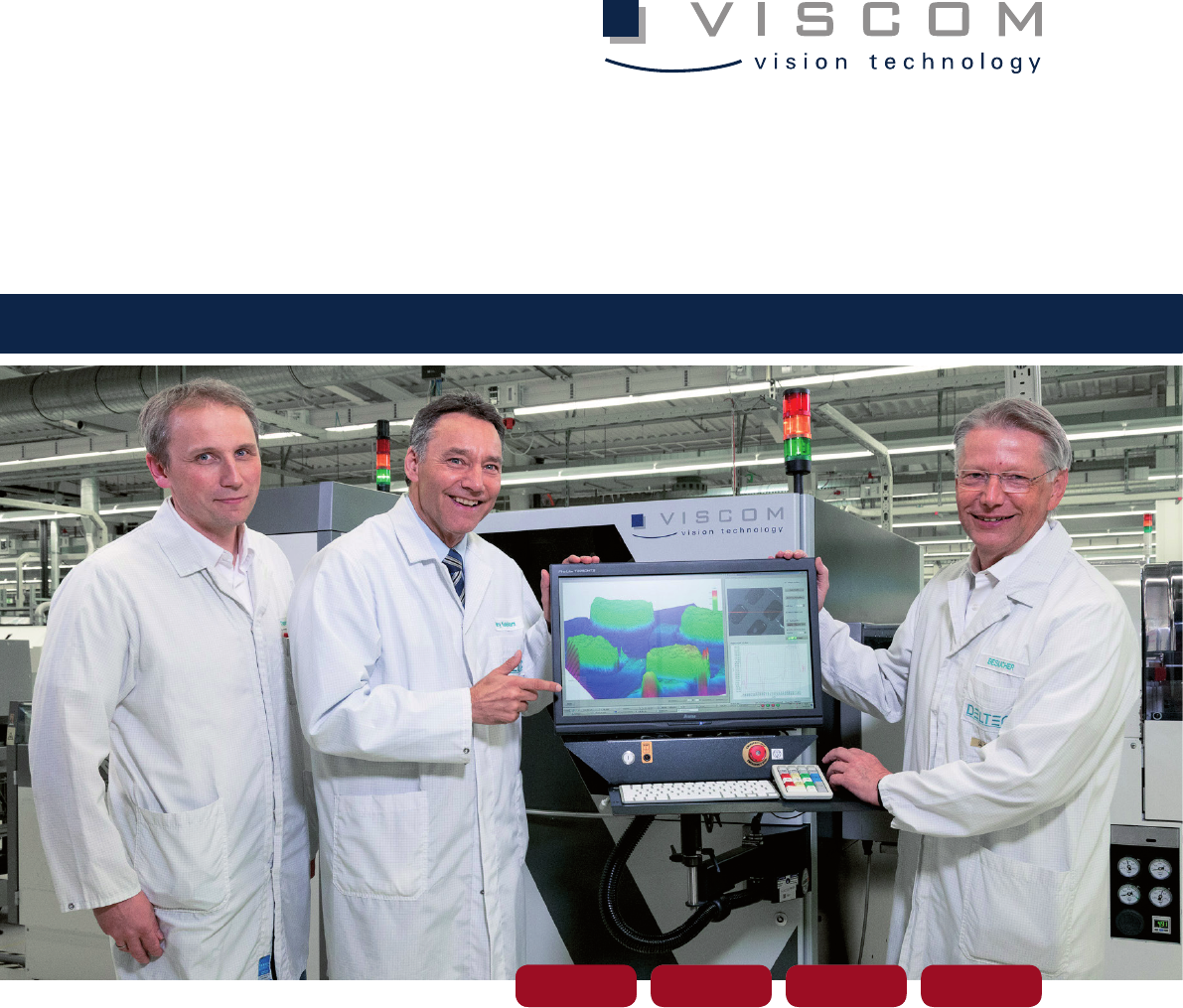
Harry Kuckelkorn, general manager at DELTEC, and account manager
Walter Schneider from Viscom in front of the S3088 SPI
2
These 3D inspection systems all come
from Viscom in Hanover, Germany.
Among them are several S3088 SPI
and S3088 ultra systems. This has a de-
cisive advantage: Using the combined
results for process analysis and qualifi-
cation is relatively simple. The data this
requires are generated and evaluated
on a software platform spanning all
the systems. One exceptionally useful
option in this context is Viscom
training for the DELTEC employees
occupied with process support and
inspection program generation.
Increasing piece counts at DELTEC are
just one of many reasons intelligent,
automated inspection is more and
more indispensable. “We passed the
ten-million-piece mark for the first
time in 2015. This included extremely
complex electronic assemblies, as
well as the simplest. But this is also an
important topic for Viscom, because
every single piece passes through the
SPI and AOI systems,” explains Rainer
Müller, manager of marketing and
sales at DELTEC.
3D SPI for more information
From DELTEC’s perspective, paste
print represents the most important
causal variable in the SMD process.
A 3D paste inspection provides the
employees comprehensive process-
relevant data essential for qualifying
and stabilizing a series process. As
well, more and more of DELTEC’s
automotive customers insist on
a 3D paste inspection for hidden
solder joints. Here, the images and
measurement values generated by
the inspection are a great help in
classifying defects. Fischer states,
“With this inspection technology, we
are handed information about vol-
ume, paste height and other aspects
and suddenly see, there are actually
differences between one and another
of the components which could not be
determined in any other way.”
As one example, the paste print for
0201 components can no longer
be inspected manually. Automatic
inspection is the only option and a
paste offset of 200 or 300 µm is already
not acceptable. In their lines, DELTEC
employs automatic data exchange
(Closed Loop) between the Panaso-
nic SP18 stencil printers and Viscom
S3088 SPI solder paste inspection
systems. In practice, this yields con-
crete advantages: Depending on the
solder paste offset values determined
by the 3D SPI system, the print offset
is automatically corrected over several
printed circuit boards. The number of
steps this correction is carried out in
can be defined. For example, an offset
is not corrected in one single step,
but over several intermediate steps.
This then reaches the optimum result.
Fluctuations between printed circuit
board materials can also be easily
compensated with the Closed Loop
from Viscom.
In the past, the print offset had to
be manually adjusted over and over.
“Then it was a matter of extreme
swings in one direction or the other.
This cost time and never resulted in
the quality I would get with simply
automating the adjustment,” recalls
Fischer. With the Viscom paste in-
spection systems, customers can also
optimize their stencil-cleaning cycles
based on the SPI results. Yet another
“With this inspection technology, we are handed
information about volume, paste height and other
aspects and suddenly see, there are actually dierences
between one and another of the components which
could not be determined in any other way.”
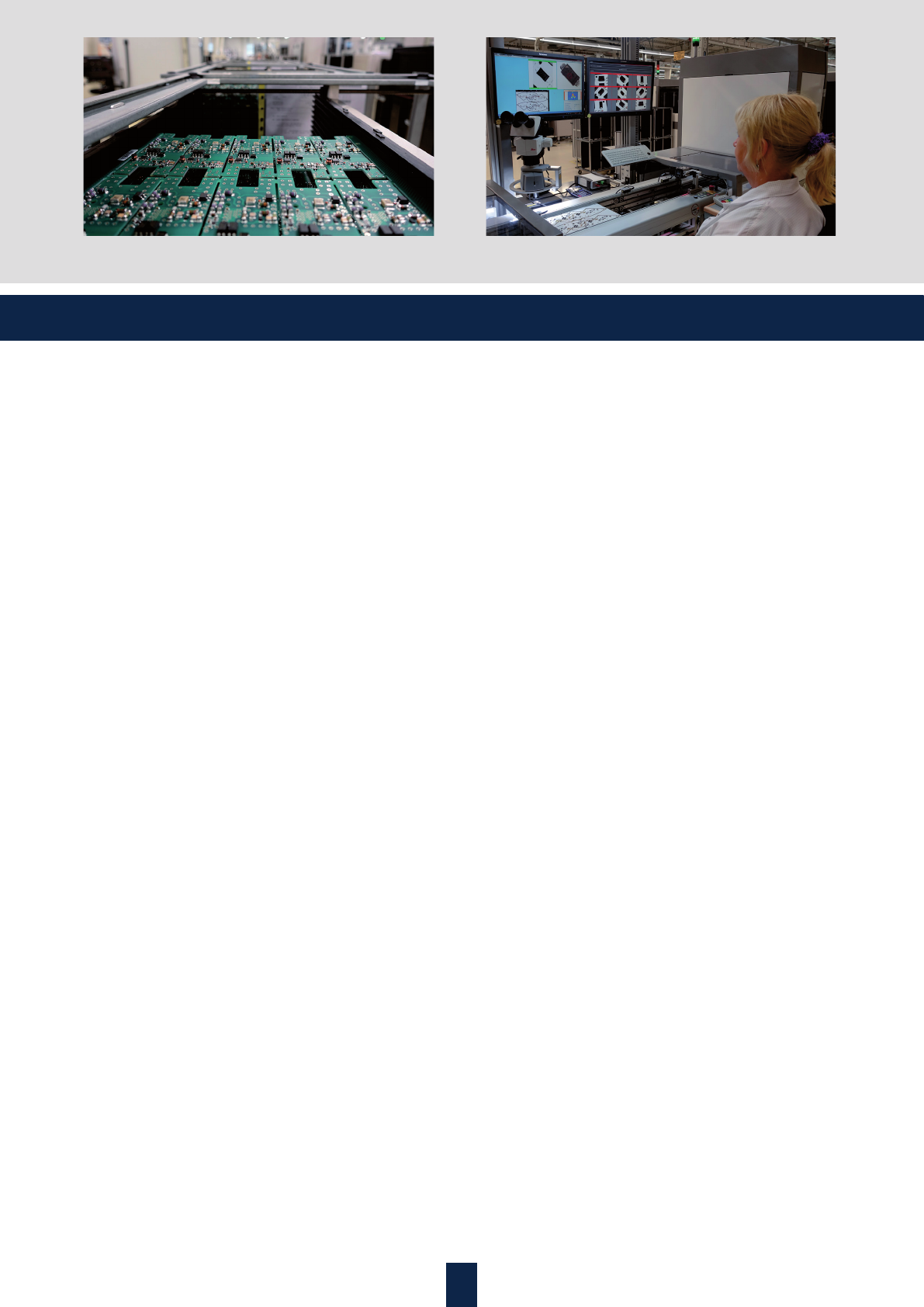
From accepting all the smallest parts to delivery of the complete
electronic assemblies, each logistical step at DELTEC is transparent
Classifying inspection results is comfortable and easy on the clearly
laid out, ergonomic HARAN verification station from Viscom
3