Viscom_Case_Studies_SP_Deltec_170116_en.pdf - 第4页
plus from Closed Loop: The S3088 SPI communicates not only with the paste printer , but with the placemen t ma - chine as well. Thus, placement offset can also be corrected. Pr esence inspection with 3D A OI In the AOI a…
These 3D inspection systems all come
from Viscom in Hanover, Germany.
Among them are several S3088 SPI
and S3088 ultra systems. This has a de-
cisive advantage: Using the combined
results for process analysis and qualifi-
cation is relatively simple. The data this
requires are generated and evaluated
on a software platform spanning all
the systems. One exceptionally useful
option in this context is Viscom
training for the DELTEC employees
occupied with process support and
inspection program generation.
Increasing piece counts at DELTEC are
just one of many reasons intelligent,
automated inspection is more and
more indispensable. “We passed the
ten-million-piece mark for the first
time in 2015. This included extremely
complex electronic assemblies, as
well as the simplest. But this is also an
important topic for Viscom, because
every single piece passes through the
SPI and AOI systems,” explains Rainer
Müller, manager of marketing and
sales at DELTEC.
3D SPI for more information
From DELTEC’s perspective, paste
print represents the most important
causal variable in the SMD process.
A 3D paste inspection provides the
employees comprehensive process-
relevant data essential for qualifying
and stabilizing a series process. As
well, more and more of DELTEC’s
automotive customers insist on
a 3D paste inspection for hidden
solder joints. Here, the images and
measurement values generated by
the inspection are a great help in
classifying defects. Fischer states,
“With this inspection technology, we
are handed information about vol-
ume, paste height and other aspects
and suddenly see, there are actually
differences between one and another
of the components which could not be
determined in any other way.”
As one example, the paste print for
0201 components can no longer
be inspected manually. Automatic
inspection is the only option and a
paste offset of 200 or 300 µm is already
not acceptable. In their lines, DELTEC
employs automatic data exchange
(Closed Loop) between the Panaso-
nic SP18 stencil printers and Viscom
S3088 SPI solder paste inspection
systems. In practice, this yields con-
crete advantages: Depending on the
solder paste offset values determined
by the 3D SPI system, the print offset
is automatically corrected over several
printed circuit boards. The number of
steps this correction is carried out in
can be defined. For example, an offset
is not corrected in one single step,
but over several intermediate steps.
This then reaches the optimum result.
Fluctuations between printed circuit
board materials can also be easily
compensated with the Closed Loop
from Viscom.
In the past, the print offset had to
be manually adjusted over and over.
“Then it was a matter of extreme
swings in one direction or the other.
This cost time and never resulted in
the quality I would get with simply
automating the adjustment,” recalls
Fischer. With the Viscom paste in-
spection systems, customers can also
optimize their stencil-cleaning cycles
based on the SPI results. Yet another
“With this inspection technology, we are handed
information about volume, paste height and other
aspects and suddenly see, there are actually dierences
between one and another of the components which
could not be determined in any other way.”
From accepting all the smallest parts to delivery of the complete
electronic assemblies, each logistical step at DELTEC is transparent
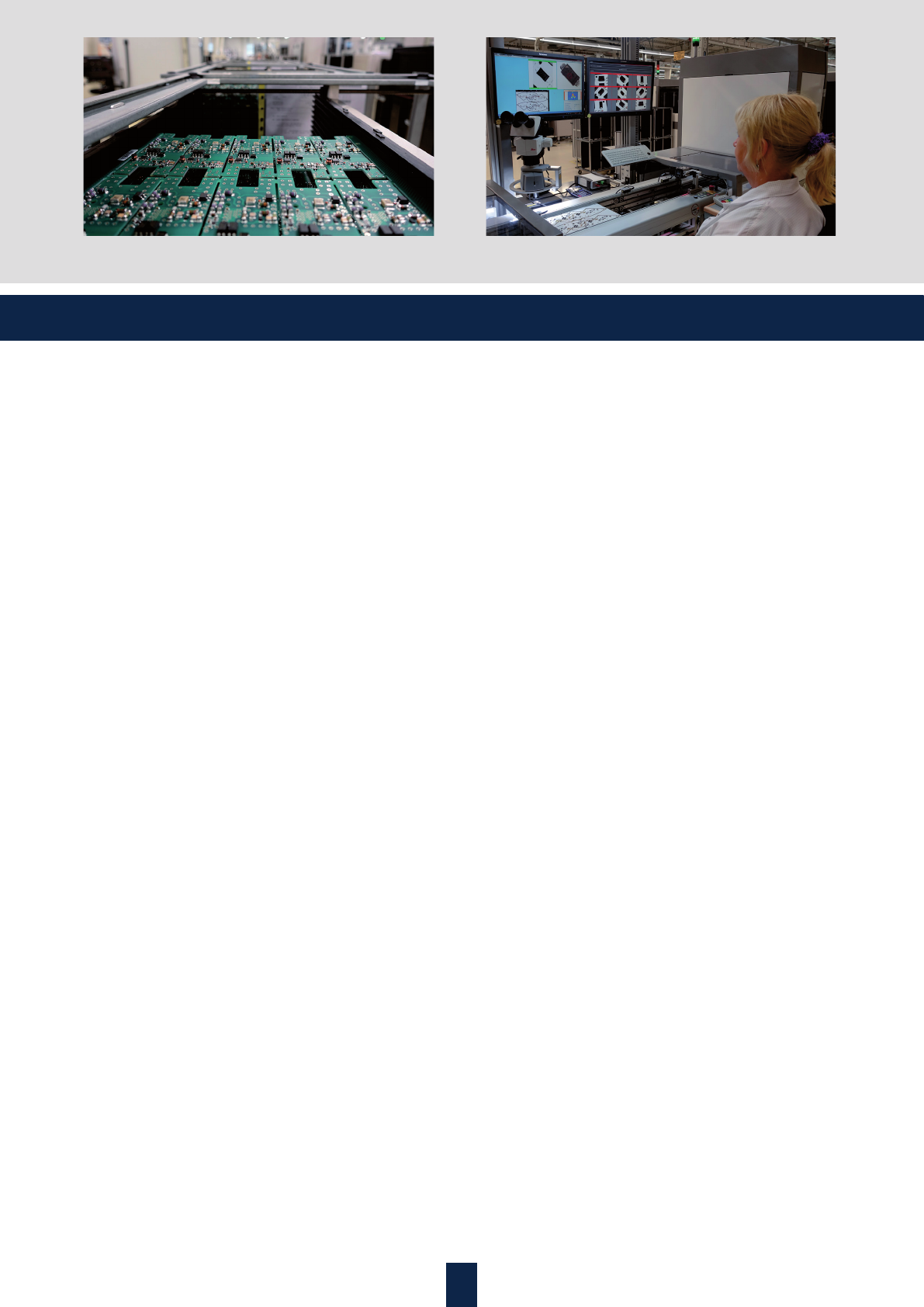
Classifying inspection results is comfortable and easy on the clearly
laid out, ergonomic HARAN verification station from Viscom
3

plus from Closed Loop: The S3088 SPI
communicates not only with the paste
printer, but with the placement ma-
chine as well. Thus, placement offset
can also be corrected.
Presence inspection
with 3D AOI
In the AOI area, DELTEC uses 3D inspec-
tion especially for SOT (small-outline
transistor) component body detec-
tion. In this case, the advantage of 3D
inspection is greater stability, which is
seen in lower false alarm rates. Thomas
Fischer: “Of course there will always
be important optical factors, such as
the great number of different body
designs with barely enough contrast
to distinguish them from the printed
circuit board background. The 3D AOI
is simply better at this.”
This inspection technology will be
a mainstay at DELTEC in the coming
years. “In the future, we will also record
menisci with 3D AOI; this is a recurring
topic for our customers,” states Fischer.
This involves ensuring the inspected
meniscus actually is IPC-compliant and
definitively extends up to a prescribed
component height. In addition to the
3D inspection, DELTEC also employs
2D and 2.5D methods in the AOI area
to inspect its assemblies (orthogonal
and angled). Inspection libraries, com-
piled and optimized by the company
over 15 years, are the solid basis for
these inspections.
Intelligent data combination
At DELTEC, highly precise assembly
with LEDs is a core process. With mod-
ern LED types, the solder joint quality
can often only be verified with X-ray. If
defects such as air inclusions or solder
beads are then determined, the result
of the paste inspection system is ex-
tremely important for optimizing the
process. By linking the results, DELTEC
can react quickly to such defects. This
is enabled by the data combination
possibilities offered by the Viscom
Quality Uplink. “When the AOI system
indicates that I have, for example, a
bad solder joint, I need to know what
it was caused by. Then I receive the
linked paste information and see, OK, I
have stayed within my limits, but still I
must take action. For example, maybe
the specified paste volume I am work-
ing with is too low. Something like this
is very important, especially during
the sample phase,” emphasizes Fischer.
The relevant image information can
be evaluated with the Viscom Uplink
Process Analyzer (VUPA). The Closed
Loop connections are also a software
element of the Viscom Quality Uplink.
High-value X-ray systems
DELTEC consciously purchased the
Viscom X7056RS with its AOI and AXI
functions so they would be able to
run a combined inspection in cases
where the automatic optical inspection
comes up against its limits, due to
shadowing or other characteristics. The
system is increasingly used for process
qualification. “Recently, we tried out
and evaluated several different stencil
designs for a specific product: a little
more paste, a little less paste, a slightly
modified paste volume. We verified the
results with the AOXI and evaluated the
statistics files,” explains Fischer.
Alongside of this, DELTEC uses the
Viscom X8011 PCB plus for manual
X-ray inspection. One of the advantag-
“Of course there will always be important optical
factors, such as the great number of dierent body
designs with barely enough contrast to distinguish
them from the printed circuit board background.
The 3D AOI is simply better at this.”
At DELTEC, the newest high-value equipment from leading manufacturers
guarantees the highest quality
4

es: “It is possible to take a printed cir-
cuit board to the machine and quickly
see what is happening with a critical
solder joint, without having to set up
an elaborate program,” says Fischer.
The system lends itself to highly ver-
satile application and enables imme-
diate manual inspection if anomalies
crop up in production or for handling
complaints. The application fields are
similar to those for the X7056RS, espe-
cially for checking solder filling in the
THT (through-hole technology) area or
inspecting SMD voids.
Statistics and traceability
For real-time evaluation, DELTEC lever-
ages the possibilities offered by Viscom
statistical process control (SPC). Each
production line is equipped with an
SPC monitor. An update arrives every
two or three minutes. This means that
when, for example, a real defect is
classified on the AOI station, the cor-
responding display promptly appears
on the line and the operator receives
just-in-time information indicating
whether the specified limits are main-
tained or intervention is called for.
At DELTEC, any electronic assemblies
found to be defective are locked
against further processing steps.
This was made possible by a Notes
databank solution based on barcode
control, which the company devel-
oped in concert with an external
programming team. “Result files
are stored within several different
inspection steps. Our DELTEC locking
system, or DLS, collects these files and
if a circuit board receives a negative
status, it is correspondingly locked
during the downstream processes,”
explains Fischer, and continues:
“We have 100 percent traceability. A
barcode scanner is positioned before
each machine. Affixing labels is also a
very important step and is the first link
in the complete traceability chain.”
ISO/TS 16949 and other
certifications
DELTEC’s orientation stands on a long
history. In 1996, the company was
certified in accord with ISO 9001, an
essential requirement level for quality
management. DELTEC began setting
its course for the automotive sector in
2003, as it opened its new Engineering
Center. “At this point it was clear that
we needed to work on our structures
again to meet the requirements of
ISO/TS 16949,” states Harry Kuckelkorn,
general manager at DELTEC. This is a
set of technical specifications based
on ISO 9001, specifically arranged for
the automotive industry and one of
the important foundations for the
DELTEC processes and systems. “This
is 28 sections and over 100 orienta-
tion points for controlling complex
processes within the company and to
ensure the reaction capabilities need-
ed to enact preventive safeguards,”
explains Kuckelkorn.
Certification under environmental
management standard ISO 14001 fol-
lowed in 2006; in the near future, the
company expects to complete the ISO
13485 certification process for medical
products. Preparations for this step are
in full swing.
Harry Kuckelkorn knows what he is
talking about. He is a council member
and delegate at the German Institute
for Quality (DGQ) and currently has a
teaching assignment with the Insti-
tute for Police and Safety Research
at the School of Public Management
in Bremen, Germany, where he holds
lectures on quality management and
conducts the examinations in this
subject. “I do this mainly to give back
something of what I was given when I
was a student,” says Kuckelkorn about
his teaching activity.
Long-term advance planning
The DELTEC general manager under-
scores the major role played by the
long-term character of the automotive
sector: “Processing a request can take
Two DELTEC colleagues with a number of mutual interfaces: Thomas Fischer, manager of production
and technology, and Markus Seidl, head of quality management
5