GEMINY-Product-Brochure.pdf - 第5页
Automatic func tions and s ys tem reports Ge miny a ims t o fr e e us e r s fr om r ou tin e wo rk b y au to ma te d fu nc tio ns for calibration and sys tem pe r forman ce tes t s : • Geometric calibration che c ks a nd…
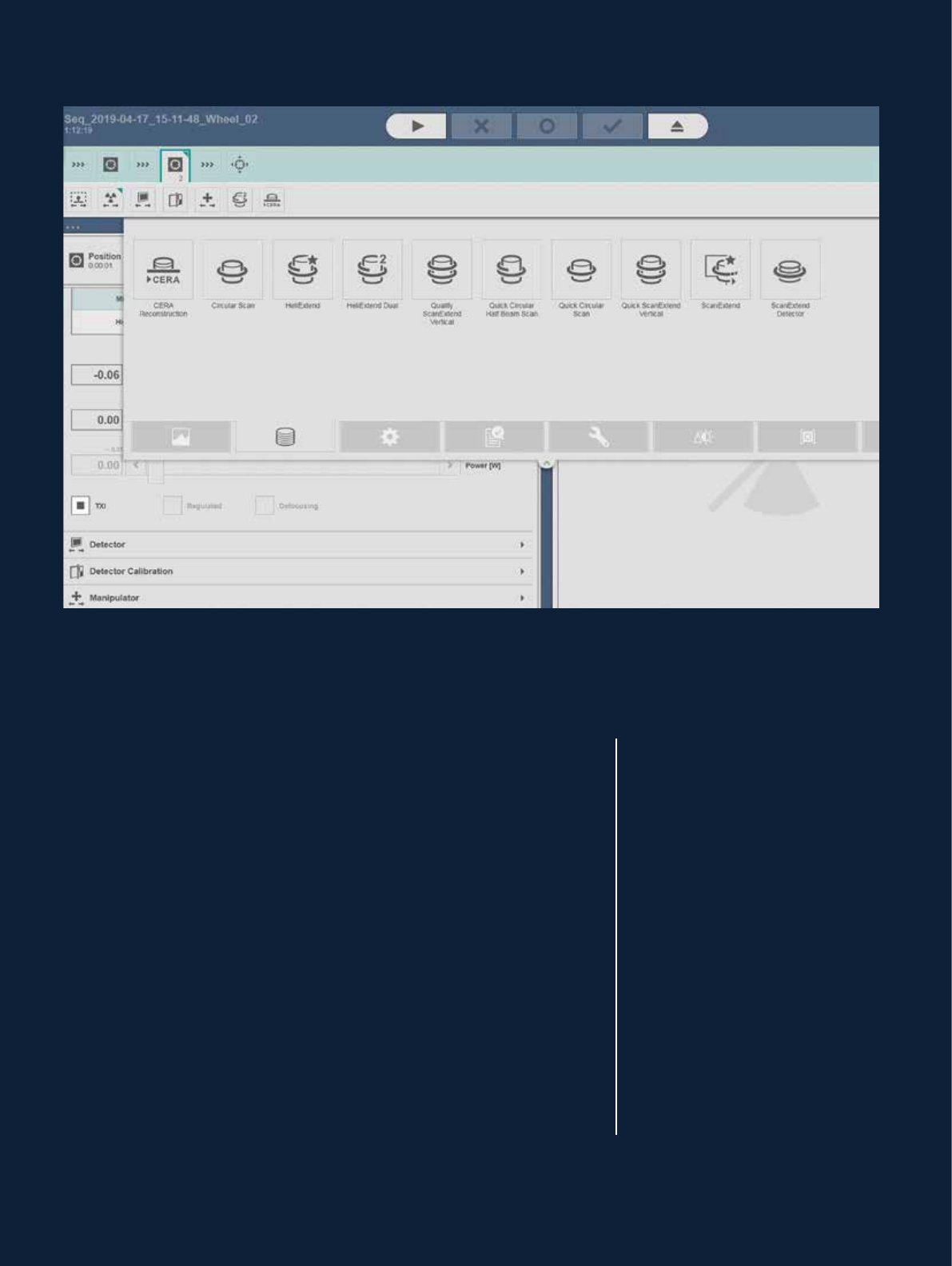
CT – large choice of scans to address different parts
• Quick scan: set the number of projections, rotation angles and
exposure times.
• Quality scan: additionally set the number of images to integrate per
projection.
• Horizontal scan extension: Scan parts of larger diameter by stitching images
into one larger projection. Alternatively, use offset scan where the rotation
axis is positioned to one edge of the detector.
• Vertical scan extension: Stack standard scans at different heights which are
merged into one larger volume.
• Combined horizontal and vertical scan extension: Stack horizontally
extended scans for largest parts.
• HeliExtend scan: Innovative scan process that boosts image quality
significantly. Optimal detail recognition is achieved especially for the
largest parts.
• Dual helical scan: combined offset and HeliExtend scan for largest parts.
• FlexCenter (not for FF20 / FF35 CT Metrology): Determination of a new
virtual rotation axis eliminates the need to reposition the test part or use
an XY table.
Geminy’s strength is a flexible selection of various CT trajectories.
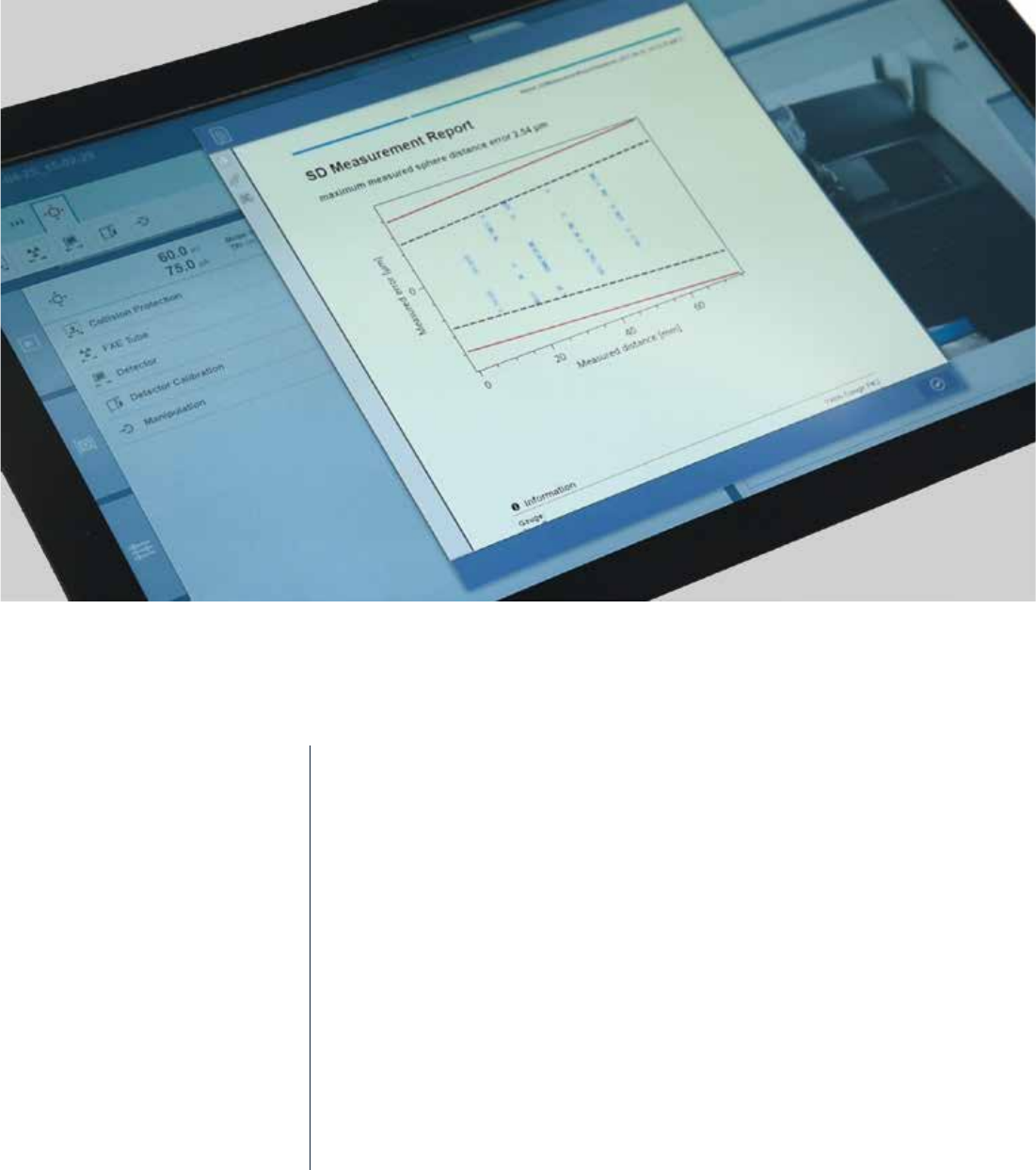
Automatic functions and system reports
Geminy aims to free users from routine work by automated functions
for calibration and system performance tests:
• Geometric calibration checks and corrects component orientations and
positions.
• Detector calibrations offer automatic single-gain, multi-gain, and
step wedge calibration. Expert mode with additional options for further
optimization.
• ASTM report is created in accordance to ASTM E1695 for MTF and CDF.
• MPE
SD
: fully automated determination and documentation of maximum
SD deviation referring to VDI/VDE 2630 – Sheet 1.3. Measurements of the
sphere distances of the Yxlon ruby gauge at two positions.
• Separation breaks multiple parts into individual volumes.
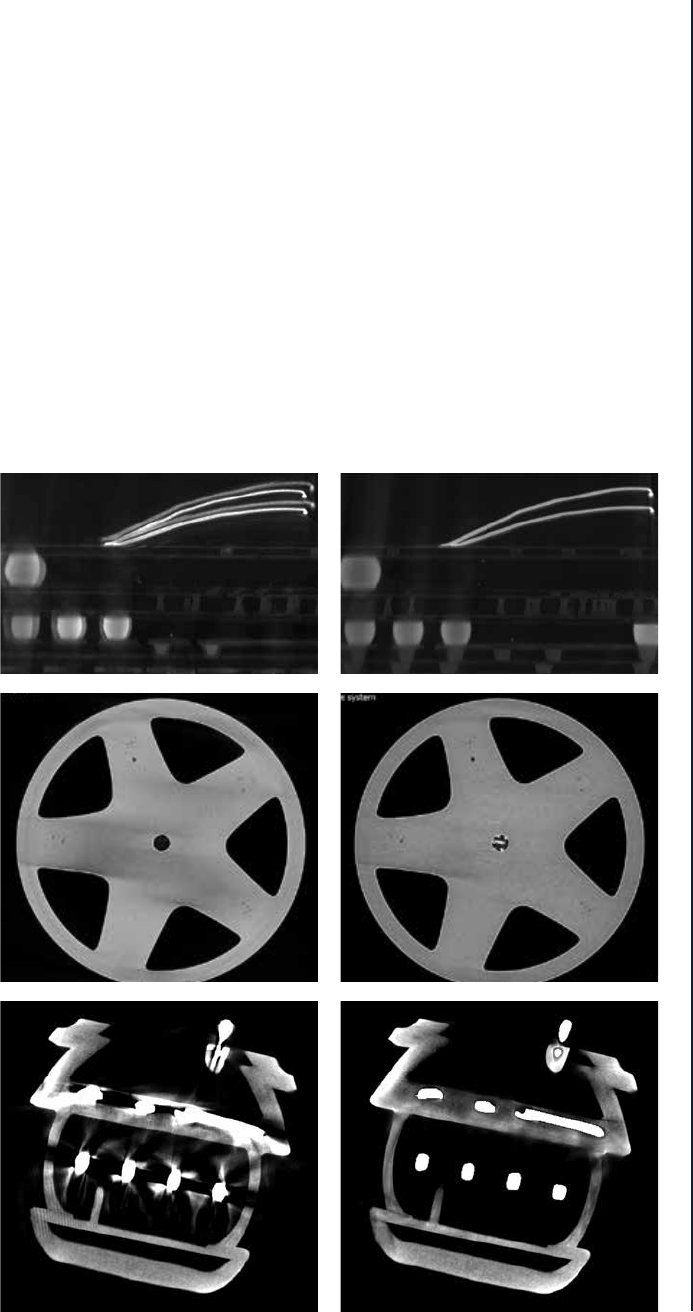
Reconstruction workspace and reconstruction improvements
CT systems based on Yxlon Geminy are equipped with separate workstations
for controlling the system and for reconstruction and analysis. The reconstruc-
tion workspace manages reconstructions and calls CERA-algorithms including:
• Jitter correction to eliminate any blurry edges caused by a focus drift or
shifted parts
• Truncation correction to correct truncation artifacts on ROI scans where the
inspected part fills the entire field of view
• Ring artifact correction for processing projections or volume or detector shift
corrections
• Beam hardening correction/reduction: Various methods are available for
reducing these artifacts, including model-based corrections.
• Metal artifact reduction: FSMAR helps in surface extraction, especially with
plastic-metal mixes and metrological applications.
Wheel without Beam-Hardening
Reduction (left) and with
Beam-Hardening Reduction (right)
Electric component
without Jitter Correction (left) and
with Jitter Correction (right)
Plug without Metal Artefact
Reduction (left) and with Metal
Artefact Reduction (right)