Oxford ICP-CVD SOP.pdf - 第8页
Page 8 of 11 Append ix A: Naviga ting the Lo gbook 2) Once inside the Log vie w, you can see 1) The processes, and 2) the indi vidual step s of each process. This makes it hard to navigat e, if you’re looking for a speci…
Page 7 of 11
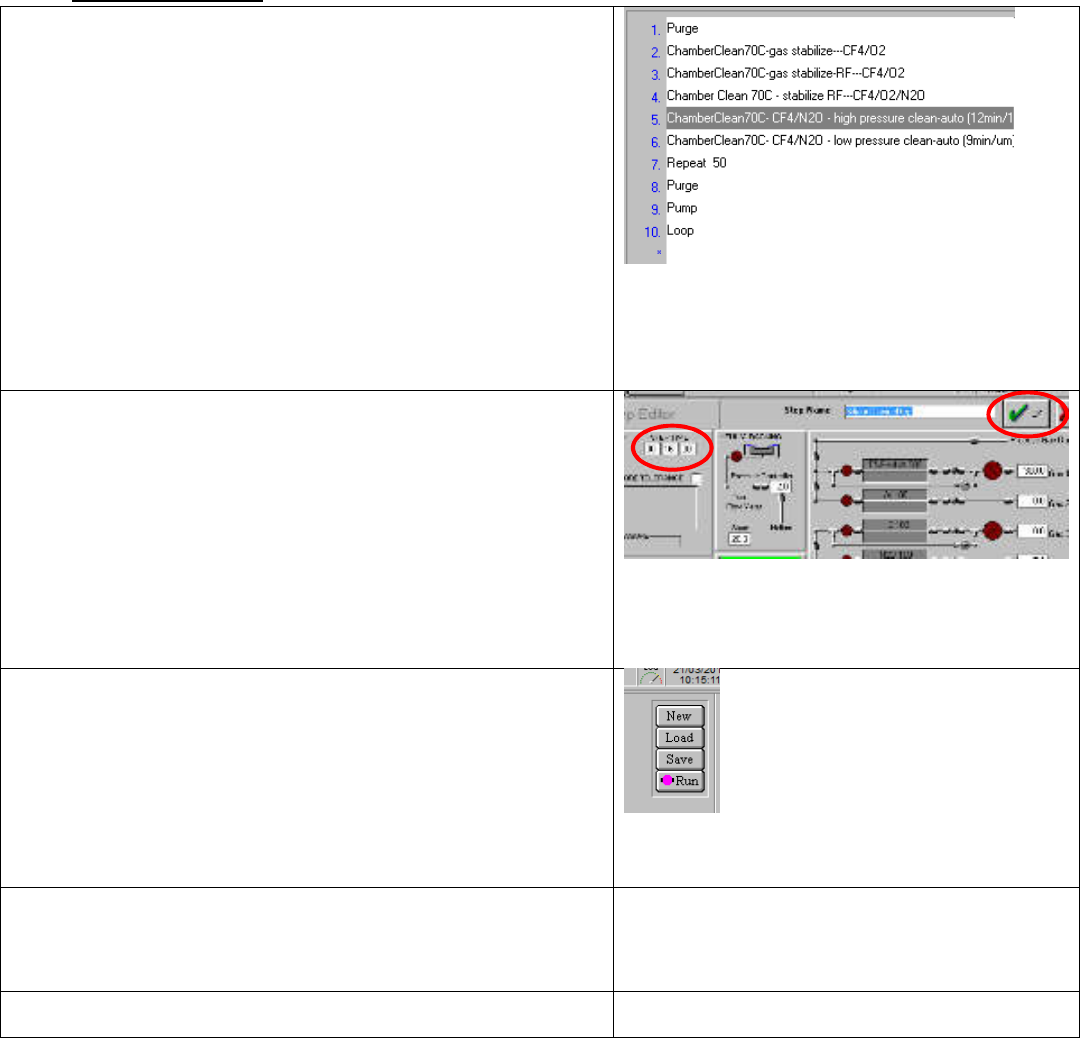
E) Run cleaning recipe
1)
Load cleaning recipe
a) Click Main Menu, then Recipes
b) Click “Load”, and choose appropriate cleaning recipe:
i) “Chamber Clean @70C” if you deposited at 70C
ii) “Chamber Clean @250C” if you operated at 250C
c) Notice the two important steps: ‘high pressure clean-
auto’ and ‘low pressure clean-auto’
i) To etch back 1um of deposited material:
ii) The “high pressure clean” step must run for 12
minutes, and
iii) The “low pressure clean” step must run for 9 minutes
Figure 29. Cleaning recipe steps. The "High Pressure clean"
and "Low pressure clean" are the two steps to modify
2)
Modify cleaning times
a) These cleaning steps have defaults of 12, and 9 minutes,
respectively. Scale these times up/down, to etch back the
amount of material you deposited, round up to nearest
minute.
i) If you deposited 2um total during your runs, set the
high pressure step for 24 minutes (12min/um * 2um)
and the low-pressure for 18 minutes (9min/um *
2um).
Figure 30. Edit Step screen. Revise times as necessary, then
press OK
3)
Run the recipe
a) Press the “Run” button
Figure 31. Recipe Load button on the recipes
page
4)
Wait for the plasma to ignite and stabilize
a) This should happen after about 1 minute; make sure
plasma is stable before leaving the tool
5)
Sign out of the tool in Mendix
Page 8 of 11
Appendix A: Navigating the Logbook
2)
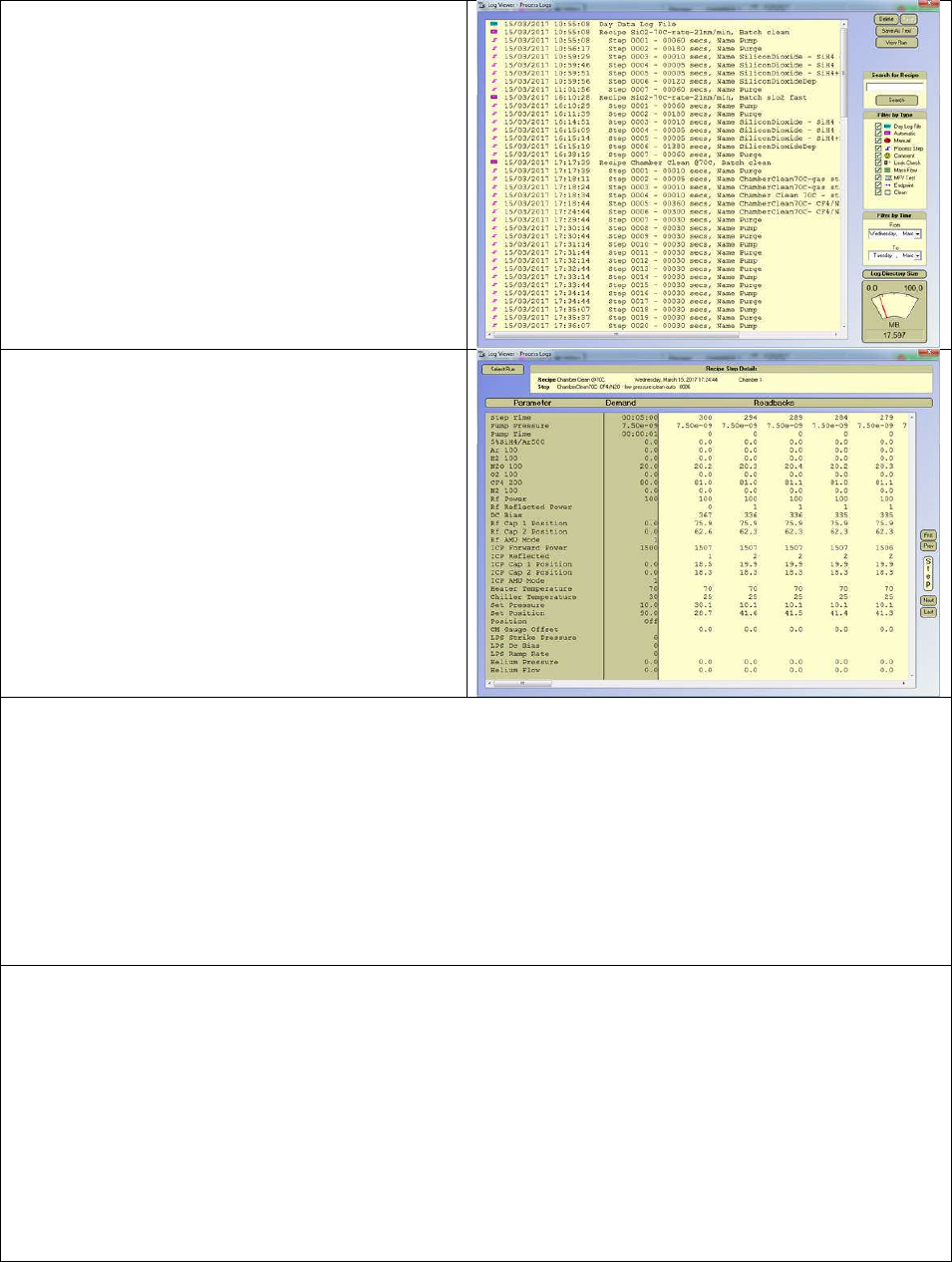
Once inside the Log view, you can see 1) The
processes, and 2) the individual steps of each
process. This makes it hard to navigate, if
you’re looking for a specific process
3) First, uncheck the “Process Step” box under
“Filter by Type”.
4) Next, select your desired date range (2-3
weeks is usually enough to find the recipe of
interest)
5) Scroll down to see more recent entries
6) Left-Click on the process of interest, then
left-click “View Run” (top-right corner)
7)
Now you’re viewing all of the sensor readings
taken during the particular step of the
process.
8) Time is displayed as a countdown, in seconds.
Scroll right to see further into each process
step
9) You can move forward/backwards by step,
clicking the “Prev” and “next” buttons (right
side of screen), and see the current step
name under “Recipe Step Details” (top of
screen)
10)
Usually you’d only use the logbook if you come back to the tool and find that your process has
stopped suddenly.
11) You can use the logbook to see how long your process was running before it got stopped, and
thereby estimate the amount of material deposited.
12) To do this, view your “Dep” step in detail, and scroll to the right until “ICP Forward Power” drops to
0. This is where you will have stopped depositing.
i) Note: When processes are disrupted, the tool will try to reignite the plasma. This usually
fails.
Look for the point where “ICP Reflected” rises significantly; this is usually about 20 seconds before the
process terminates.
13)
Process Checks:
ii) It is good practice to check the DC bias of the last time your process was used, along with
the capacitor positions (you may have to dig back a few weeks to find your process being
run)
14) Cleaning checks:
iii) It is good practice to check if the cleaning recipe used by the last user is sufficient for the
primary recipe run
iv) For either oxide or nitride deposition, the plasma steps of the cleaning recipe, run at the
deposition temperature, should be the following
(1) High-pressure step: 12min/um
Low-pressure step: 9min/um

Page 9 of 11
Appendix B: Explanation of the cleaning recipe
6)
Plasma Steps:
a) There are two CF4/N2O steps designed to chemically etch the deposited SiO2/SiNx: a high-
pressure and a low-pressure step
b) The high-pressure step is designed to remove the bulk of the deposited material, using a
relatively low ion-bombardment strength
c) The low-pressure step is designed to remove any remaining deposited material, using a high
ion-bombardment strength
7) Pump/purge steps
a) There is a set of 50 pump/purge cycles after these plasma steps, designed to induce flaking of
any thick material that was only partially-attacked during the plasma steps.
b) If the most recent deposition was <300nm thick, the potential for flaking during your process is
small (this grows at >1um total thickness), and it is likely “safe” to skip these pump/purge steps
8) To skip the pump/purge steps, click “stop” during the cleaning process, assuming it is in the middle
of the pump/purge steps
9) Make sure to allow the tool to unload the process wafer into the loadlock before starting your run
Version history
Draft
Date
Author
Notes on changes
v.0.1
3/23/17
Eric Mills
V 0.2
5/24/17
Eric Mills
More images
V 0.3
6/4/17
Eric Mills
Appendix B
V 0.4
4/3/18
Eric Mills
Format Changes