Nordson_EFD_Medical_Device_Assembly_White_Paper.pdf
Published by: Nordson EFD LLC, 40 Catamore Boulevard, East Providence, Rhode Island 02914-1206 10 Essential Questions for Reevaluating Your Medical Device Assembly Process Thank you for your interest in Nordson EFD’s Dis…
Published by:
Nordson EFD LLC, 40 Catamore Boulevard, East Providence, Rhode Island 02914-1206
10 Essential Questions for
Reevaluating Your
Medical Device Assembly Process
Thank you for your interest in Nordson EFD’s Dispensing Solutions.
For a confidential discussion of how we can help you improve your
medical device dispensing systems, we invite you to contact our
experienced Product Application Specialists at 800.556.3484 or
info@nordsonefd.com.

Medical device manufacturers that assemble devices and equipment must meet stringent
FDA regulations for quality and product consistency, which makes rigorous process control
essential. Fluids for medical device manufacturing can be extremely expensive. It is vital to
have quality assembly equipment that generates consistent and accurate results, without
fluid contamination, to avoid costly waste.
Is your current dispense valve system giving you accurate deposits with minimal
maintenance – or are you applying inconsistent amounts of fluid and wasting too much
time and money on downtime, rework, and cleanup?
This paper discusses some common problems encountered with typical fluid dispensing
systems in the medical device industry, and offers helpful tips for improving your dispense
valve performance.
We hope that you find this information helpful. If we can be of further assistance,
please contact our experienced Product Application Specialists at 800-556-3484
or info@nordsonefd.com.
Is Your Medical Device Dispense Valve System Delivering
All The Performance You Paid For?
www.nordsonefd.com 2
1. Are You Using the Best Dispense Valve for Your
Fluid Application?
3 www.nordsonefd.com
For most medical device dispensing applications, a well-designed, general-purpose
diaphragm or piston valve that can handle a range of fluid viscosities is a good
choice.
In most situations, however, best results will be obtained with a valve style and
configuration carefully matched to the specific properties of the fluid being
dispensed.
Difficult Fluids Such as Medical-grade Cyanoacrylate
Wetted internal parts, as well as any fittings and tubing that come in contact with
the fluid, should always be carefully chosen for compatibility with the fluid being
dispensed.
When working with the cyanoacrylates used in catheters and stents, for example,
diaphragm valves with wetted parts made of inert, Ultra High Molecular Weight
(UHMW) polymer are a good choice because they will not react with the fluid. Nylon
or metal fluid fittings, however, should never be used with cyanoacrylates because
they absorb moisture and will promote premature curing. Use polyethylene or
polypropylene fittings instead. Chemically inert, polyethylene-lined or PTFE FEP
tubing is a good choice for fluid feed lines.
Thin to Medium Fluids
Thin fluids like solvents and watery adhesives have much different requirements,
especially when very small deposits are needed. For these applications, needle
valves are often recommended because shutoff occurs close to the valve outlet or
dispense tip. This is an important design feature because it minimizes dead volume
that can cause dripping or oozing.
When applying fluids in critical applications such as needle bonding, there is even a
needle valve that “seats” the needle in the dispensing tip instead of the valve body.
By virtually eliminating dead volume, this design makes it possible to produce even
smaller and more consistent microdeposits.
Thick Fluids
Thick materials like sealants or the RTV silicones used to bond pacemaker
assemblies, for example, pose very different challenges than thinner fluids like
adhesives or solvents.
When using thick fluids, a high-pressure valve with a balanced spool design will
provide good control. Also look for a snuffback feature – it will prevent drooling and
tailing, and help reduce the rework and cleanup often associated with these more
challenging assembly materials.
Best results will be obtained when the
valve design is matched to the properties
of the fluid being dispensed.
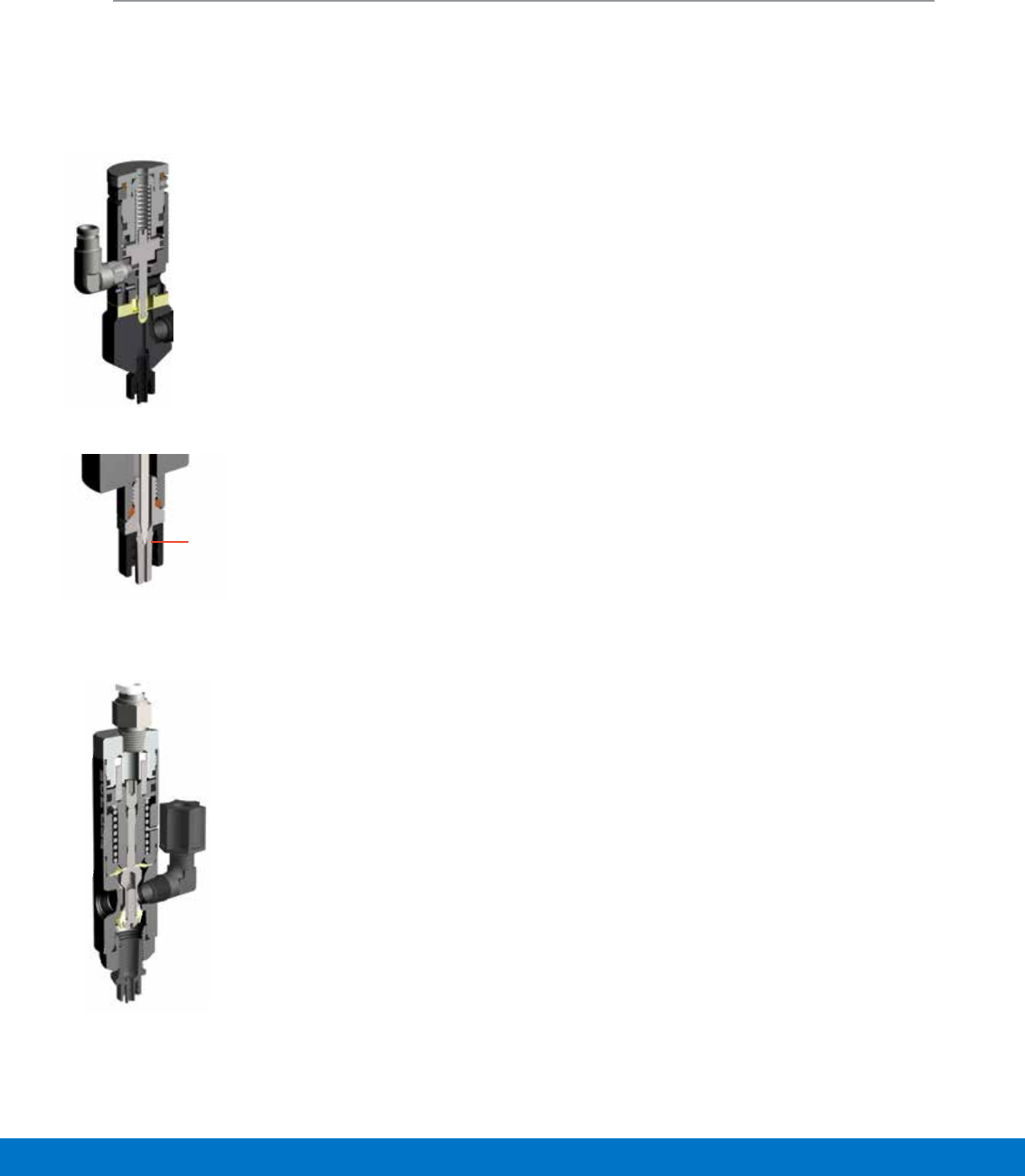
Diaphragm valves
with inert wetted
parts are a good
choice when working
with reactive fluids.
Needle valves minimize dead
volume when making very small
shots of thin fluids.
Needle Seat
Piston valves have snuffback to
keep thick fluids from drooling.