Nordson_EFD_Medical_Device_Assembly_White_Paper.pdf - 第8页
www.nordsonefd.com 8 8. Are You Cutting Corners on Your Dispense Tips? 9. Is Your Current Valve Setup Trapping Air? Entrapped air can cause oozing and variations in shot size. Be sure to purge all air and fluid lines whe…
7 www.nordsonefd.com
6. Do Your Valves Leak and Drip?
Leaking is a common problem with valves that have complex designs, or seals
andO-ringsthatwearoutovertime.
The most reliable diaphragm designs entirely eliminate the need for seals and
O-rings.Thebestvalveswilleasilyhandlemanydifferentfluidapplications,and
provide tens of millions of cycles without maintenance.
Carefully choosing the valve seat materials will also prevent many problems.
UHMW (Ultra High Molecular Weight) polyethylene, for example, provides excep-
tional wear characteristics and chemical compatibility with a wide range of medi-
cal assembly fluids, keeping the valve system working longer without downtime or
maintenance.
When valves are too large or heavy to be mounted at the dispensing station, extra
time must be spent on design and fixturing. If extra lines and fittings must be
added to transfer the fluid from the valve (where cutoff takes place) to the point of
deposit, it increases the risk of dripping and drooling.
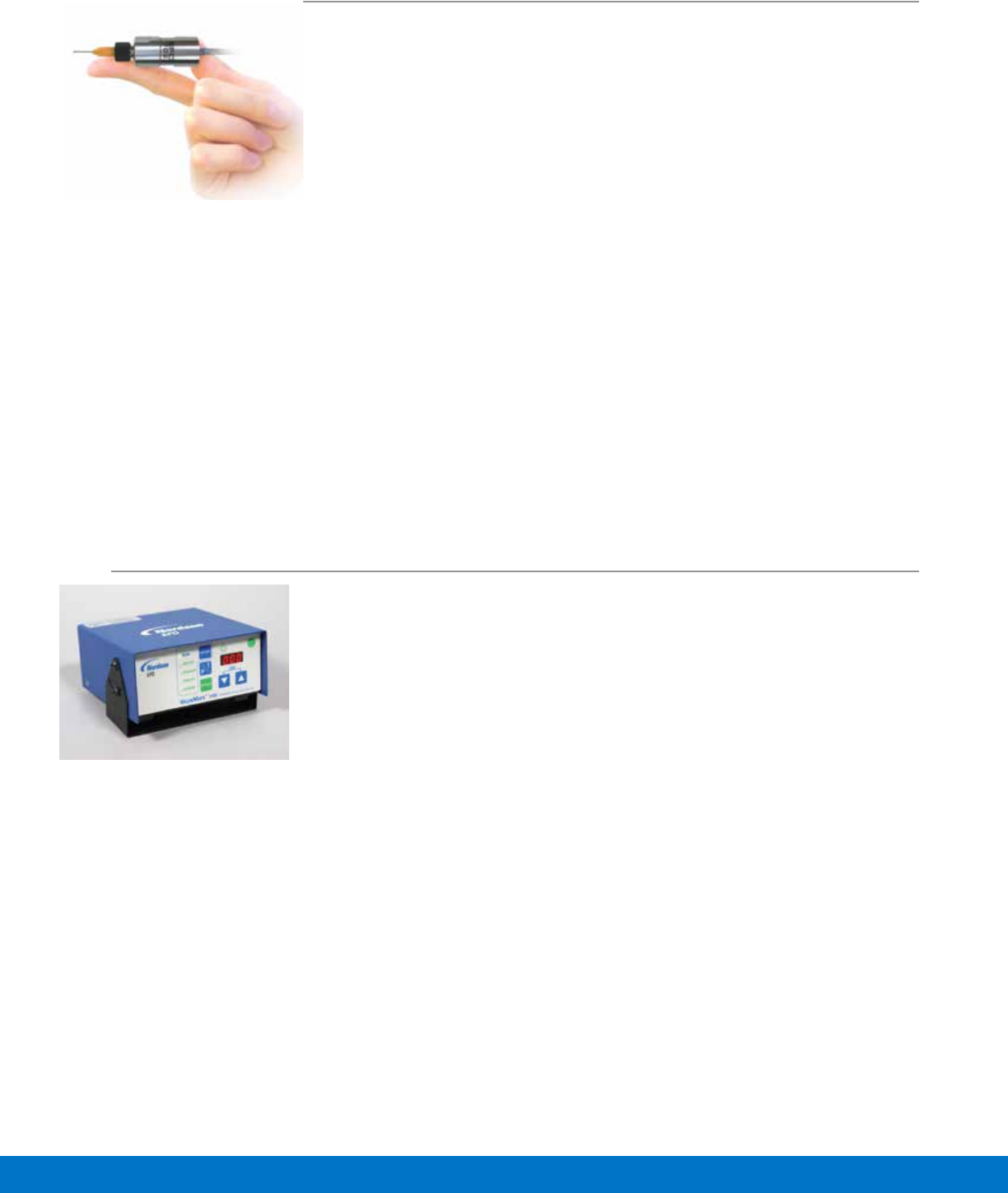
Using a compact, fast-acting valve that is small enough to be mounted directly at
the dispensing station will provide several advantages: greater flexibility in system
design, a neater installation that takes up less space, and a cleaner cutoff.
Using valves small enough to be mounted
at the point of fluid application reduces the
risk of drooling.
A digital controller allows for programmable
settings that allow for consistent, repeat-
able deposits.
7. Is It Difficult to Produce Consistent Shots?
Valves that require time-consuming manual or mechanical adjustments to
establish shot size can make it difficult to dispense a specific amount of fluid.
When several valves are used on the same machine or production line without
the proper control systems, it is nearly impossible to get each valve to produce an
identical shot.
If your valves are taking too long to set up and you cannot obtain consistent
results, a valve system with a dedicated controller is a more efficient approach
to establish shot size and regulate valve operation. Another advantage of using a
controller is that settings can be recorded and saved for the next time that spe-
cific job is run, or after maintenance has been performed.
Valve open time is the most precise way to adjust shot size. With a digital valve
controller, open time can be adjusted in increments as small as 0.001 seconds,
for exceptional control over the amount of material applied.
Onproductionlineswithmultipledispensingstations,usingadedicatedvalve
controller at each station can make it simple to adjust each valve’s open time
independently, and obtain an identical shot from each valve.
www.nordsonefd.com 8
8. Are You Cutting Corners on Your Dispense Tips?
9. Is Your Current Valve Setup Trapping Air?
Entrapped air can cause oozing and variations in shot size. Be sure to purge all air
and fluid lines whenever setting up a system, refilling the fluid tank, or performing
maintenance.Otherrecommendationsinclude:
• Keepingairlinesshorterthan5feettoreducetheriskoftrappedairand
improve valve response time.
• Tipselectionisveryimportant,andcanhelppreventairentrapment.When
using metal tips, use 21 gauge (0.020”) or larger if the application permits,
as they will allow small air bubbles to purge through.
• Taperedpolyethylenetipsareagoodchoiceinanysize.Theyallowfluidto
flow freely through the tip to purge and prevent air bubbles from collecting.
Tapered tips typically range from 14 gauge to 27 gauge.
• Useavalvecontrollerwithapurgefunctionthatallowstheusertobleed
any air in the system quickly and easily.
• Useafluidtankwithaconstant-bleedairregulatortopreventfluctuations
in pressure and shot size.
• Installafilter/regulatorbetweentheplantairsupplyandthedispensevalve
to remove any residual moisture from the system – this is especially import-
ant when working with cyanoacrylates.
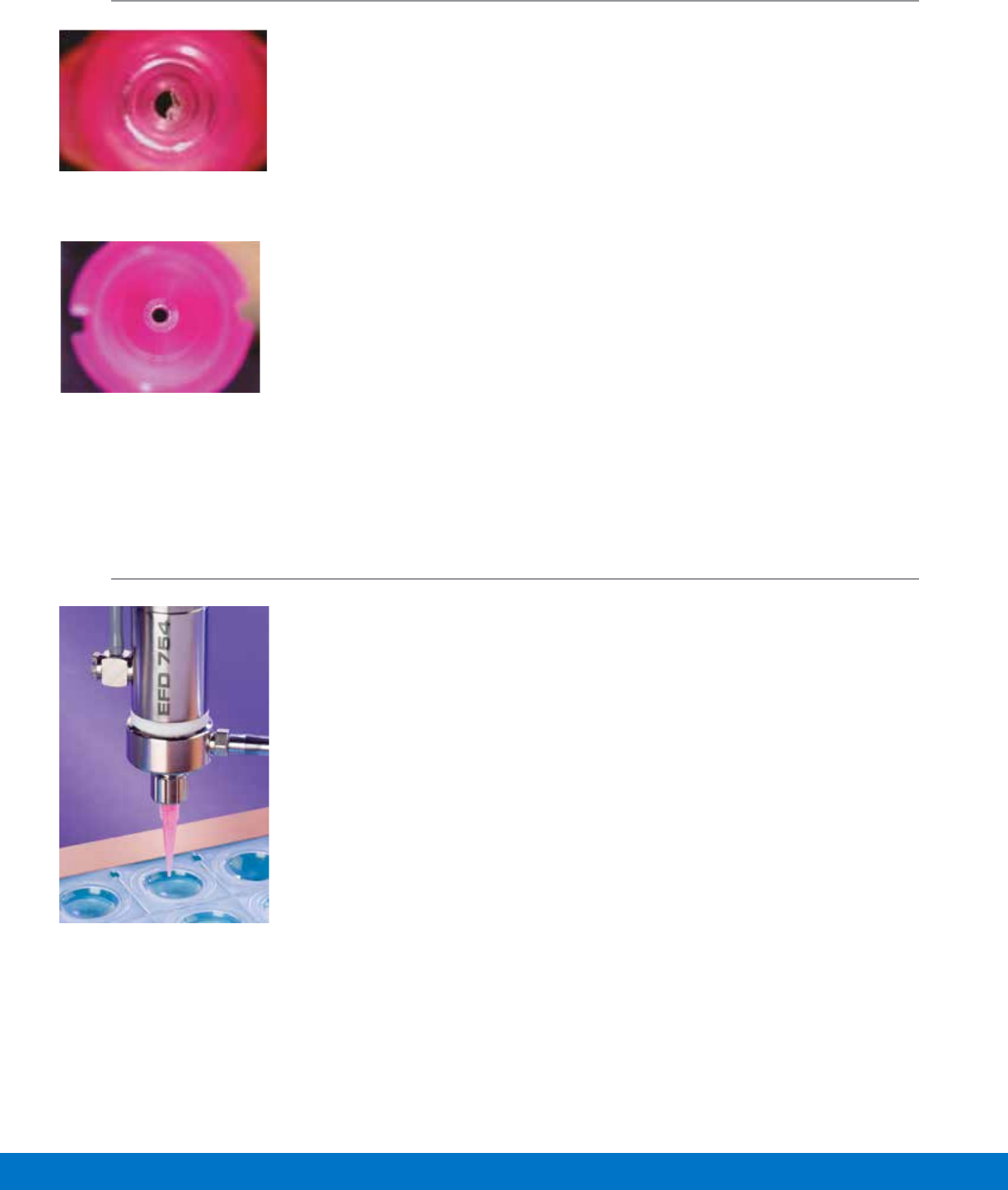
“Flash” inside hub of low-quality
tip restricts fluid flow.
High-quality tip provides unob-
structed fluid path.
Tips should be selected based on the
specific fluid and application.
Correct tip selection is very important to dispense valve performance. The best
choice is using a tip with the largest possible internal opening for the intended appli-
cation. This will prevent air bubbles from forming.
Tip quality has a surprisingly large effect on the accuracy and uniformity of fluid
deposits – especially in critical applications where very small deposits are required.
Trying to save a few cents on lower-quality tips may result in costing more in the
long run once factors such as fluid waste and additional operating time are factored.
Even the most precise dispensing system will not produce consistent results if the
tip – the last path the fluid travels before it reaches the part – is obstructed by debris
from the molding or machining process.
Which of these components would you rather use?
9 www.nordsonefd.com
Should You Replace Your Current Dispense Valve System?
In the middle of coping with day-to-day production challenges, it can be difficult to calculate just how
much poor valve performance is really costing you.
However, doing so could save you money, increase production, reduce bottlenecks, and improve the
overall quality of your products. It may be worth tracking valve-related problems for a week or so, then
converting them into a yearly expenditure.
Some key points to analyze:
• Howmuchtimeandlaborareyouspendingonvalvesetup?
• Howmucharevalve-relateddowntimeandmaintenancelaborcostingyouperyear?
• Ismostofyourvalvemaintenancescheduled,ordoyourvalvesbreakdownunexpectedly?
• Ifyourcurrentvalvesmakeithardtocontrolshotsize,howmuchareyouspendingonvalve-
related rework, rejects, and cleanup?
• Areyourdispensingstationscausingabottleneck?
• Areyouwastingexpensiveassemblyfluid?
• Doyouhaveanyvalve-relatedsafetyissues–spills,fumes,storage/disposalofhazardouswaste?
Depending on the responses you come up with, the most cost-effective solution may be to install a
more accurate and reliable dispense valve system.
In many instances, the savings will pay for the new equipment in a surprisingly short time and continue
to reduce operating expenses year after year.
10. How Often Do Your Valves Require Maintenance?
All valves will eventually require maintenance, but some designs require more
frequent repair than others. Here are some things to consider:
• Howoftenismaintenancerequired?Whileawell-engineeredvalvedesign
will go tens of millions of cycles without any degradation in performance or
accuracy, others may require maintenance after they have been shut down
over the weekend, or even at the start of every shift.
• Ifvalvemaintenanceisrequired,canitbeperformedonsite,ordoesthe
valve have to be returned to the manufacturer?
• Ifservicecanbeperformedonsite,howcomplicatedisit?Canyousimply
removethefluidheadwithoutdismountingthevalve?Ordoesthevalve
have to be removed from the mounting fixture and taken apart? With some
high-performance designs, routine maintenance is as simple as replacing the
dispense tip.
• Sparepartsprovidedbylocalmachineshopsmaynotalwaysbereadily
available. This delay could lead to line downtime when replacement parts
are needed. Using engineered products that have an abundant supply of
replacement parts can add significant value.
If you’re spending too much time and money keeping your valves up and
running, it might be worth looking at a more reliable, low-maintenance design.
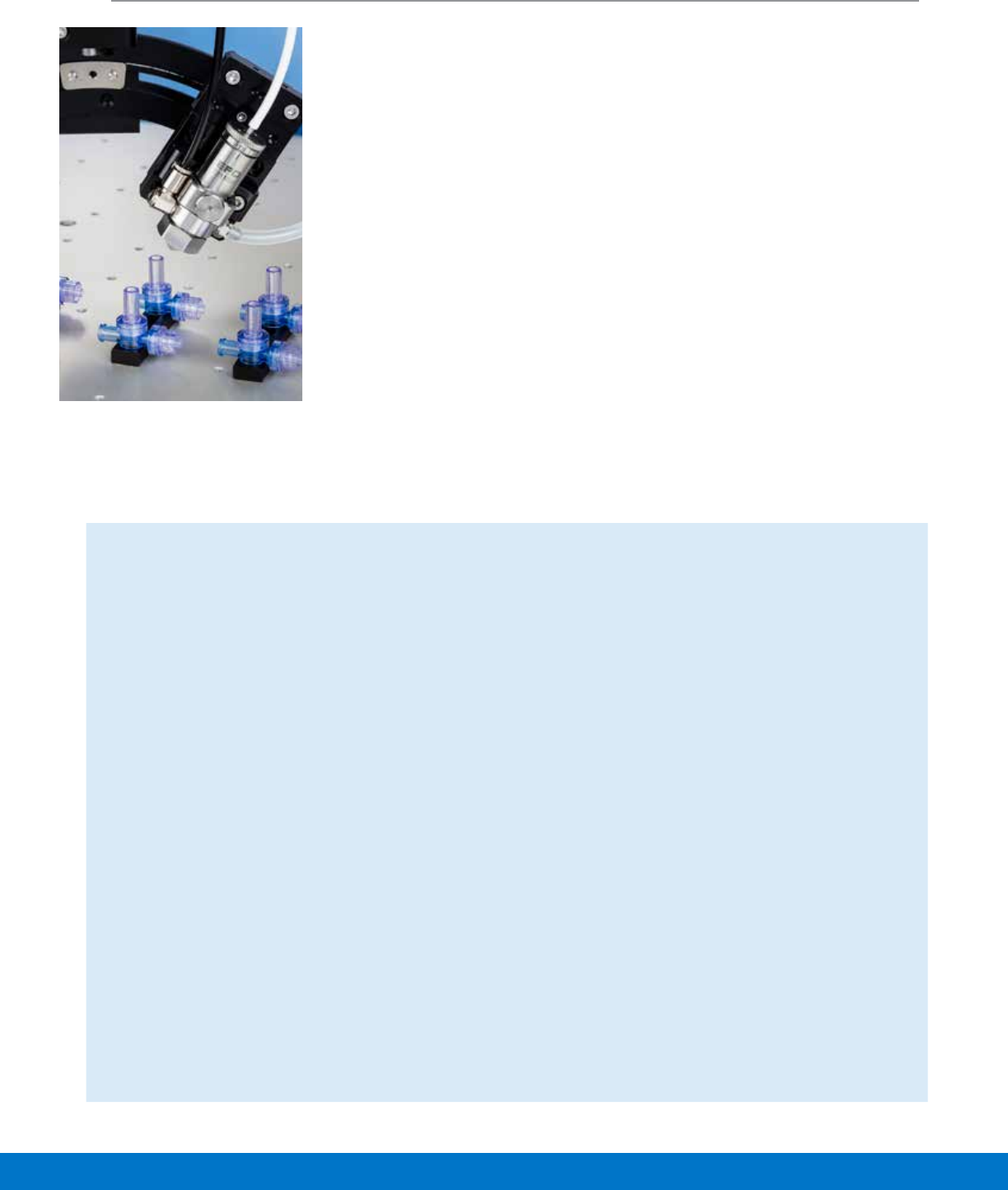
Required maintenance can greatly vary
between valve systems.