Nordson_EFD_Medical_Device_Assembly_White_Paper.pdf - 第5页
5 www.nordsonefd.com 3. Does your application require valves that must meet CIP or SIP standards? Proper coating placement, coverage, and thickness are critical in medical applications. Manual tools and spray systems tha…
2. Are You Using a Dispense Valve System – or Just
a Dispense Valve?
www.nordsonefd.com 4
Taking a “system” approach to fluid dispensing and carefully evaluating all the details – even something
as small as a fluid fitting – will help prevent many problems on your medical device assembly line.
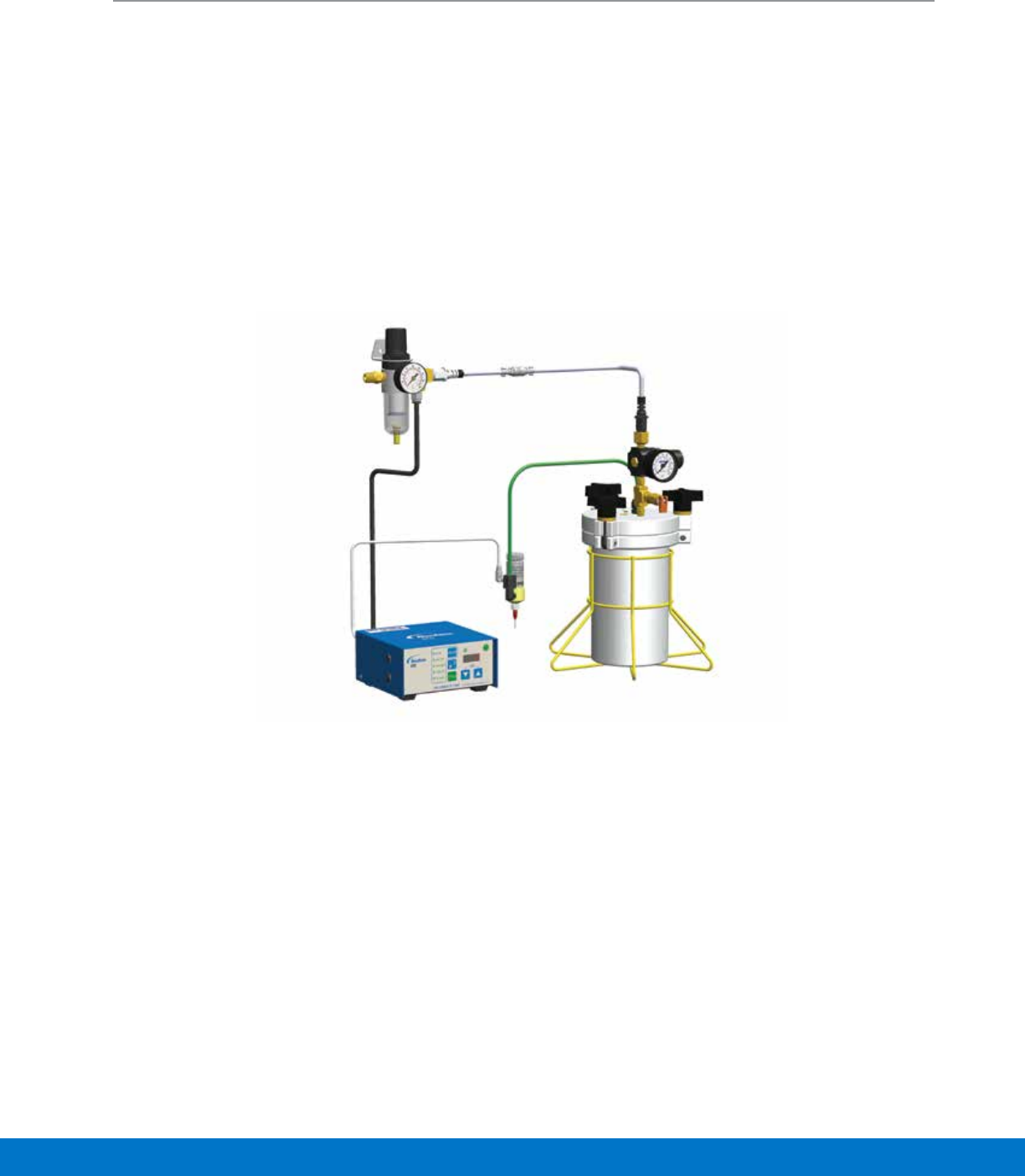
A dispense valve system has four main components:
• Thedispensevalve
• Aprecisiondispensetip
• Ameansofinitiatingthedispensingcycle
• Afluidreservoir
The greatest accuracy, reliability, and production yields will be obtained when all four components are
engineered to work together as an integrated system. This approach will also simplify qualification and
validation processes.
A valve paired with a dedicated valve controller will typically provide faster response time than a valve
triggered by mechanical means or a remote PLC. A dedicated controller will also allow deposit size to
be fine-tuned with much greater precision than other methods, and can be interfaced with the assembly
line’s main PLC.
Tips should be of high quality to ensure unobstructed fluid flow, and matched to the specific fluid and
volume being dispensed.
Fluid tanks should always be fitted with constant bleed regulators, to maintain steady fluid pressure and
prevent variations in deposit size as the fluid level moves from full to empty.
An integrated dispense valve
system with valve, dispense tip,
valve controller, and fluid tank.
5 www.nordsonefd.com
3. Does your application require valves that must meet CIP
or SIP standards?
Proper coating placement, coverage, and thickness are critical in medical applications.
Manual tools and spray systems that allow only coarse adjustment may not provide
the controlled, consistent coverage needed to achieve predictable process results and
reliable device performance.
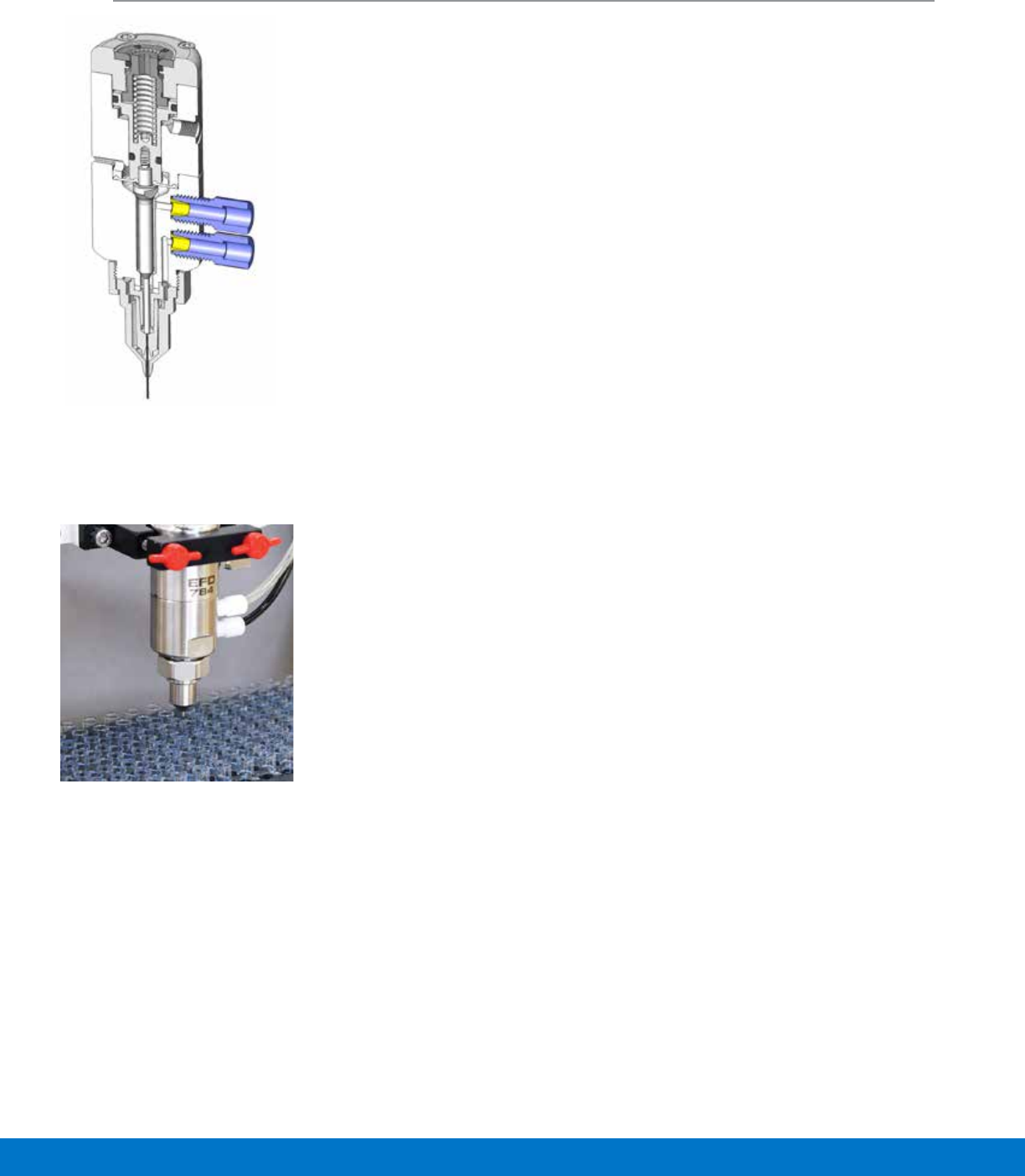
Aseptic valves feature a smooth fluid flow path that is free of any entrapment areas.
FDA-compliant wetted parts make the valve suitable for CIP (Clean-In-Place) and SIP
(Sterilize-In-Place) medical assembly processes.
Aseptic dispense valve wetted components can be made of 316L stainless steel or
PTFE, to conform to biopharmaceutical regulations in medical assembly processes.
Internal threads can be removed to provide a smooth, easily cleaned fluid flow path,
free of entrapment areas and the valve fluid body can be made electro-polished to
increase corrosion resistance.
Aseptic valve shot sizes can range from 0.5 microliter deposits to a continuous flow
rate of 60 milliliters per second. These dispense valves close after each cycle with a
fast, clean cut-off that eliminates drips.
Similarly, aseptic spray valves also feature a fluid flow path that is free of any
entrapment areas—a critical consideration in sterile and aseptic fluid applications
that use low- to medium-viscosity fluids. An aseptic spray valve works best with a
small gauge dispensing tip to produce uniform round spray patterns. Alternatively,
some aseptic spray valves can be fitted with fan air caps for a wider area of coverage.
Aseptic valves and aseptic spray valves offer medical device manufacturers an
accurate, cost-effective coating method that can increase yields, reduce production
costs, and improve process control.
Aseptic valves meet FDA regulations while
providing accurate consistent shots.
The unique design of the aseptic spray
valve is critical for sterile fluid applications.
•Salinesolutions
•OpticalMonomers
•Pillcoatings
•Stentcoatings
•Siliconeoils
•Solvents
•Reagents
•Pharmaceuticalfluids
Compatible Fluids
www.nordsonefd.com 6
If your dispense valves are not cycling fast enough, the valve control system may
not be compatible with the dispense valve.
Most automatic assembly machines use PLCs (Programmable Logic Controllers)
to sequence machine functions, but a PLC’s primary purpose is not to control
dispense valves.
A PLC also may or may not offer online programming of dispensing functions.
Without this capability, entire production lines have to be shut down just to make
simple adjustments to deposit size, and even if a PLC can program valve functions,
the valve may not be within the line of sight of the engineer or operator trying to
adjust it.
A dedicated controller mounted at the dispensing station will simplify initial valve
setup, make it faster and easier to purge the valve after refilling the fluid reservoir,
and allow adjustments to be made and checked “on the fly” without shutting down
the production line. A devoted valve controller with a fast-acting solenoid and a
digital timer can be a simple and cost-effective way to achieve faster cycle times
and more precise control of deposit size. The valve controller can also be interfaced
with the PLC if desired.
Smaller details in the valve system can also make a big difference. A tapered
polyethylene tip, for example, can shorten dispense time by reducing resistance
and providing a faster flow rate than a straight metal tip of the same size. Using a
fluid line with a larger internal diameter is another way to reduce cycle time in
certain applications.
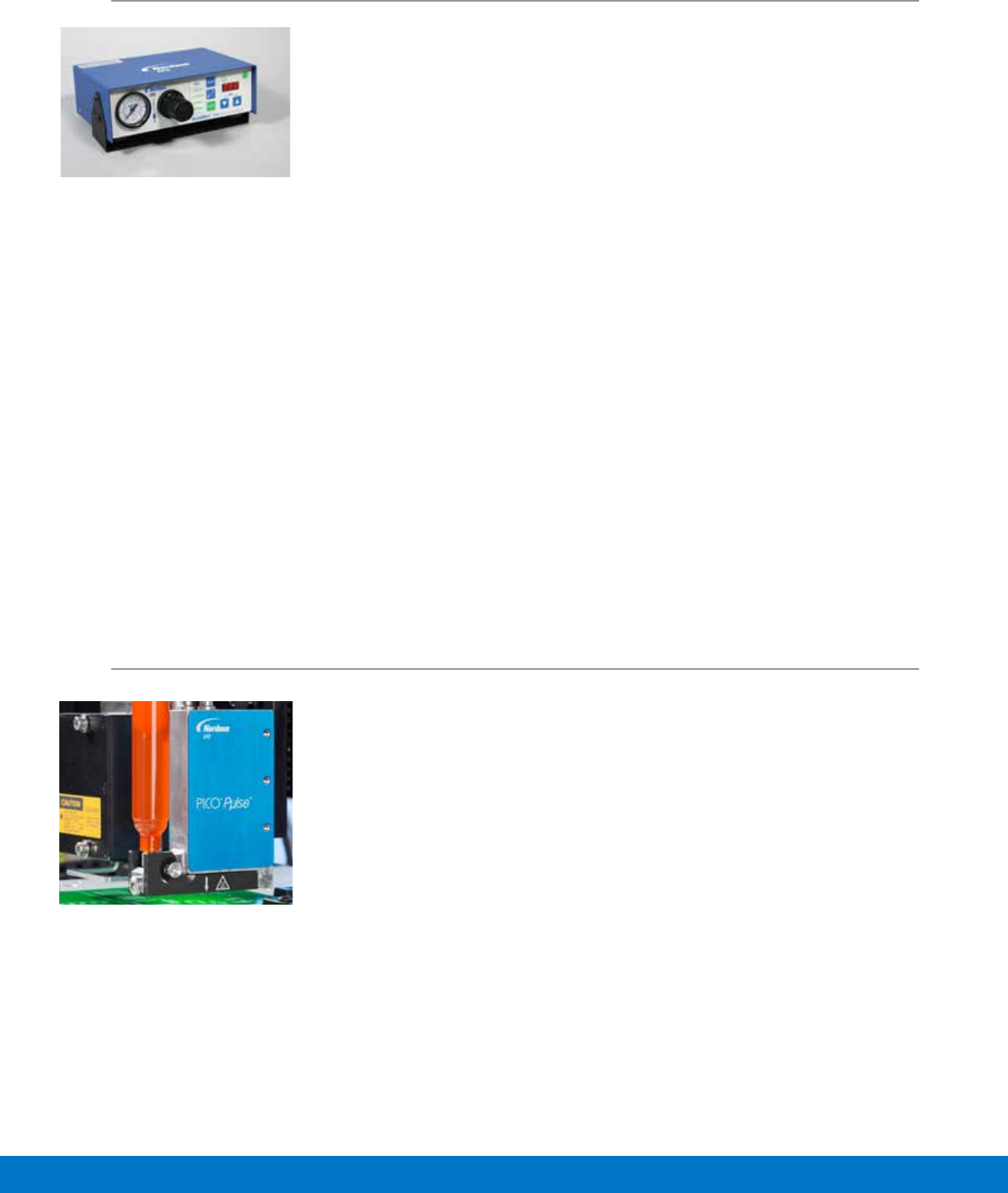
A dedicated valve controller at the dis-
pensing station simplifies setup and
helps valves cycle faster.
Jetting valves can dispense a wide
range of fluids in volumes as small as
0.5 nanoliters at continuous speeds of
up to 1500Hz, or 1500 shots per sec-
ond, with exceptional process control.
4. Is Your Dispensing Line Running as Fast as it Can?
5. Would High-Speed Jetting Fit Your Application Needs?
Non-contact jetting systems are capable of dispensing a wide variety of fluids
at speeds of up to1500Hz, or 1500 shots per second. By combining high speed
with exceptional accuracy, these systems allow medical products to be built more
cost-effectively with consistently high quality.
Additionally, since jet valve systems are non-contact, it is possible to apply fluid in
hard-to-access areas or onto uneven or delicate substrates where dispensing
needles cannot be used.
Jetting can be used with a wide range of fluids. Applications include:
• Syringes • Endoscopes
- Lubricating interiors with - Bonding lenses with optical
silicone oil adhesives
-BondingneedleswithUV • Teststrips
adhesive - Jetting or dispensing protein
• Bloodbags solution
- Sealing bags with - Insulin/blood sugar test strips
cyanoacrylate - Veterinarian test strips