Tech Article._X-ray Inspection_Final Version.pdf
How i s X -r ay Insp ec tion used i n Semi c onduct or Manuf actu ring ? T echnology i s K ey With th e ever pr esent pr essu r e to produc e more e cient devices with mor e po wer , t he sizes of the st ructur es and e…
How is X-ray Inspection used in Semiconductor Manufacturing?
Technology is Key
With the ever present pressure to produce more ecient devices with more power, the sizes of the
structures and electrical connecons in the producon of chips have become smaller and smaller. In
addion the shear number of these connecons in a given unit area has also increased in a
spectacular way. At the heart of all X-ray inspecon, whether it is manual or fully automated
metrology, is the imaging chain. This can be thought about in basic terms by the 2 main elements,
the source and the detector. Over the decades these 2 fundamental items have had to evolve
enormously to keep up with the ever growing demands of the semiconductor industry.
Fig 1. Design of Sealed Transmissive Tube
All X-ray sources are designed to balance 3 things. Power, resoluon and lifeme. The most
advanced today being the Sealed Transmissive Tube g 1. This combines high resoluon, long
lifemes at high power while producing a consistent source of X-rays. This stability, exibility
and quality could not be more important to the inspecon of such small but ever so
important structures.
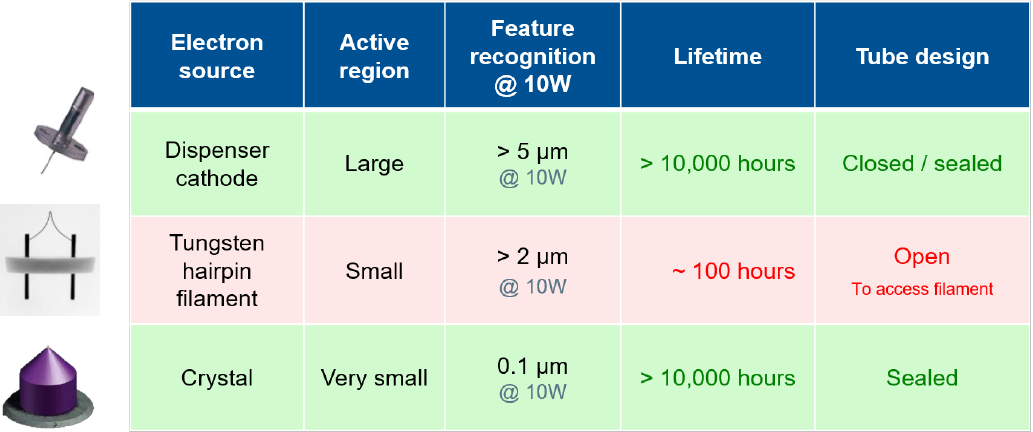
Fig 2. Filament technology comparison
Fundamental to this design is the crystal lament which produces a very ne, ecient
electron beam. This material is able to do this far below it’s crical temperature meaning
much longer life than with a Tungsten lament. When this beam hits the target material the
X-rays are produced. This design allows the device under test to be placed very close to the
source of the X-rays giving the highest possible magnicaon. Magnicaon being dened by
the rao of the distance from source to object and source to detector.
Inspecon strategy should always be a zero defect strategy
The further into the manufacturing process, the more me and expense has been invested
into a single device. That can start adding up very, very quickly into 10s of 1000s of dollars.
Idenfying defects early is essenal, parcularly as more and more devices are being used in
sensive applicaons such as aerospace, autonomous driving vehicles, medical devices etc.
Failure or breakdown in the real world is simply not an opon. If the entertainment system
breaks in a car, it’s inconvenient, but if the ABS system fails, lives depend on it. In this context,
X-ray has the task to make sure that everyone is safe.
There are a number of ways this can go wrong. If the electronic connecons aren’t strong,
they can become suscepble to early life failures through for example, thermal cycling. Let's
look at how processors are usually used. They get really hot, they get turned o, and then
they're cold, then hot, then cold and so on. Components and bonds can then start cracking
and breaking, if they don’t have a really good connecon or are made of low quality
materials.
The complete inspecon picture
Nordson TEST & INSPECTION designs, develops and manufactures various dierenated
technologies which complement each other: these include Acousc, Opcal and Manual X-ray
Inspecon, Autonomous X-ray Inspecon, X-ray Component Counng, Semiconductor Wafer
Metrology, Semiconductor Metrology Sensors and Nordson X-ray Technologies.
A good example is to use both acousc and X-ray inspecon. Acousc inspecon is very
strong when viewing delaminaon in the silicon wafers themselves, where this is much more
of a challenge for X-ray. If this defect is not viewed from the correct angle the imaging isn’t
able to create a clear contrast between that empty space and the material around it. But
when the sound wave in acousc imaging hits this air gap it cannot pass through, is reected
back and detected giving the strongest signal possible. Conversely, where it is dicult to get
this acousc signal back or detect it transmissively (due to scaering or obstrucon by
another void), X-ray makes inspecon simple.
In a similar way, 2D X-ray imaging is complimented by 3D inspecon allowing users to analyse
in ever greater detail.
This is done using Computed Tomography (or CT) which provides the ability to create 3D
models which can then be virtually dissected over and over again, without the need to
destroy the sample under test. This does require more images to be taken in the rst place
and therefore more me than a single 2D strategy. With the ever present need to improve
cycle mes in producon, oen referred to as units per hour (UPH), 3D may never completely
replace 2D. But the major payo is being able to isolate individual layers of devices,
exponenally increasing the chance of nding any problem areas. Something that can be
really challenging, somemes impossible when inspecng highly complex devices with 2D
imaging.
Each of these dierent perspecves have their own strengths and weaknesses. Combined,
they provide a really strong strategy, revealing any defects. Ulmately, by ulizing mulple
technologies and techniques, a more complete inspecon picture can be built up and deeper
understanding can be gained.
Today’s challenge: 3D stacking and heterogeneous ipchips
One of the hot topics in semiconductor engineering right now is 3D design. While this is being
tackled in a few forms, the need to go 3D is simple – the reducon of distance and with that,
resistance/temperature. This is one of the main factors driving the density (in terms of
number of connecons in a given space) of devices and with that the challenges in inspecon.
Given that, high resoluon imaging is clearly required as well as mulple techniques and
technologies. So is the need to implement these at dierent stages of the design and
producon process (g 3.).
We have already established this also makes sense in terms of the cost of failure by capturing
the defects early, before you have invested too much. It also follows that inspecon at the