ConneX_Help.pdf - 第3页
D M S P rogra m m er Ma c h i n e Ma n ager Com m on Types

Table of Contents
Articles
Getting Started
Introduction
Installation
Configuration
User Interface
Manage
Template Records
Settings
Users
Logs
Troubleshooting
Overview
ConneX Service
Changelog
API
API Getting Started
API Overview
GraphQL
Schema
Queries
Objects
Interfaces
Enums
Input Objects
Scalars
MQTT
Automated Handler

DMS
Programmer
Machine Manager
Common Types
Introduction
ConneX 3.0 Introduction
In addition to the job auditing and manufacturing traceability capabilities (delivering device programming results through customizable XML
templates) provided in prior releases, the latest ConneX version introduces an Event Model that you can access through the new ConneX API
(application programming interface) to expand the accessibility and scale of your programming operations data.
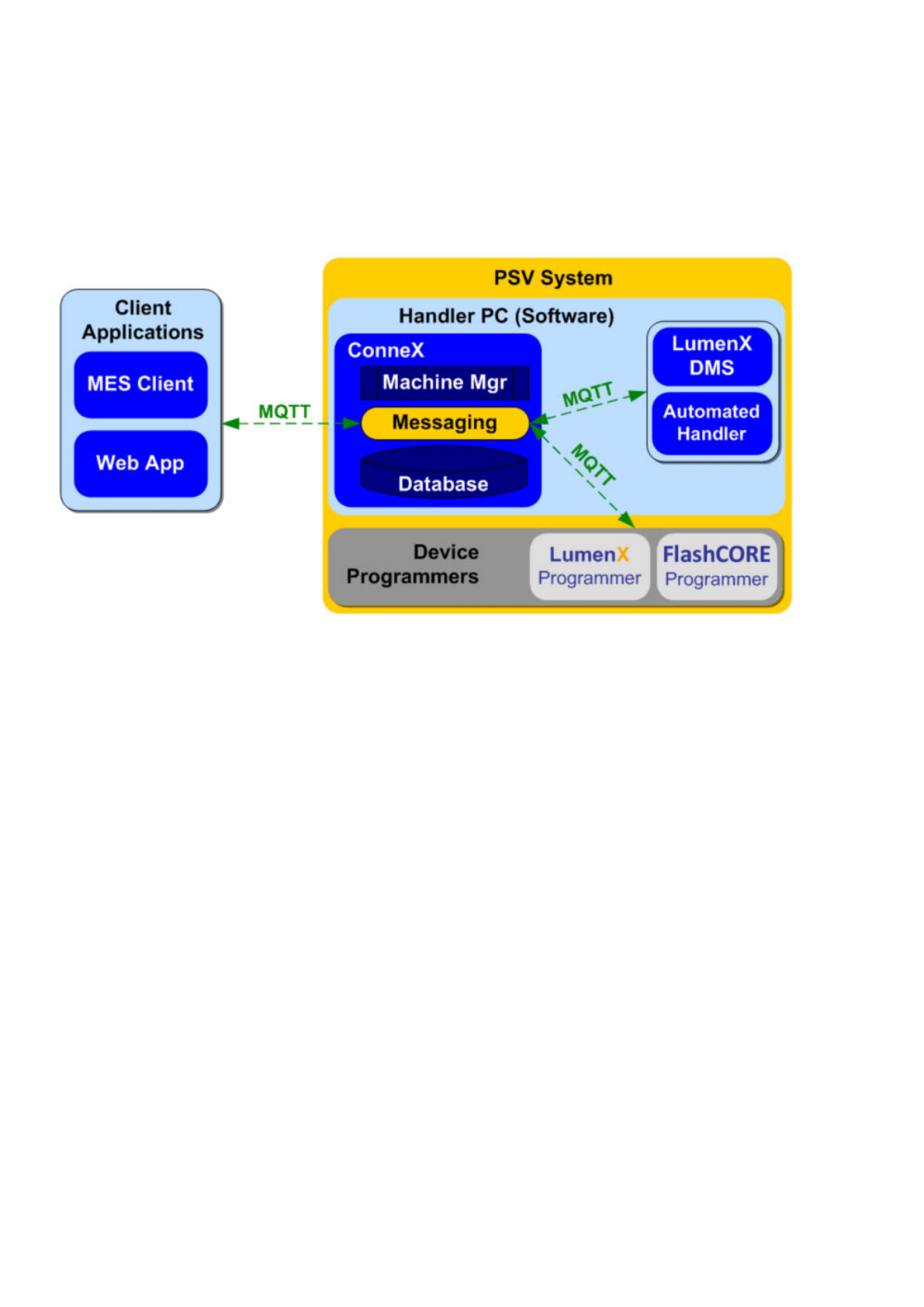
The latest ConneX leverages the Message Queuing Telemetry Transport (MQTT) protocol to exchange event messages between both internal
PSV system components and external client applications.
Internally, ConneX handles all of the data collection and event retrieval from underlying system components (ex. Automated Handler,
Programmers, and LumenX Data Management Software) and exposes them through an external API with a Publisher-Subscriber model:
consumers (ex. a custom dashboard/Web or MES application) call a specific ConneX API to register a callback URL that essentially subscribes
them to the desired event--each time the event occurs, ConneX notifies each consumer who registered/subscribed for event notification.
The ConneX API operates asynchronously to essentially detach internal system functions and events from external applications and
consumers, which in turn simplifies the development skills required to integrate your programming operations data with your MES or custom
Web application because developers need not know or learn the intricacies of how PSV Systems operate. API Consumers simply need to
create an HTTP URL (with some query string parameters to fetch and filter desired event fields).
Template Records/Manager is the component in ConneX that transforms ConneX data and delivers it through standard templates (such as
.XML and .JSON), making it easier for customers to view and export raw records using a template for storage on disk.
From custom real-time dashboards for programming operations to data integration with MES applications, the latest ConneX provides
increased visibility and control over your programming operations to reduce the burden and cost of managing your programming systems.
The latest ConneX maintains backwards-compatibility for existing ConneX users who are now collecting and analyzing their programming
data but also makes it easier for all users to access more data because it features a commonplace yet flexible Web service over standard
HTTPS as the API Provider.
The ConneX API conforms with the MQTT Version 5.0 OASIS Standard, which you can reference at https://docs.oasis-
open.org/mqtt/mqtt/v5.0/mqtt-v5.0.html.
Note
The ConneX API returns MQTT data as a real-time feed of Automated Handler, LumenX/FlashCORE Software, and Programmer events (which
are all persisted by Machine Manager in the Audits database for ConneX). Therefore, if any disruption occurs (ex. ConneX service goes offline
during a job) then events may be lost and retry functions must be implemented for MQTT (and/or any missed events must be retrieved from
the GraphQL API, which provides historical data).
Requirements
This section describes the software requirements for running Machine Manager and ConneX Server.
Machine Manager Requirements
To use the latest ConneX version, each Machine Manager computer must meet the following minimum requirements.
*
PSV
System
Device
Programmers
'
1r
1
1
FlashCORE
Programmer
Programmer
-
A
」
LumenX