XPM2-Site_Preparation.pdf - 第14页
Site Preparation & Installation Section: 2 Page: 14 Revision Date: April 2005 Exhaust Specifications (continued) The oven requires one main facility exhaust connect ion branched into t w o sections and connected to t…
Site Preparation & Installation Section: 2 Page: 13 Revision Date: April 2005
FACILITY SERVICES & CONNECTIONS
Exhaust Specifications
Number of Connections per Oven 2
Oven Exhaust Duct Size 8”
Facility Duct Material High Temperature Flexible Hose – Rated For 125
0
C Minimum
Onload Stack ( Entrance ) Offload Stack ( Exit )
CFM IWC CFM IWC
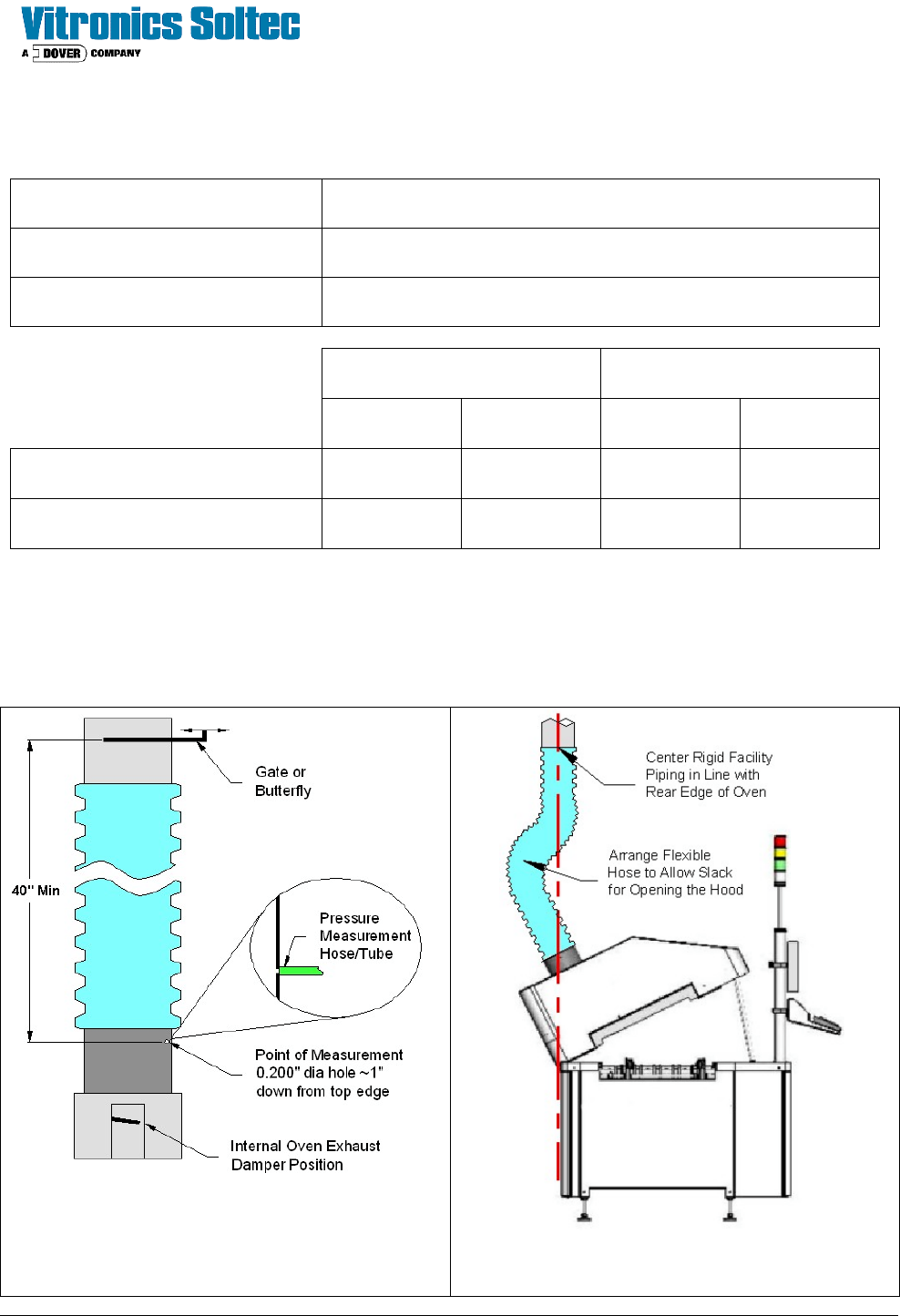
Standard Air or Nitrogen 250 - 300 -0.10 to -0.20 250 - 300 - 0.09 to -0.14
If Equipped with Integrated
Exhaust Stack Filter Option
250 - 300 - 0.90 to -1.30 250 - 300 - 0.12 to - 0.17
CFM = Cubic Feet Per Minute
IWC = Inches of Water Column
Note: On ovens equipped with the Exhaust Sensing System option, insufficient exhaust flow will cause an
oven alarm condition if the exhaust flow is below the minimum setpoint.
Exhaust Measurement Detail End View - Service Position Shown
Site Preparation & Installation Section: 2 Page: 14 Revision Date: April 2005
Exhaust Specifications (continued)
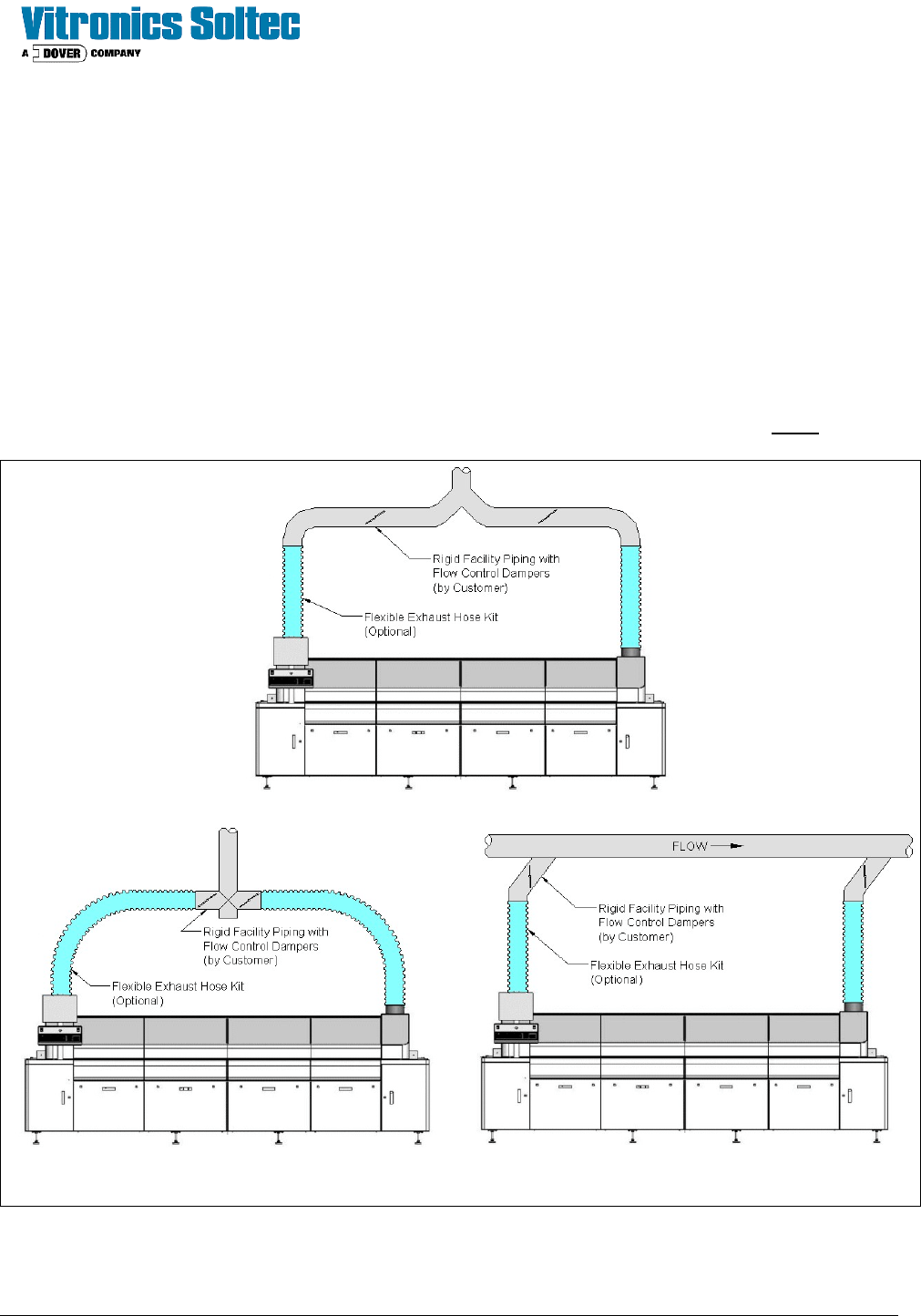
The oven requires one main facility exhaust connection branched into two sections and connected to
the exhaust ducts/ vents on the oven. The main facility drop should be offset to the rear of the oven by
approximately two feet. The connecting hose must be flexible and durable enough to allow for the
opening and closing of the Hood / upper heat zone for servicing. The installation of adjustable
dampers (as shown
below) in the exhaust connection is required to allow flow adjustments as necessary. Flow dampers
must be installed 40 inches above the top of the oven duct / vent. The Customer is responsible for
supplying the main exhaust drop, the two branch sections, flow dampers and hose clamps to connect
to the oven ducts/vents.
Adjustable dampers located approximately 40” (102 cm) above the oven duct / vent in each branch.
Examples of Acceptable Exhaust Configurations
Site Preparation & Installation Section: 2 Page: 15 Revision Date: April 2005
Electrical Power
Vitronics Soltec electrical wiring design is based on the USA National Electrical Code
(NFPA-70 & 79) from the National Fire Protection Association guidelines and European
Standard EN 60204-1. Vitronics Soltec makes no claims or warranties for compliance to
any other standard or any local, state, federal or country codes, expressed or implied.
Unless purchased as an option, XPM
2
ovens are not equipped with a main circuit
breaker disconnect switch. A properly rated fused disconnect or main circuit breaker
switch, facility power cable and connection to the oven switch must be supplied by the
customer and installed by a qualified electrician in accordance with applicable regulations
and codes.
Estimating Power Requirements
Refer to the Electrical Configuration on the Purchase Order for the oven or the oven’s Nameplate Data to
determine the voltage. CAUTION: Incorrect voltage can result in extensive damage to the oven .
The Electrical values in the data tables are based on Vitronics Standard Factory Settings for power
management. Modification to the power management settings in the Oven Control Software may
render these numbers invalid
XPM
2
Current Draw at Start-up in Amperes (kVA)
MODEL
520 730 / 820 940 / 1030 1240
200 vac, 3 ph 110 (38) 120 (42) 120 (42) 120 (42)
208 vac, 3 ph 120 (43) 120 (43) 120 (43) 120 (45)
220 vac, 3 ph 120 (46) 125 (48) 125 (48) 130 (50)
240 vac, 3 ph 125 (52) 130 (54) 135 (56) 140 (58)
380 vac, 3 ph 55 (36) 60 (39) 60 (39) 65 (43)
400 vac, 3 ph 60 (42) 65 (45) 65 (45) 65 (45)
415 vac, 3 ph 60 (43) 65 (47) 65 (47) 70 (50)
440 vac, 3 ph 60 (46) 65 (50) 65 (50) 70 (53)
480 vac, 3 ph 65 (54) 70 (58) 70 (58) 70 (58)
Power Connections
Connect the power and ground cables from the dedicated service (fused disconnect or circuit breaker) to the
power connectors located inside equipment access door located at the front-right corner of the oven. Connect
and secure the cables to the power and ground blocks. A hex wrench for socket head screws will be needed
to tighten the power connections after inserting the supply conductors. The Circuit Breaker also uses socket
head screws for securing the conductors.