20200227103734031.pdf - 第108页
C 46 焊接式切削刀具结构应具有足够的刚性 足够的刚性是以最大允许的外形尺寸,以及采用较高强度的钢号和热处理 来保证。 硬质合金刀片应固定牢靠 硬质合金刀片应有足够的固定牢靠程度,它是靠刀槽及焊接质量来保证 的,故要根据刀片形状及刀具几何参数,选择刀片镶槽形状。 在将刀片焊接至刀杆上以前须要对刀片、刀杆进行必要的检查,首先应检 查刀片的支承面不能有严重弯曲。硬质合金焊接面不得有严重渗碳层,同时还 应将硬质合金刀片表面及刀杆镶槽中的污垢…
C
45
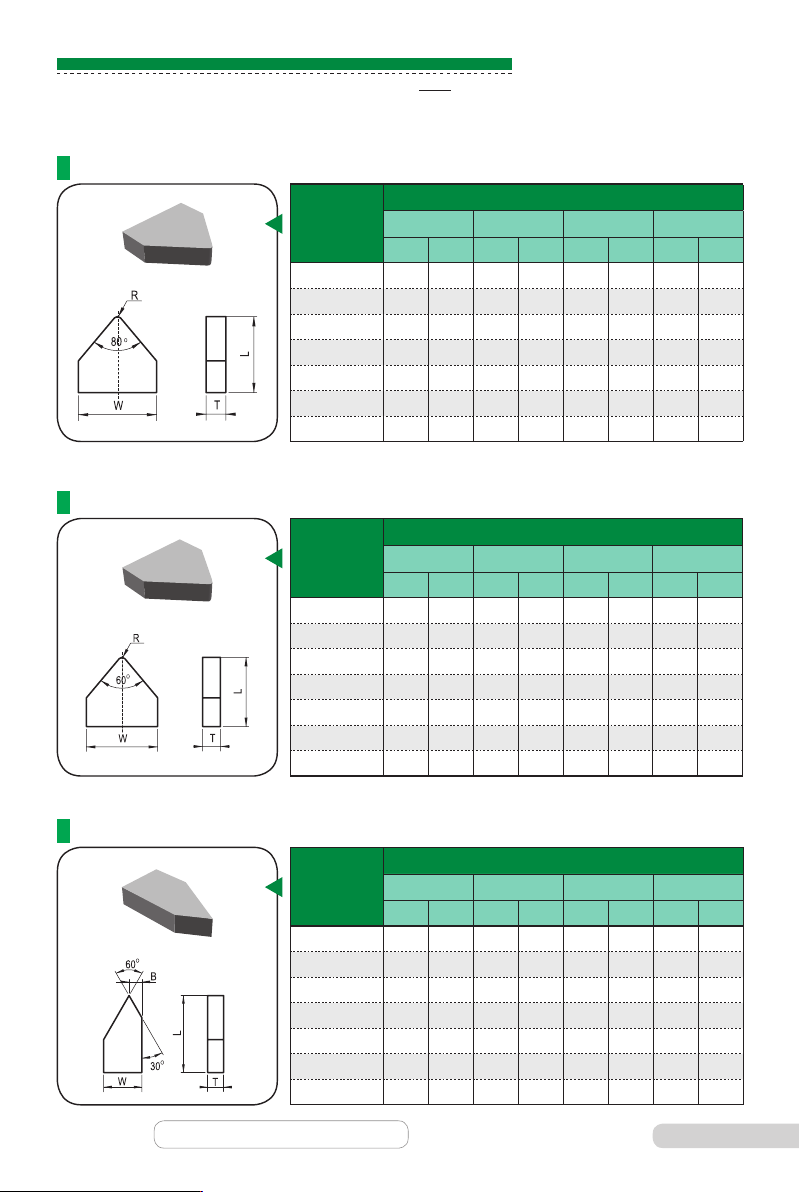
硬质合金焊接刀片
Cemented Carbide Brazed Tips
C
89 系列
Series 89-
型号 Type
尺寸 Dimensions(mm)
L W T R
Inch mm Inch mm Inch mm Inch mm
89-5080
3/8 9.5 5/16 7.9 3/32 2.4 1/64 0.4
89-5100
1/2 12.7 3/8 9.5 3/32 2.4 1/64 0.4
89-5105
1/2 12.7 7/16 11.1 3/32 2.4 1/32 0.8
89-5200
1/2 12.7 1/2 12.7 1/8 3.2 1/32 0.8
89-5240
5/8 15.9 5/8 15.9 5/32 4 1/32 0.8
89-5340
3/4 19.1 3/4 19.1 3/16 4.8 1/32 0.8
89-5410
3/4 19.1 1 25.4 1/4 6.4 1/32 0.8
型号 Type
尺寸 Dimensions(mm)
L W T R
Inch mm Inch mm Inch mm Inch mm
89-6030
5/16 7.9 1/4 6.4 1/16 1.6 1/16 1.6
89-6080
3/8 9.5 5/16 7.9 3/32 2.4 1/64 0.4
89-6100
1/2 12.7 3/8 9.5 3/32 2.4 1/64 0.4
89-6200
1/2 12.7 1/2 12.7 1/8 3.2 1/32 0.8
89-6205
9/16 14.3 1/2 12.7 1/8 3.2 1/32 0.8
89-6240
5/8 15.9 5/8 15.9 5/32 4 1/32 0.8
89-6340
3/4 19.1 3/4 19.1 3/16 4.8 1/32 0.8
型号 Type
尺寸 Dimensions(mm)
L W T R
Inch mm Inch mm Inch mm Inch mm
89-7060
3/8 9.5 1/4 6.4 3/32 2.4 1/16 1.6
89-7160
1/2 12.7 5/16 7.9 1/8 3.2 1/8 3.2
89-7230
3/4 19.1 3/8 9.5 5/32 4 1/8 3.2
89-7000
系列
89-6000
系列
89-5000
系列
Series 89-7000
Series 89-6000
Series 89-5000
公差值
L、W、T允许偏差同C42页
C
46
焊接式切削刀具结构应具有足够的刚性
足够的刚性是以最大允许的外形尺寸,以及采用较高强度的钢号和热处理
来保证。
硬质合金刀片应固定牢靠
硬质合金刀片应有足够的固定牢靠程度,它是靠刀槽及焊接质量来保证
的,故要根据刀片形状及刀具几何参数,选择刀片镶槽形状。
在将刀片焊接至刀杆上以前须要对刀片、刀杆进行必要的检查,首先应检
查刀片的支承面不能有严重弯曲。硬质合金焊接面不得有严重渗碳层,同时还
应将硬质合金刀片表面及刀杆镶槽中的污垢进行清除,以保证焊接牢靠。
对焊接用焊料的要求:
为了保证焊接强度,应选择合适的焊料。在焊接过程中,应保证良好的湿
润性和流动性,并排除气泡,使焊料与合金焊接面充分接触,无缺焊现象。
对焊接用熔剂的要求:
建议采用工业硼砂,在使用前应在烘干炉中进行脱水处理,然后进行碾
碎,过筛去除机械夹杂物,待用。
在焊接高钛低钴细颗粒合金及焊接长而薄的合金刀片时,为减少焊接应
力,建议采用厚度为0.2-0.5mm的薄片或网孔径1-2mm的网状补偿垫片进行
焊接。
由于硬质合金刀片脆性较大,对裂纹形成敏感性强,所以刀具在刃磨过
程中应避免过热或急冷,同时还要选择合适粒度和硬度的砂轮及合理的磨削工
艺,避免产生刃磨裂纹,影响刀具使用寿命。
在安装刀具时,刀头伸出刀架的长度应尽量小,否则,容易引起刀具震
动,从而损坏合金片。
刀具使用达到正常磨钝时,必须进行重磨,重磨后的刀具,一定要用油石
对刃口及刀尖圆角进行研磨,这样会提高刀具的使用寿命及安全可靠性。
焊接式硬质合金刀片使用说明
1
2
3
4
硬质合金焊接刀片
Cemented Carbide Brazed Tips
C

C
47
A guide to the applications of cemented
carbide brazed tips
1
2
3
4
The structure of brazed tips tools should be tough enough
Enough toughness shall be guaranteed by the maximum allowable sizes of the tips
and by using a rather strong steel grade and heat treatment.
Cemented carbide tips should be strongly fixed securely
The cemented carbide tips should have a secure xation and it is guaranteed by
the Flutes of the tool holders and the quality in welding, so the utes of the tools holders
must be selected based on the shapes and the geometrical parameters of the tips.
Before welding of the tips to the tool holders, a check must be done on the tips And
the tool holders. An initial check must be done to ensure that there is no serious bending
on the support surface of the tips. There shall be no serious carbulization on the welding
surface of the tips and at the same time the contaminants on the surface of the tips and
in the utes of the tools holders must be eliminated to ensure the quality of a secure
welding.
There are requirements for the welding materials
In order to endure the toughness of the welding, a suitable welding material must
be selected. During the welding, good wettability and owability must be guaranteed and
the air bulbs must be got ridden of in order to ensure the sufcient contact of the welding
material and the surface of the tips to be welded leaving nothing to be welded.
There are requirements for the flux in the welding process
It is recommended that industrial borax is to be used. Before the use of the borax, it
should be dewatered in a drying oven and then milled and sieved to get rid of the foreign
objects.
During the welding of cemented carbide tips of ne grain size with high titanium and
low cobalt content and long and thin cemented carbide tips it will be recommended that
compensation shims of a thickness of 0.2-0.5mm or similar shims with holes of l-2mm in
order to reduce the stress in the welding process.
As cemented carbide tips are rather brittle and are most sensitive to the formation
of cracks. excessive heating or rapid cooling must be prevented in the grinding of the
tools and at the same time, grinding wheels with an appropriate grain size and hardness
must be selected and a proper grinding technique to avoid cracks in the grinding of the
edges of the tips and not to affect the lifetime of the tools.
When the tools are installed, the length of the tips outstretching the tools must be
as less as possible, as otherwise the vibration of the tools will occur thus damaging the
cemented carbide tips.
When the tools come to a normal bluntness, they must be reground. The edges
and the radius of the edges must be ground with oilstones after the tools are ground to
increase the lifetime and reliability of the tools.
硬质合金焊接刀片
Cemented Carbide Brazed Tips
C