(TI)对半导体器件的长期存储评估.pdf - 第3页
In addition to the studies performed on the long term storage products, package qualifications include humidity testing tests to evaluate the effect of moisture on die metallization (galvanic corrosion). Devices routinel…

1 Introduction
This paper details the ongoing results of studying the quality, reliability, and usability of semiconductor products
after long-term storage in a controlled environment. To better understand long-term storage viability, additional
data was collected to further comprehend the time that products can be stored before the reliability can be
compromised.
2 Background
Prior to 1995, the U.S military specified electrical retest of devices if a three-year date code window was
exceeded. In 1995, the military specification MIL-PRF-19500M that mandated electrical retest after three years
was revised and that requirement was removed entirely. The military now prohibits date code restrictions on
component orders.
2
The NEDA (National Electronic Distributor Association) "recommends that date code age
restrictions be eliminated from the ordering process."
2
Shelf-Life Evaluation of Nickel and Palladium Lead Finish for Integrated Circuits was published in 1998 and
validated that this finish had good solderability after eight years in normal packing materials. In 2004, Shelf-Life
Evaluation of Lead-Free Component Finishes concluded that the storage period for NiPdAu, NiPd, NiPdAu-Ag,
matte Sn, and SnPb lead finish is >8 years as measured by solderability after exposure to a Battelle Class 2
MFG environment. The white paper Component Reliability After Long Term Storage was published in 2008 in
support of the storage extension for NiPdAu leaded products >15 years and packaging materials for a minimum
of six years under the worst case condition (38°C/100% RH). This was followed by BGA Package Component
Reliability After Long-Term Storage in 2009 to include BGA and DSBGA/WCSP product with the long term
storage conclusion of > 10 years.
In 2020, a new study validated that semiconductor products can be stored in a controlled environment for a
minimum of fifteen years. The results from this study are documented in this technical white paper.
3 Procedure
56 lots of product from different package types (leaded, leadless QFN style, silicon based BGA – DSBGA/WCSP
and contact finishes NiPdAu, Sn, or SnAgCu solder balls) were evaluated in this study. The age of the products
studied ranged from 10 years and up to 21 years of storage in a controlled environment (<30°C and <80% RH).
The acronym LTS (long term storage) is used to identify this aged material.
The product packaging was carefully examined when the samples were received and the Humidity Indicator
Card (HIC) was recorded for each lot at the first time opening of the sealed Moisture Barrier Bag (MBB), when
applicable. The labels on the bags and boxes were evaluated for legibility and adhesion. MBB and cover tape
were assessed and tested for any deterioration in ESD protection through Tribocharging testing. A cover tape
peel test was performed to ensure there were no compromising attributes of the cover tape adhesion to the
cover tape for long term storage.
The product underwent extensive reliability testing to determine if any adverse effects occurred while storing the
devices for a long period of time. They were carefully examined for any evidence of deterioration on the lead or
package body. Solderability, which can be the most significant concern with long term storage, was performed on
all lots in addition to other reliability testing to determine if there were any detrimental effects.
4 Risk Assessment
The reliability risk to semiconductor products that have been stored for longer period of time is low. In the most
recent and prior studies, no evidence of diminishing reliability has been found that would adversely affect the
product or the ability for it to be soldered to a PCB for material stored for a long period of time. No failure
mechanisms have been identified that would compromise the electrical performance or circuit reliability of LTS
devices. HTOL and HTSL qualification data provides the best estimate of parametric performance over time.
Devices are biased during HTOL testing; this is the worst case compared to unbiased storage. FIT rates for
analog products have been in the single digits for more than a decade. This assures that biased and unbiased
devices would remain within data sheet limits far beyond the design and storage life of the device.
2
NEDA Publication, (2002). Managing Date Code Restrictions on Orders for Electronic Components
Introduction www.ti.com
2 Long Term Storage Evaluation of Semiconductor Devices SLPA019 – SEPTEMBER 2021
Submit Document Feedback
Copyright © 2021 Texas Instruments Incorporated
In addition to the studies performed on the long term storage products, package qualifications include humidity
testing tests to evaluate the effect of moisture on die metallization (galvanic corrosion). Devices routinely pass
high temperature and high humidity testing. All products are stored in a properly controlled environment prior
to being shipped. Moisture sensitive products are packaged with appropriate MBB and desiccant based on
TI internal specification for moisture sensitivity which aligns with JEDEC J-STD-033C. Packaging material and
cover tape was evaluated using Tribocharge testing and showed no issues. Any failure of the MBB would be
detected immediately by the HIC discolorations upon opening the package.
5 Products Samples Included in the Evaluation
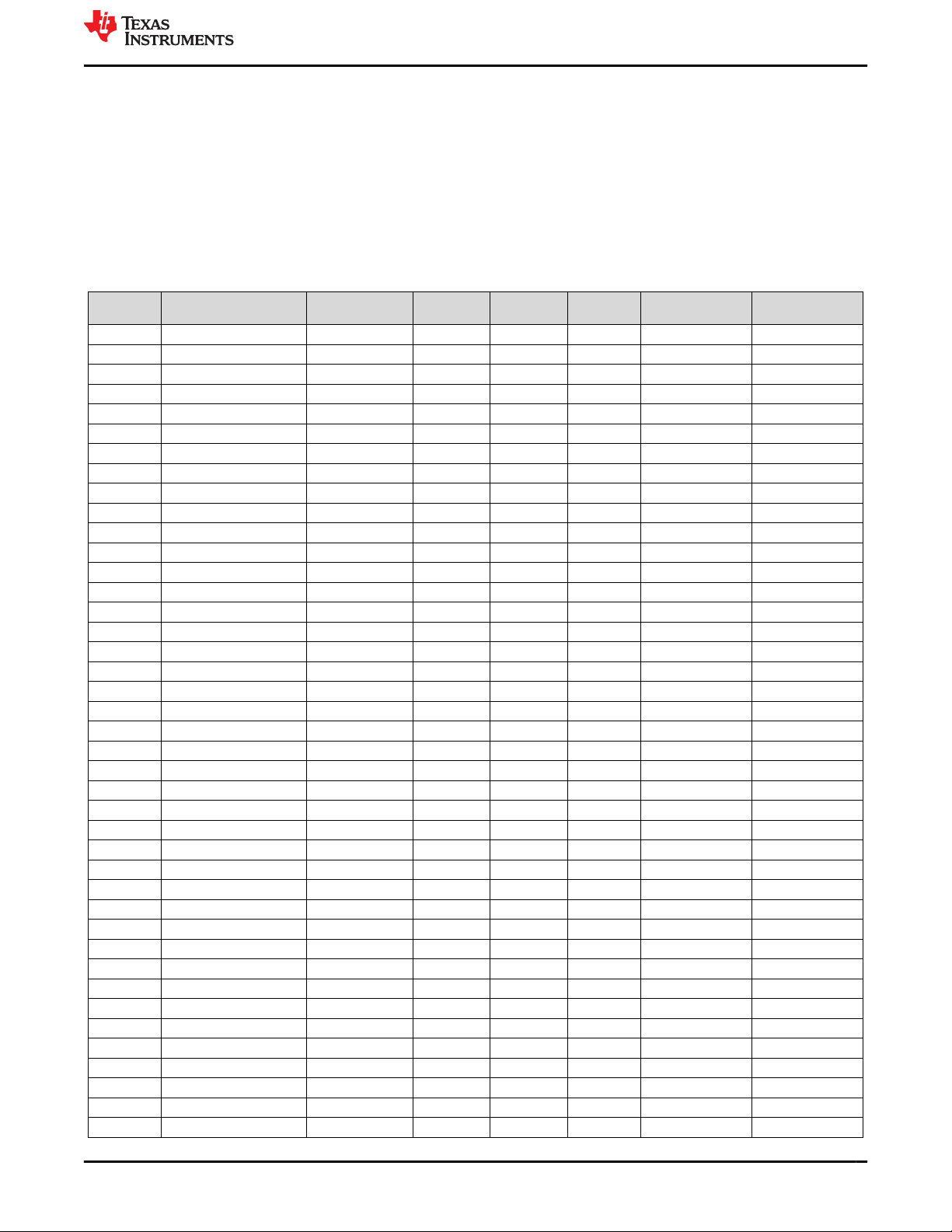
Table 5-1 lists the evaluated device samples.
Table 5-1. Product Samples
Sample
Batch #
Product Name Shelf Storage Age
(Years)
(2)
Terminal
Finish
Package
Type
Pin Count Soldering Results.
Units Tested/Fail
Moisture Sensitivity
Level
1 CC2530F64RHAR 11 NiPdAuAg VQFN 40 5 / 0 MSL3
2 CC2531F256RHAR 10 NiPdAuAg VQFN 40 7 / 0 MSL3
3 TPS51621RHAR 10 NiPdAu VQFN 40 7 / 0 MSL3
4 TPS65182RGZR 10 NiPdAu VQFN 48 8 / 0 MSL3
5 BQ25015RHLR 11 NiPdAu VQFN 20 9 / 0 MSL3
6 TRF3761-GIRHAR 13 NiPdAuAg VQFN 40 9 / 0 MSL3
7 TPS65810RTQR 11 NiPdAu VQFN 56 9 / 0 MSL3
8 LP3906SQ-VPFP/NOPB 10 Matte Sn WQFN 24 9 / 0 MSL1
9 TS3L500RHUR 15 NiPdAuAg WQFN 56 8 / 0 MSL1
10 DS92LV0411SQE/NOPB 10 Matte Sn WQFN 36 8 / 0 MSL3
11 TS3L500RHUR 10 NiPdAuAg WQFN 56 8 / 0 MSL1
12 TLV70029DSER 10 NiPdAuAg WSON 6 8 / 0 MSL 1
13 TPS73418DRVR 12 NiPdAu WSON 6 10 / 0 MSL 1
14 TPS62750DSKR 11 NiPdAu WSON 10 10 / 0 MSL 1
15 TPS71926-15DRVR 13 NiPdAu WSON 6 8 / 0 MSL 1
16 TPS79425DCQR 15 NiPdAu SOT-223 6 9 / 0 MSL2
17 TPS73233DCQR 11 NiPd Au SOT-223 6 9 / 0 MSL2
18 TPS73233DCQR 16 Sn SOT-223 6 9 / 0 MSL2
19 OPA343NA/3K 20 Sn SOT-23 5 9 / 0 MSL 1
20 TLV431AIDBVR 20 Sn SOT-SC70 5 9 / 0 MSL 1
21 SN74AHC1G00DBVR 17 NiPdAu SOT-23 5 9 / 0 MSL 1
22 LMV331IDCKR 15 NiPdAuAg SOT-SC70 3 9 / 0 MSL 1
23 TL431CDBVR 15 NiPdAu SOT-23 5 9 / 0 MSL 1
24 REF3112AIDBZT 14 NiPdAuAg SOT-23 3 10 / 0 MSL 1
25 TL431QDBVT 10 NiPdAu SOT-23 5 10 / 0 MSL 1
26 TLV809J25DBZT 10 NiPdAu SOT-23 3 10 / 0 MSL 1
27 SN74LVC1G06DBVR 10 NiPdAu SOT-23 5 10 / 0 MSL 1
28 SN74AHCT1G86DBVR 10 NiPdAu SOT-23 5 10 / 0 MSL 1
29 ADS7868IDBVR 10 NiPdAu SOT-23 6 10 / 0 MSL2
30 OPA2337EA/3K 11 Sn SOT-23 8 10 / 0 MSL2
31 SN74LVC1G08DCKR 10 NiPdAu SOT-SC70 5 10 / 0 MSL 1
32 SN74AHCT1G04DCKR 15 NiPdAu SOT-SC70 5 10 / 0 MSL 1
33 SN74AHC1G02DCKR 15 NiPdAu SOT-SC70 5 10 / 0 MSL 1
34 LMV321IDCKT 10 NiPdAuAg SOT-SC70 5 10 / 0 MSL 1
35 TXS0206YFPR 10 N/A DSBGA 20 10 / 0 MSL 1
36 TLV320AIC3107IYZFR 10 N/A DSBGA 42 10 / 0 MSL 1
37 WL1251B2LYFBR 11 N/A DSBGA 104 10 / 0 MSL 1
38 PCM1870YZFR 12 n/a DSBGA 24 10 / 0 MSL 1
39 LMV641MAX/NOPB 11 Sn SOIC 8 9 / 0 MSL 1
40 SN74HC595DR 11 NiPdAu SOIC 16 10 / 0 MSL 1
41 USBN9604-28MX 10 Sn SOIC 28 10 / 0 MSL3
www.ti.com Products Samples Included in the Evaluation
SLPA019 – SEPTEMBER 2021
Submit Document Feedback
Long Term Storage Evaluation of Semiconductor Devices 3
Copyright © 2021 Texas Instruments Incorporated
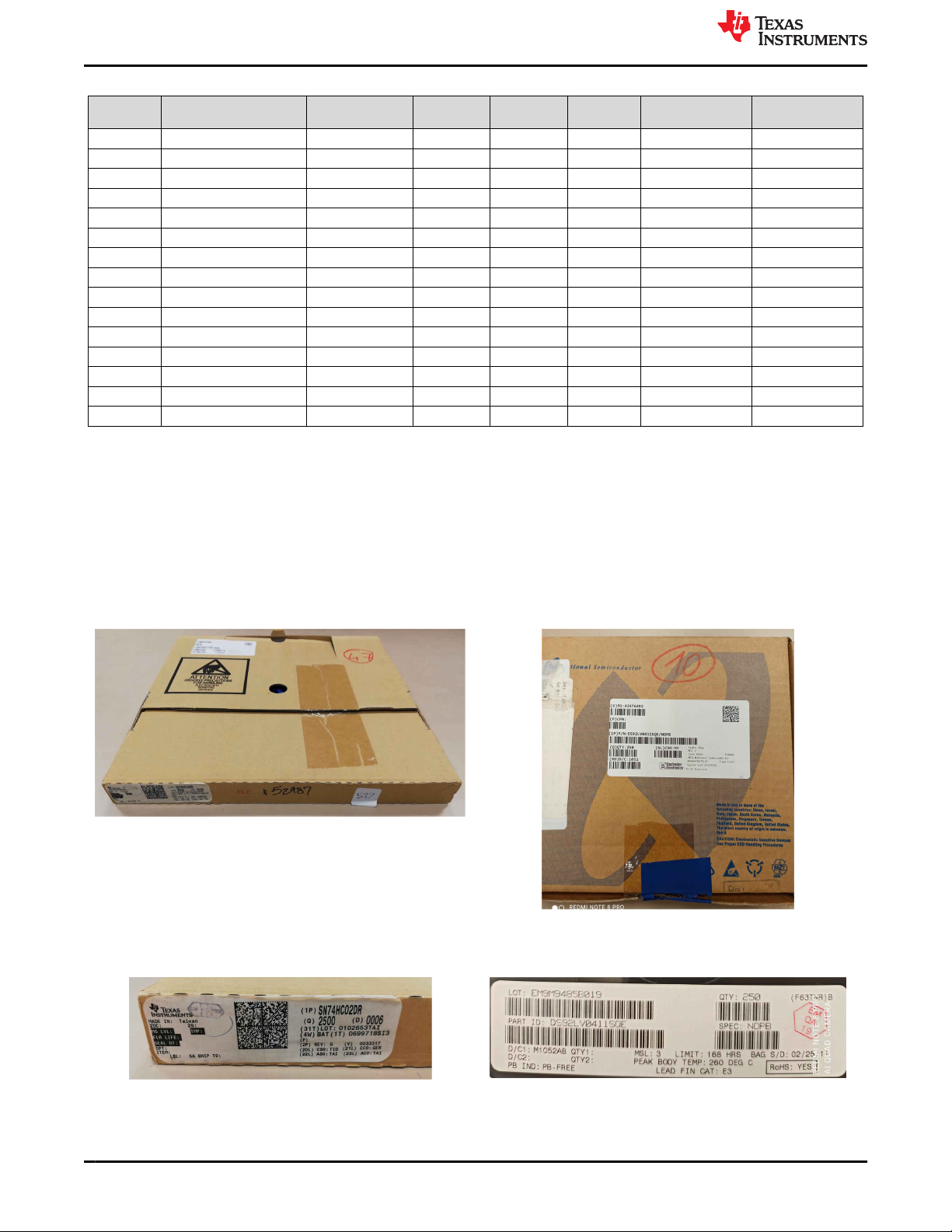
Table 5-1. Product Samples (continued)
Sample
Batch #
Product Name Shelf Storage Age
(Years)
(2)
Terminal
Finish
Package
Type
Pin Count Soldering Results.
Units Tested/Fail
Moisture Sensitivity
Level
42 LOG2112AIDWR 11 NiPdAu SOIC 16 9 / 0 MSL3
43 TL1451ACDR 16 NiPdAu SOIC 16 9 / 0 MSL 1
44 SN94754IDR 15 NiPdAu SOIC 8 10 / 0 MSL3
45 LOG101AIDR 19 NiPdAu SOIC 8 10 / 0 MSL3
46 SN74AHC00D 21 NiPdAu SOIC 14 9 / 0 MSL 1
47 SN74HC02DR 21 NiPdAu SOIC 14 9 / 0 MSL 1
S1
(1)
BQ24202DGNR 18 Sn HVSSOP 8 6 / 0 MSL1
S2
(1)
MSC1210Y3PAGT 18 Sn TQFP 64 6 / 0 MSL3
S3
(1)
OPA2822U/2K5 18 NiPdAu SOIC 8 6 / 0 MSL3
S4
(1)
REG101NA-2.85/250 18 NiPdAu SOT-23 5 6 / 0 MSL3
S5
(1)
SN75LVDS179D 18 NiPdAu SOIC 8 5 / 0 MSL1
S6
(1)
TLV2463CDGSR 18 Sn VSSOP 10 6 / 0 MSL1
S7
(1)
TPS75933KTTT 18 Sn VSSOP 5 6 / 0 MSL2
S8
(1)
TSB12LV31PZ 19 Sn LQFP 100 6 / 0 MSL3
S9
(1)
SH6950DAAOPFP 17 NiPdAu HTQFP 80 6 / 0 MSL3
(1) The products S1 through S9 were the original 2008 risk assessment and were continuously stored in the Singapore Product
Distribution Center (PDC) and retested for this paper.
(2) Age determined as of March 2021.
6 Packaging Materials Evaluation
The sample products used in this study were retrieved from storage warehouses and shipped to the evaluating
TI reliability lab. Original packing materials from the actual production time were preserved and evaluated. Upon
receiving the material in the evaluating lab, the outer cardboard box, also referred to as shipping box, was
inspected and documented. Device information labels continued to properly adhere to the box after 20 years of
warehouse storage and were readable.
Figure 6-1. Sample #47 Image of Shipping Box as
Received
Figure 6-2. Sample #10 Image of Shipping Box as
Received
Figure 6-3. Sample #47 Label on Box
Figure 6-4. Sample #10 Label on Box
Packaging Materials Evaluation www.ti.com
4 Long Term Storage Evaluation of Semiconductor Devices SLPA019 – SEPTEMBER 2021
Submit Document Feedback
Copyright © 2021 Texas Instruments Incorporated