03253524-01 KPO 2 Closed Loop.pdf - 第18页
3 USER INFORMATION 3.3 GETTING STARTED 18 Standalone Manual Interface To Koh Young KPO 2 08/2021 3.3.2 KPO Monitor The KPO Monitor app is a separate application that can be used to monitor the status of the KPO interface…
3 USER INFORMATION
3.3 GETTING STARTED
Standalone Manual Interface To Koh Young KPO 2 08/2021 17
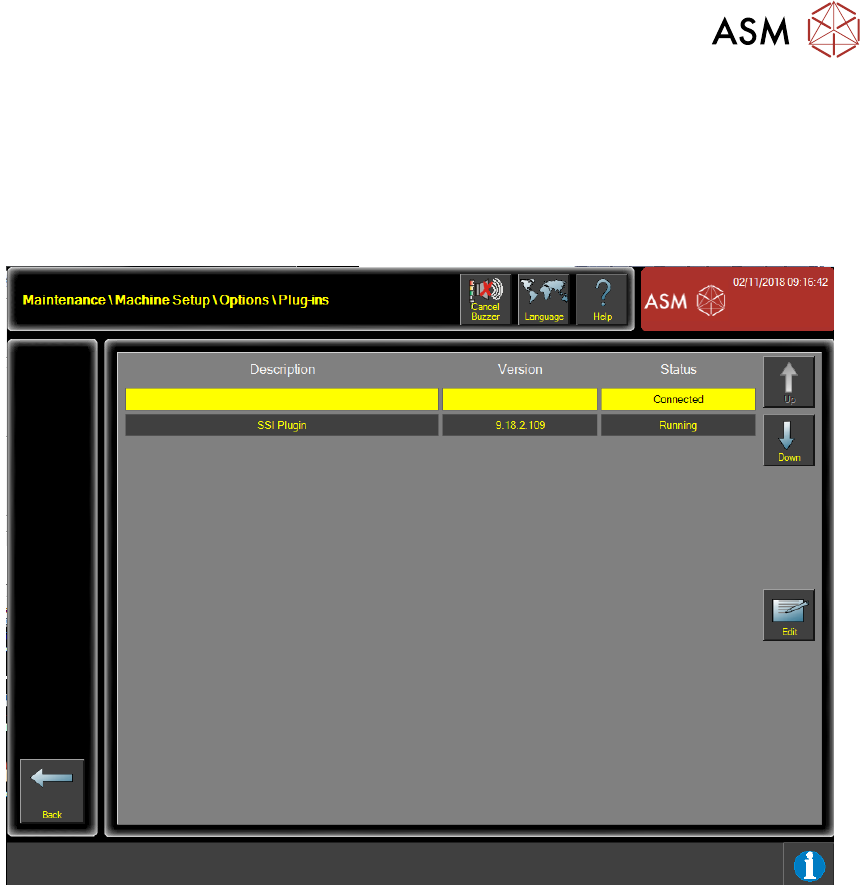
Within the Maintenance\Machine Setup\Options\Plug-Ins menu the following status conditions of
the KPO plug-in are displayed:
●
Connecting - The plug-in is enabled and waiting for the SPI to connect
●
Connected - The plug-in is communicating with the SPI
●
Disabled - The plug-in has been disabled
KPO Plugin
9.17.2.1590
Plug-Ins Page
3.3.1 Running A KPO DOE
Before a KPO DOE is run, the printer should be prepared for a print run and left in the Ready page.
The checklist in Appendix A may assist in preparing the printer. The tables in Appendix B are
provided to assist in monitoring the print performance before and after KPO optimisation. These
may also help with any troubleshooting activities.
The KPO system takes control of the printer and runs the printer for the duration of the test. Whilst
in KPO mode, boards are only printed when the SPI is ready.
During the DOE, the SPI changes print parameters for pressure, speed and separation and can
also instigate under stencil cleans.
When the DOE has been completed the printer returns to normal operation ready to resume pro-
duction. It is recommended that the correct recipe/product file is loaded before production resumes.
3 USER INFORMATION
3.3 GETTING STARTED
18 Standalone Manual Interface To Koh Young KPO 2 08/2021
3.3.2 KPO Monitor
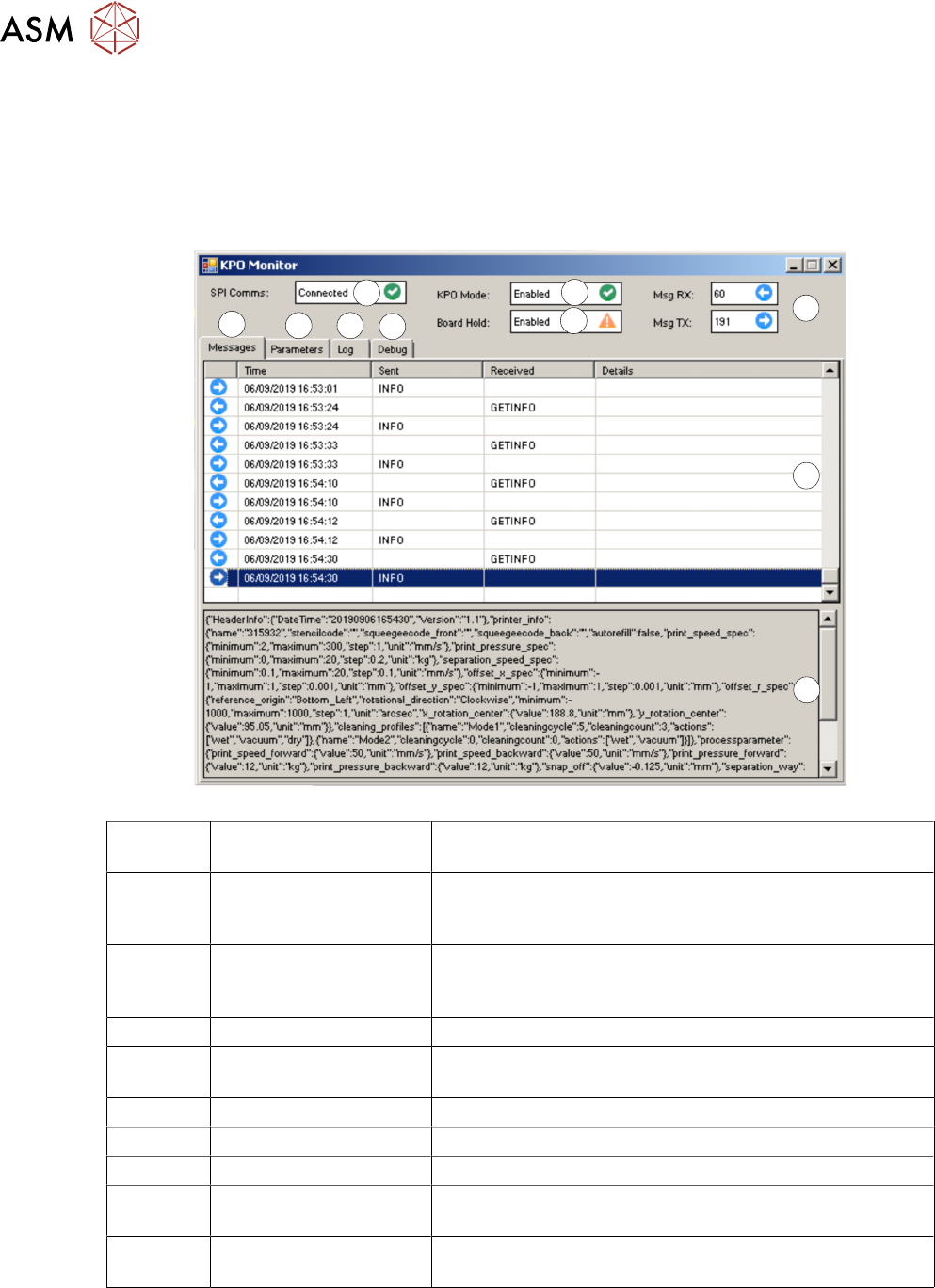
The KPO Monitor app is a separate application that can be used to monitor the status of the KPO
interface. It is a useful application for monitoring and testing any KPO operation.
The app is available via the Start menu.
The Monitor app window displays the following User information:
1
2
3
4
5
6 7
8
9
10
}
1 SPI Comms Communication status between the printer and the SPI.
Options – Connected/Not Connected
2 KPO Mode Enables print and USC clean data being sent to the SPI.
Also, the SPI can control the print cycle.
Options – Enabled/Disabled
3 Board Hold Enable the blocking of the next board by the SPI if it is not
ready. Typically, only used during a PAM DOE
Options – Enabled/Disabled
4 Msg RX/Msg TX Message counts between the printer and SPI
5 Messages Tab Displays the summary of KPO messages sent and re-
ceived by the printer.
6 Parameters Tab Not implemented
7 Log Tab Not implemented
8 Debug Tab Not implemented
9 Message List Pane Displays the last 100 messages. The time and date, mes-
sage sent/received are shown.
10 Message Pane Displays the full message details for the highlighted mes-
sage in the Message List (9)
3 USER INFORMATION
3.3 GETTING STARTED
Standalone Manual Interface To Koh Young KPO 2 08/2021 19
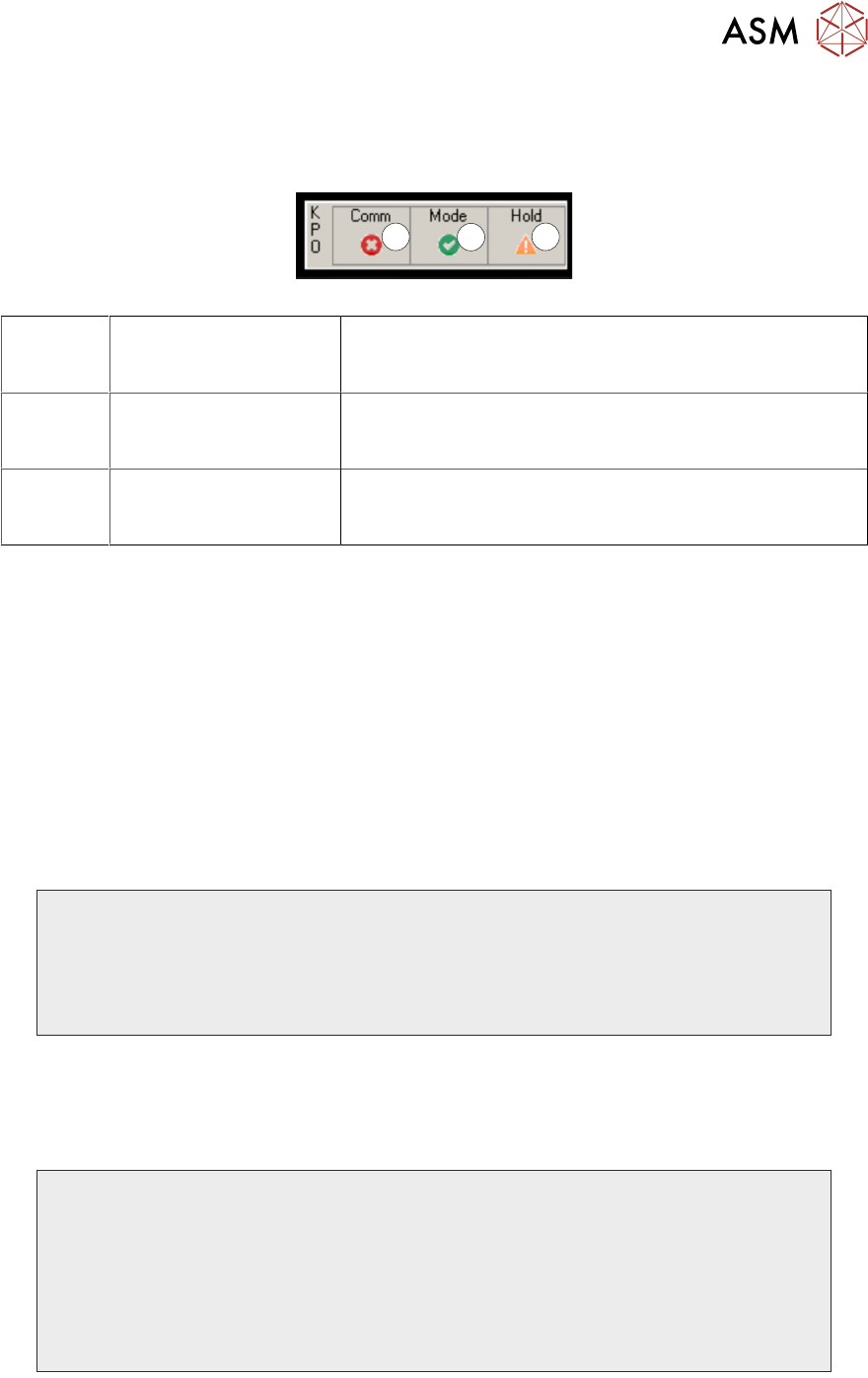
When the KPO Monitor app is running it can be accessed from behind the printer user interface us-
ing Alt-Tab on the keyboard. When the application is hidden or minimized the following small float-
ing window summarizing the KPO interface status is displayed in front of the printer user interface:
1
2
3
1 Comm Displays the communication status between the printer
and the SPI (as in 1 in previous table)
Options – Tick – connected/Cross - not connected
2 Mode Displays the status of the KPO Mode (as in 2 in previous
table)
Options – Tick - enabled/Cross - disabled
3 Hold Displays the status of the Board Hold (as in 3 in previous
table)
Options – Exclamation Mark – enabled/Tick - disabled
The floating window can be positioned by the user by clicking and dragging anywhere in the win-
dow border.
3.3.3 KPO Logs
The KPO plug-in records data in the following log, e:\log\plug-in\kpo folder. The log is automatically
managed, so the size of the log does not exceed 10 MB.
The log records all messages exchanged between the printer and the SPI and any process adjust-
ments. The log can be viewed, but it is intended for use by ASM Service to diagnose any commu-
nication issues.
3.3.3.1 Log Examples
Below are displayed three examples of the KPO log:
2018-09-07 14:57:40.2817: INFO: KPOPlugIn: Enabling interface
2018-09-07 14:57:40.2817: INFO: KPOPlugIn: Interface manager starting
2018-09-07 14:57:40.2817: INFO: KPOPlugIn: Comms manager starting
2018-09-07 14:57:40.2917: INFO: KPOPlugIn: Starting comms thread
2018-09-07 14:57:40.2917: INFO: KPOPlugIn: Server socket created: address=0.0.0.0:7001
2018-09-07 14:57:40.3067: INFO: KPOPlugIn: Server socket listening
2018-09-07 14:57:40.3067: INFO: KPOPlugIn: Waiting for client to connect
Waiting For Connection
2018-07-10 12:00:20.4501: INFO: KPOPlugIn: Client connected: address=10.49.40.41:53547
2018-07-10 12:00:20.4501: INFO: KPOPlugIn: Current comms state: Connected
2018-07-10 12:00:21.5951: INFO: KPOPlugIn: Packet received: |GETINFO|{"HeaderInfo": {"Version":
"1.0", "DateTime": "20180710165956"}}|
2018-07-10 12:00:21.5951: INFO: KPOPlugIn: Processing input buffer: |GETINFO|{"HeaderInfo": {"Version":
"1.0", "DateTime": "20180710165956"}}|
2018-07-10 12:00:21.5951: INFO: KPOPlugIn: Received GETINFO message:
{"HeaderInfo": {"Version": "1.0", "DateTime": "20180710165956"}}
2018-07-10 12:00:21.6101: INFO: KPOPlugIn: Sending INFO message:
Connected To SPI