192277 - Micron Technical Reference Volume 3.pdf - 第81页
BLUE UNDER SCREE N CLEANER MODULE OVERVIEW Chapter Issue 10, Jul 16 Technical Reference Manual 24.1 CHAPTER 24 BLUE UNDER SCREEN CLEANER MODULE OVER VI EW Figure 24-1 Blue Under Screen Cleaner NOTE V acuum Filtration Uni…
CAMERA SYSTEM MODULE
APPENDIX A - VISION SYSTEM SET UP
23.38 Technical Reference Manual Chapter Issue 9, Feb 18
26. Select Unload Board.
27. Select Auto Board.
28. Select Back.
29. If the changes are permanent and need to be saved in the product file, go
to Step 30. If the changes are temporary, go to Step 31.
NOTE
If the changes are not saved, the changes remain in memory until the
machine is shut down or another product file is loaded.
30. Select Save.
31. Select Back.
32. Remove the board from the rails.
The above procedure is for a circular fiducial. There are some extra parameters
for the other fiducials which are listed in the table below:
Video Model If a board has no fiducials or the condition of the fiducials prevents satisfactory
recognition, the user can employ video models as an alternative to fiducials.
Video models use the relationship between the image of an area of the stencil
and the same area of the board to align the board and stencil. The area of the
board selected for use as a video model should have shapes with consistent,
solid boundaries. The shape should also have edges in both the X and Y planes
to produce an image with good X and Y information for accurate positioning.
There are three video model types:
• Auto - Uses a video model type best suited to the type of fiducial being
learnt.
• Type 1 - Uses a geometric pattern matching technique to produce a
synthetic model of the feature to be learnt. Best suited to features that are
not replicated in the camera field of view. A unique view is ideal for this
model.
• Type 2 - Uses a reference image to make a template of all the features and
the board background within the camera field of view and uses comparison
techniques to locate the model. A good choice where there is duplication
in the image such as a BGA device or QFP pad.
Rounding Height Rotation Leg Width
Rectangle Yes Yes Yes No
Diamond No Yes Yes No
Triangle No Yes Yes No
Double Square No Yes Yes No
Cross No Yes Yes Yes
BLUE UNDER SCREEN CLEANER MODULE
OVERVIEW
Chapter Issue 10, Jul 16 Technical Reference Manual 24.1
CHAPTER 24 BLUE UNDER SCREEN CLEANER MODULE
OVERVIEW
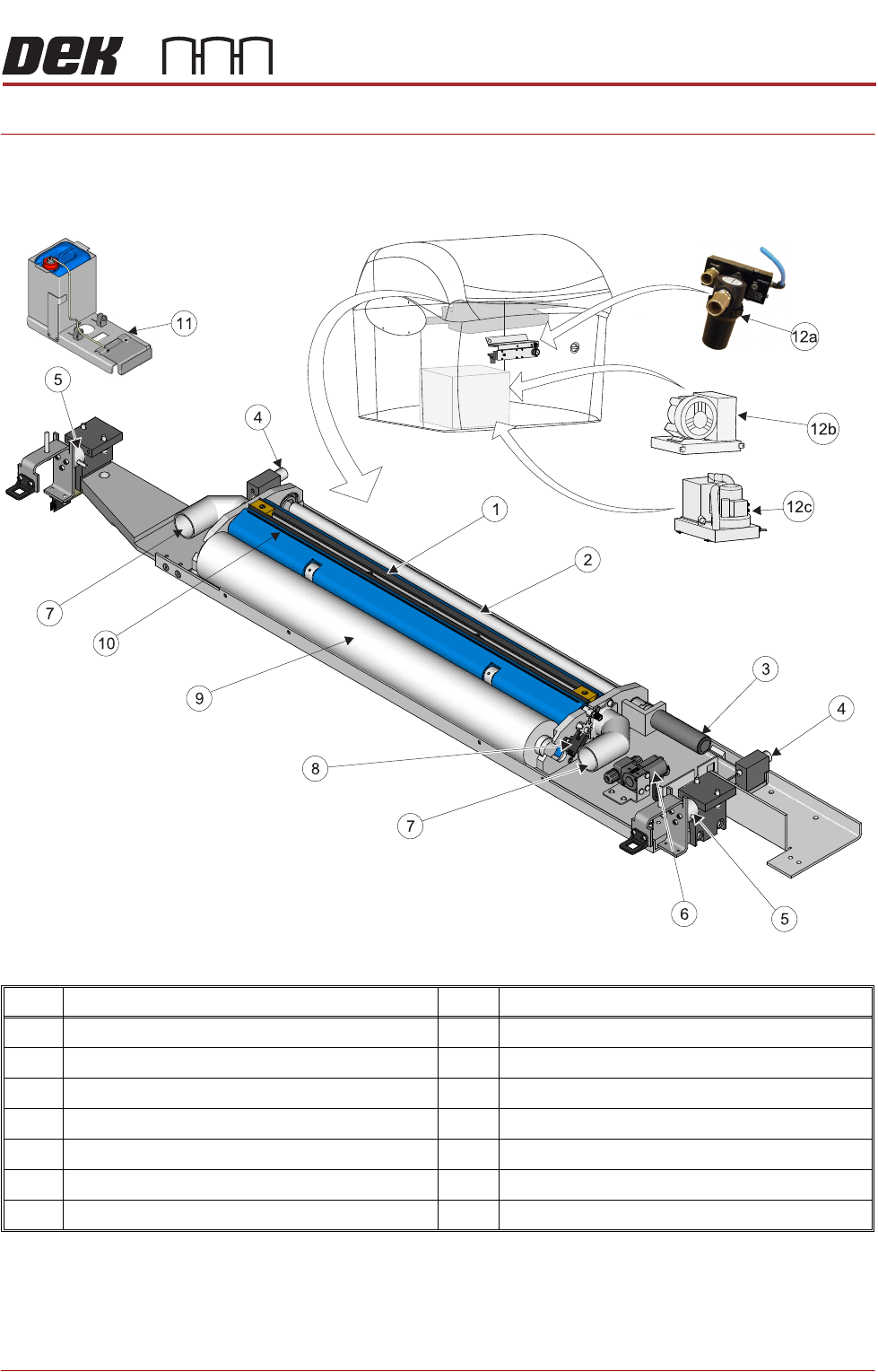
Figure 24-1 Blue Under Screen Cleaner
NOTE
Vacuum Filtration Units VF35i is located at the rear of Type 4 machines and
accessed by removing the rear panel.
Item Description Item Description
1 Squeegee Assembly 8 Paper Usage Sensor
2 Take Up Roll 9 Clean Paper Roll
3 Paper Feed Motor 10 Solvent Spray Bar
4 Permanent Magnet (2 positions) 11 External Solvent Tank
5 Electromagnetic Clamp (2 positions) 12a VF10 Venturi Vacuum Filtration Unit
6 Solvent Pump 12b VF35i Vacuum Filtration Unit
7 Vacuum Connector (2 positions) 12c VF25 Vacuum Filtration Unit
BLUE UNDER SCREEN CLEANER MODULE
OVERVIEW
24.2 Technical Reference Manual Chapter Issue 10, Jul 16
The blue under screen cleaner (USC) wipes lint free paper, dry or wet across
the underside of the stencil to minimize paste build up. The frequency and mode
(wet/dry/vac) is programmable in the product file.
When a stencil cleaner operation is required, the camera carriage approaches
the cleaner and attaches to the cleaner using two permanent magnets. The two
electromagnetic clamps holding the stencil cleaner unit in the home position are
de-energized allowing the camera carriage to control the cleaner. The paper
feed motor supplies a clean section of paper across the two rubber wiper blades
of the squeegee assembly. During a ‘Wet’ clean, a solvent pump dispenses
solvent through the solvent spray bar, wetting the width of the paper just behind
the squeegee assembly. The squeegee assembly is lifted (engaging the cleaner
with the underside of the stencil) and the camera carriage pulls the cleaner
across the underside of the stencil, removing any surplus print medium.
The two wiper blades form the mouth of the vacuum cleaner.
A paper usage sensor enables the software to monitor the paper roll usage. If
‘Time To Go’ is enabled, software measures how much paper is remaining and
displays this as a percentage. If ‘Time To Go’ is disabled, software monitors
the pulses from the sensor and if no pulses are detected during paper advance,
it is assumed that the paper roll is empty and displays an error message.
Solvent The solvent pump supplies solvent to the paper roll from the external solvent
tank, mounted on the rear or either side of the machine. The external solvent
tank container is capable of accommodating a 5 litre container of solvent. A load
cell in the base of the external solvent tank enables the software to calculate
the percentage level of solvent within the container.
Solvent Advice The plastic tubing that transports the solvent from the solvent tank to the
underscreen cleaner head is designed to withstand most types of solvent.
However, mixing of two different solvents can cause a chemical reaction and
seriously damage the plastic tubing. When changing to a different type of
solvent, the tubing must be replaced completely to prevent solvent leaks. To
obtain new tubing and replacement instructions, order Machine Performance
Upgrade (MPU) 601187*2.
ASM only recommend the DEK-PRO and the DEK-PRO XF (Environmentally
Friendly) USC solutions to be used with the under screen cleaner. The following
are available from ASM:
NOTE
The following solvents MUST NOT be used in the under screen cleaner unit,
however, this list is not complete and does not mean that any solvent not
mentioned is compatible, with DEK machines.
• Rosstech 106 FE
• Rosstech 162 ND
• Acetone
• Iso-Propyl Alcohol (IPA)
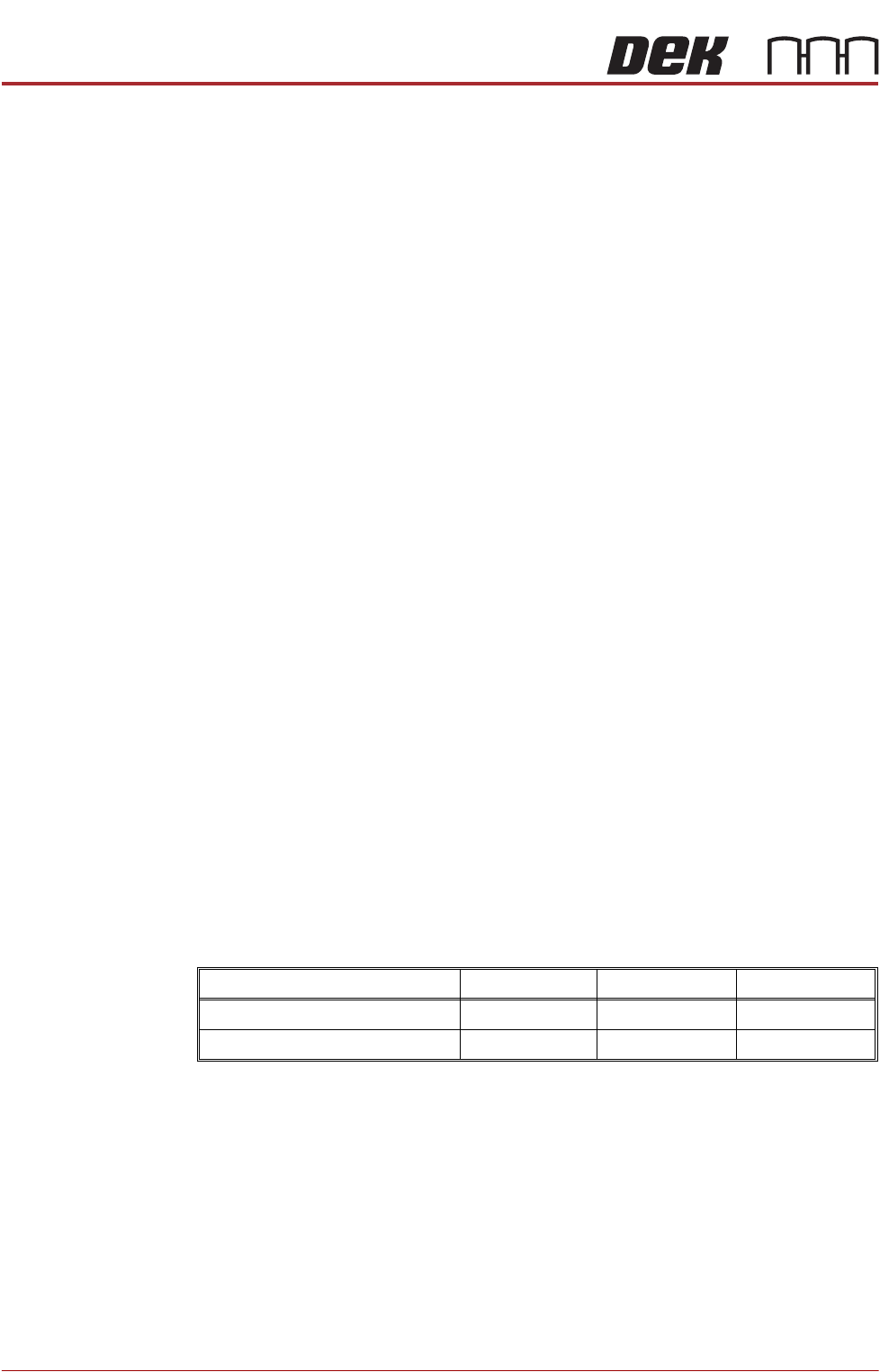
Description 1 Litre 5 Litre 20 Litre
DEK-PRO 173483 173485 431093
DEK-PRO XF 431513 431514 -