Understanding_ the_Cleaning_Process_for_Automatic_Stencil_Printers.pdf - 第24页
Solvent Chec klist • Chem ical c ompatibility with the solde r pas te • Diss olve t he f lu x & free up t he po wder sp heres • No bad reaction with pas te that af fects p ast e viscosity • Pr oc ess com patibility •…
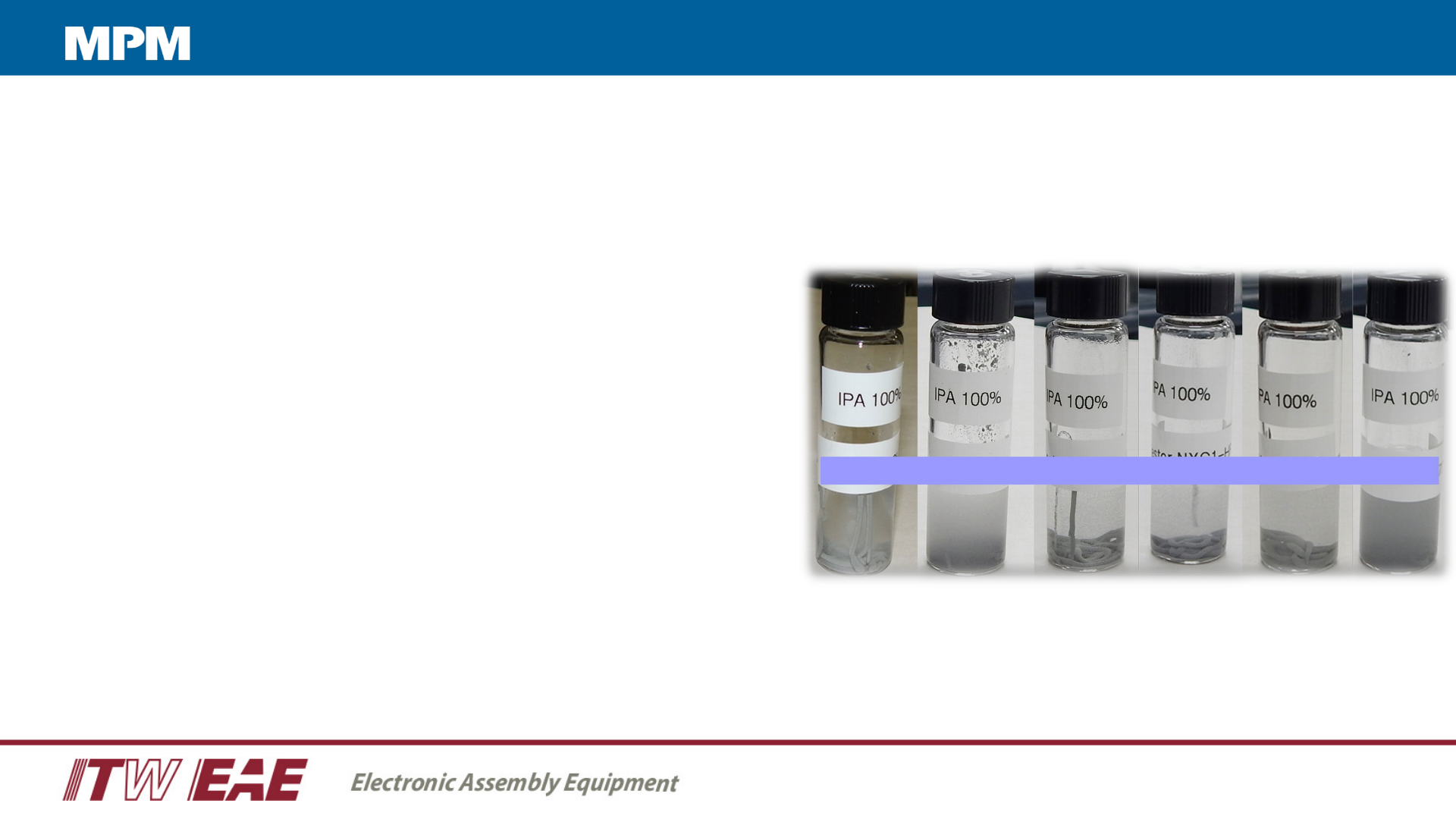
Isopropyl Alcohol
Alcohol Types
• Ethanol – Fermented / yeast – consumable
• “
the root cause and solution to all of life's problems
” – Homer Simpson
• Methanol – Fermented / wood – toxic
• Ethanol + Methanol = denatured alcohol
• Propanol – Fermented / bacterium (Clostridium Acetobutylicum) - feeds on cellulose – common name – Rubbing Alcohol
• Isopropyl - mixture of Propanol and ethyl methyl ether - secondary alcohol that uses a binder
Issues with Isopropyl
• Flash Point = 53 F (open cup) 55 F l (closed cup)
• Defined as a Class 1B flammable liquid ( same as Gasoline)
• Definition of a flammable liquid – flash point below 100 F
• National Fire association
• US Environmental Protection Agency (EPA)
• US Occupational Safety and Health Administration (OSHA)
• Previously Isopropyl was a match as it was the solvent of choice used in paste
• Newer paste designs use a solvent to increase stencil life – can react badly to Isopropyl
• Results in “clumping” of paste when combined with flux
• Less than 90% purity will leave residue on stencil that will result in poor transfer efficiency
Understanding the Cleaning Process for Automatic Stencil Printers
Solvent Checklist
• Chemical compatibility with the solder paste
• Dissolve the flux & free up the powder spheres
• No bad reaction with paste that affects paste viscosity
• Process compatibility
• Dry evenly and at a controlled rate
• No adverse paste reactions
• Leave no residue
• Equipment compatibility
• Does not attack valves, seals, pumps, reservoirs
• Safety & health
• Non-toxic, non-flammable, low- (or no-) odor
24
Understanding the Cleaning Process for Automatic Stencil Printers
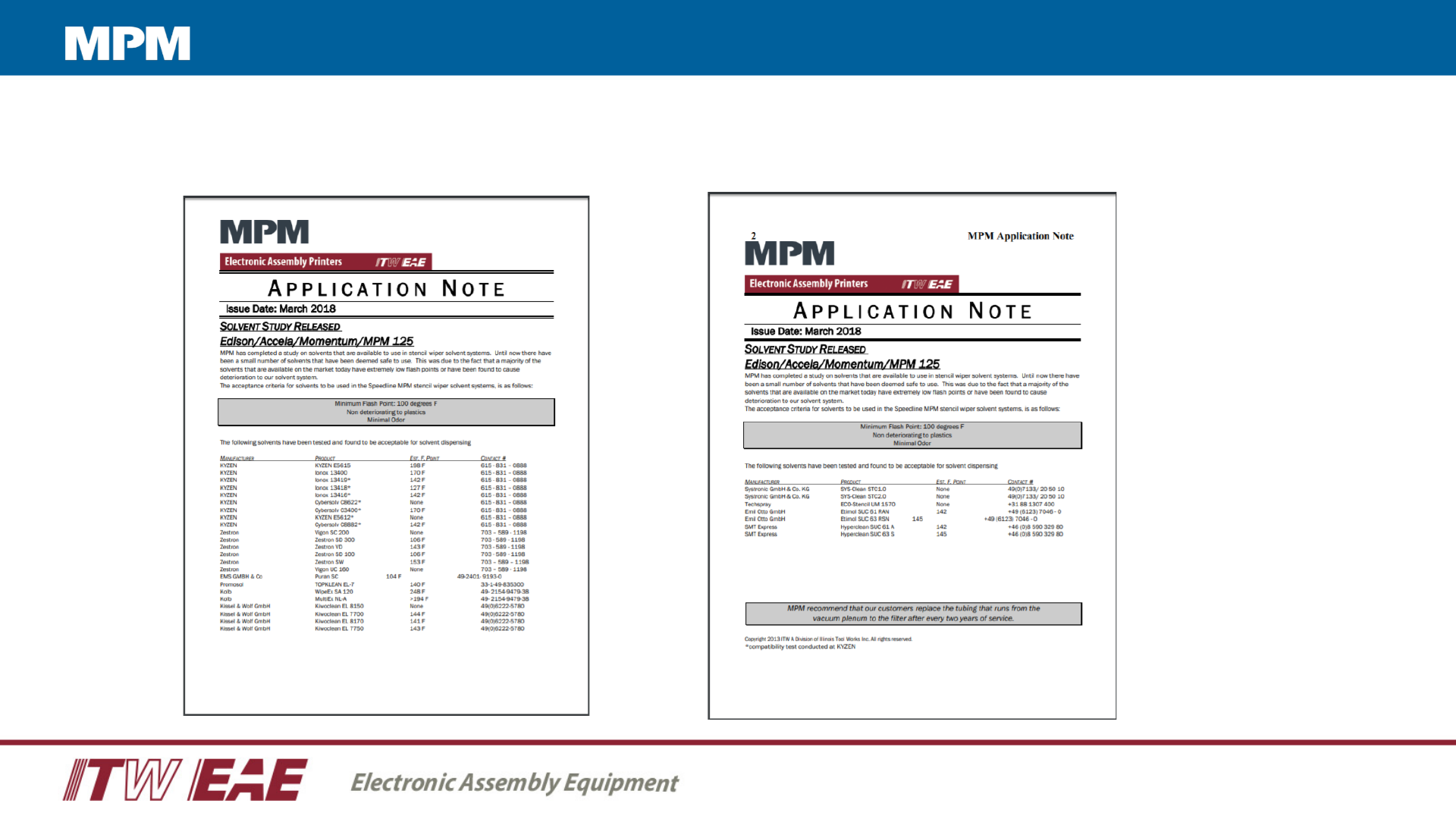
Approved Solvents
25
Understanding the Cleaning Process for Automatic Stencil Printers