Vision_Serie_EN_2023.pdf - 第12页
12 It is important to have a high-performance cooling tract in order to guar antee optimum soldering results and ensure that modules are cooled gently. Rehm Thermal Systems offers a wide r ange of cooling tract variants …
11
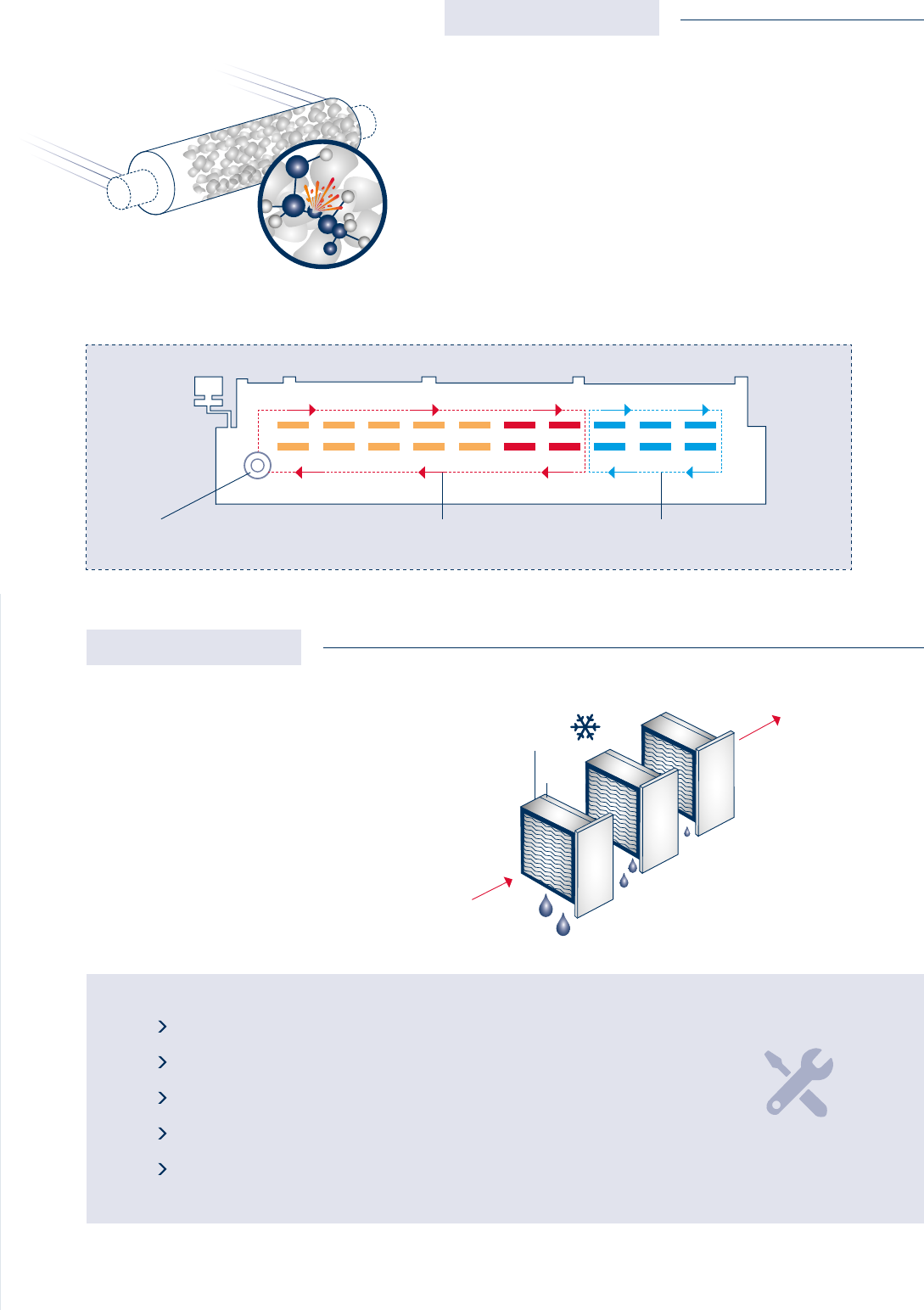
lter
cooler
drop formation
pyrolysis
closed loop process atmosphere closed loop cooling
Residues are separated with the help of a special granulate during
pyrolysis. Long molecular chains are broken down (cracked) into smaller
elements by means of thermal ssion. Temperatures from about 500 °C
are required to this end. Afterwards, the molecular chains are small
enough to be taken up by the granulate and removed from the pro-
duction process. The granulate only needs to be changed once a year,
making the pyrolysis unit easy to maintain – and you prot from minimal
downtime. Your manufacturing processes continue to run smoothly.
Pyrolysis at 500 °C
Liquid residues condense above all on the cooling
tract’s lter units, by which they are then removed.
The system is easy to clean. The lters are ex-
changed in sets at the back of the system. The
process chamber doesn’t even have to be opened.
Depending on system type, the oven is equipped
with a 2, 3 or 4-stage condensation trap.
Cold condensation
Efcient cleaning for a clean and dry process chamber
System integrated solution
Reliable, stable process
Easy accessibility
Low maintenance effort
low
maintenance
expenses
not available for VisionXC
Vision-Series | Residue Management
12
It is important to have a high-performance cooling tract in order to guarantee optimum
soldering results and ensure that modules are cooled gently.
Rehm Thermal Systems offers a wide range of cooling tract variants for reow convection
soldering with its VisionX-Series, which can be precisely ne-tuned to suit any production
process. The water-cooled standard solution with heat exchanger and adjustable ventilation
system works as an effective "Closed Loop" system. There are several efcient, additional
options for large and high-mass boards, primarily a power cooling unit as an extended
cooling tract or a bottom cooling system.
Stress-free to below 50 °C
with powerful cooling systems
Stress-free cooling using individually adjustable ventilators in the classic cooling zones
Gentle cooling through the use of the power cooling unit as an extended cooling tract
Optimum cooling of large, high-mass boards thanks to additional bottom cooling
Flexible combination possibilities through a range of different options
New, sustainable cooling principle as a result of liquid nitrogen cooling
13
Power Cooling Unit
Rehm CoolFlow
In order to cool complex modules it is possible to extend
the cooling zones using a power cooling unit. As part of this
process, cold air is fed onto the board from above and below,
where it can be cooled in a more intensive, gentle manner as
a result of the process being extended. The power cooling
unit can be implemented in the form of an extension to the
standard cooling zones under nitrogen atmosphere and
is also available as a separate, downstream module for
increased cooling capacity for insensitive materials under
normal atmospheric conditions.
Rehm Thermal Systems has been working with its partner
Air Liquide to develop an innovative cooling principle for the
effective use of the nitrogen required for inertisation and
designed the rst coolant-water-free reow soldering system
with liquid nitrogen cooling. The liquid nitrogen, which reaches
temperatures as low as -196 °C, cools the inside of the cooling
tract, evaporates and is then used for inertisation whilst in a
gaseous state. This not only provides the system with the nec-
essary coldness, but also the inert environment. As a result,
the coolant water that is re-cooled using a high amount of
energy, as well as the cooling unit and refrigerant are no longer
required at all. This method could save around 17 tonnes of
CO
2
and 30,000 kWh per system, per year.
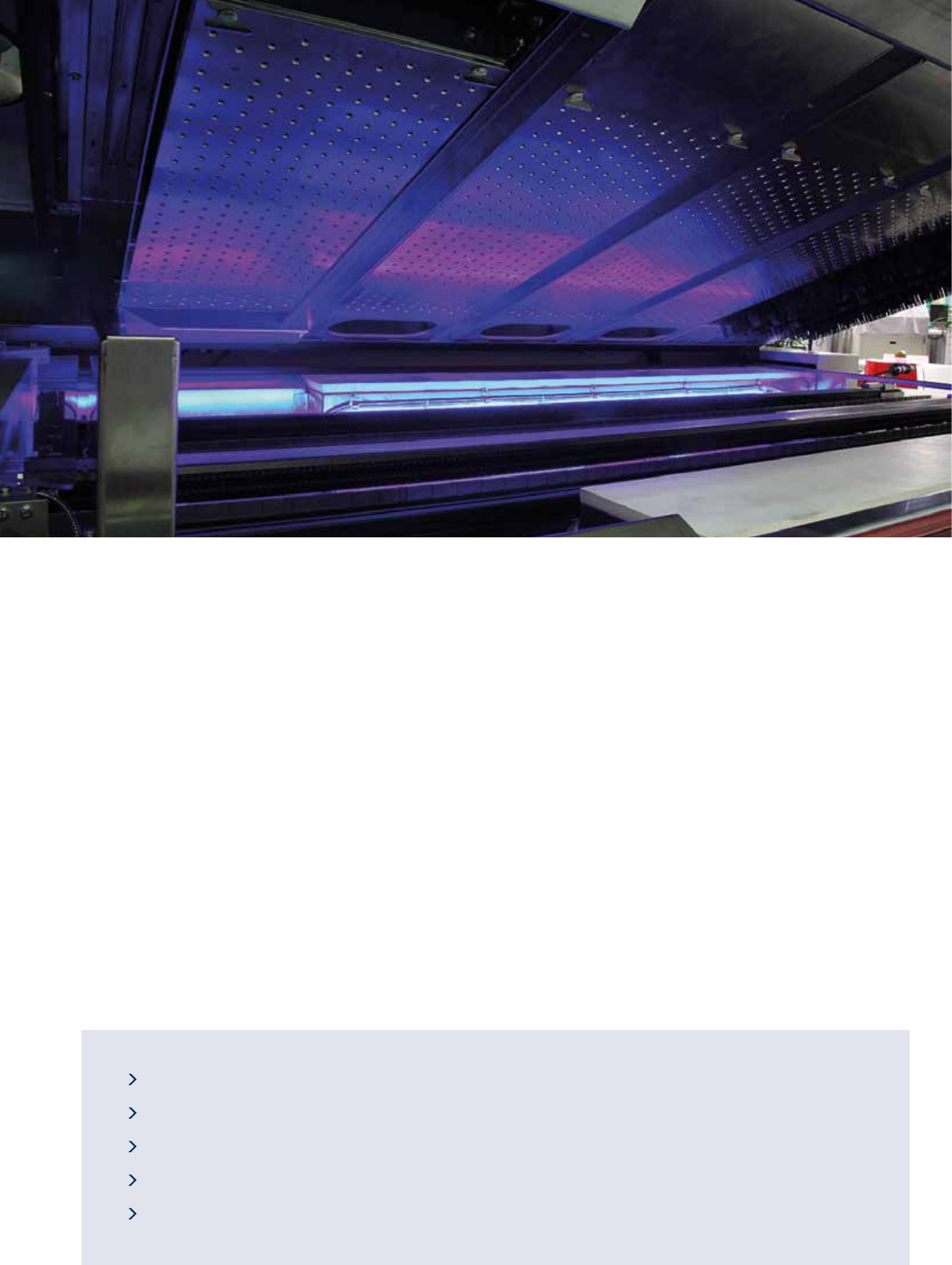
The Vision-Series transforms the classic cooling tract into a two or four-layer system, depending on the
facility. This design incorporates an active cooling process, water-cooled using heat exchangers following
an efcient "Closed Loop" system. The process air is cooled in the heat exchangers and then ows onto
the module from above. The air is subsequently sucked underneath, cleaned using a lter system and
is then ready for the next cooling process. Individually adjustable ventilators in each of the zones make
it possible to precisely control the cooling process and inuence the cooling gradient by adjusting the
speeds.
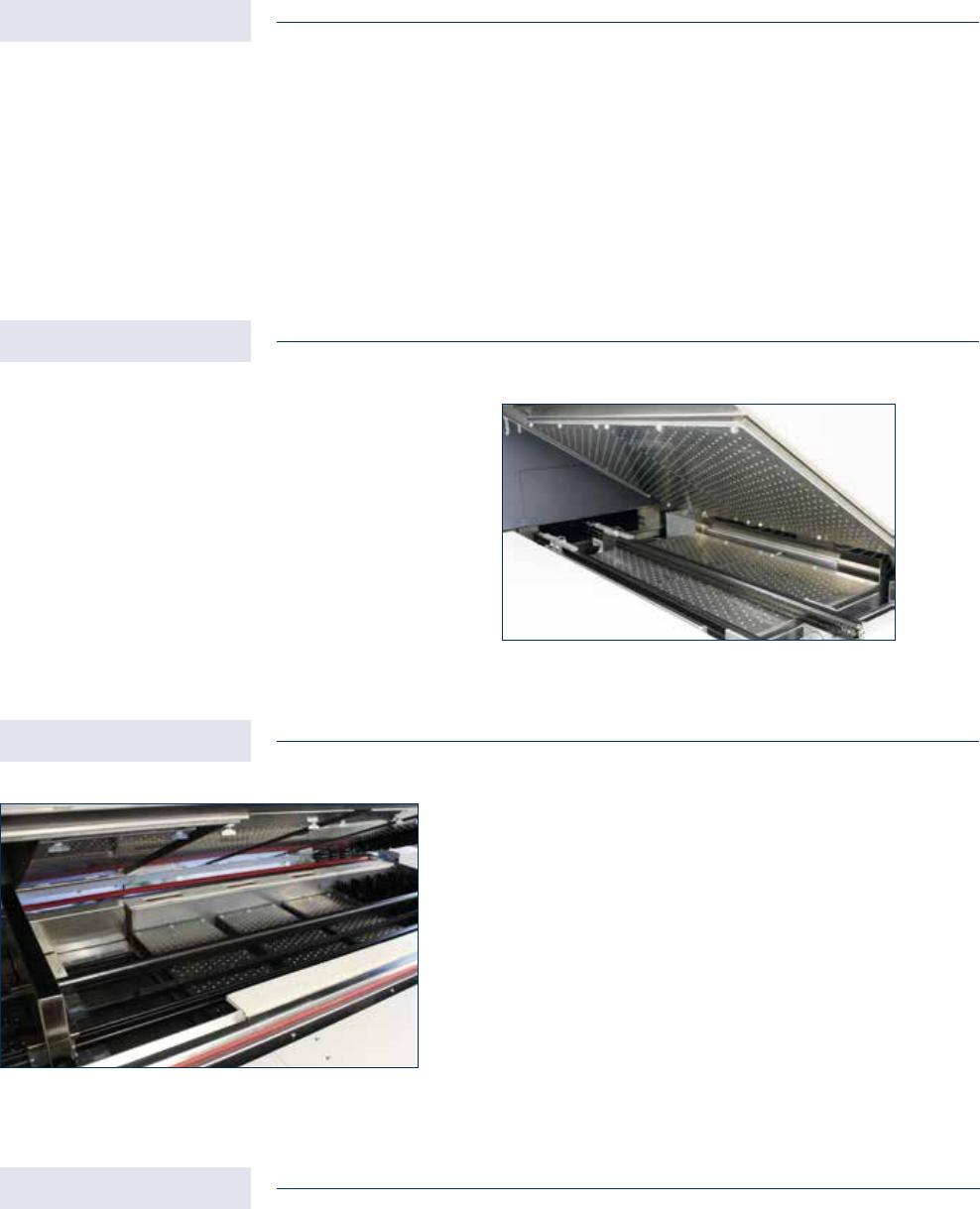
Bottom cooling makes it possible to cool high-mass boards
easily and effectively. The cold process air is blown onto the
board in equal measures from above and below in order to
facilitate a particularly homogeneous cooling process and
to reduce tension in the material. It is possible to adjust the
ventilator speeds for each module. This means additional
cooling measures, such as an outfeed belt with ventilators,
are unnecessary thanks to the low outlet temperatures. It is
predominantly modules with inhomogeneous distribution of
the copper positions that will be protected against twisting
and warping as a result of bottom cooling.
Closed Loop System
Bottom Cooling
Cooling zone with bottom cooling
Power Cooling Unit PCU
only VisionXP+
Vision-Series | Cooling